Agentic workflows

The AI Bill Is Too Damn High: Tokenomics 101 — Eugene Cheah, Featherless AI

The AI Bill Is Too Damn High: Tokenomics 101 — Eugene Cheah, Featherless AI

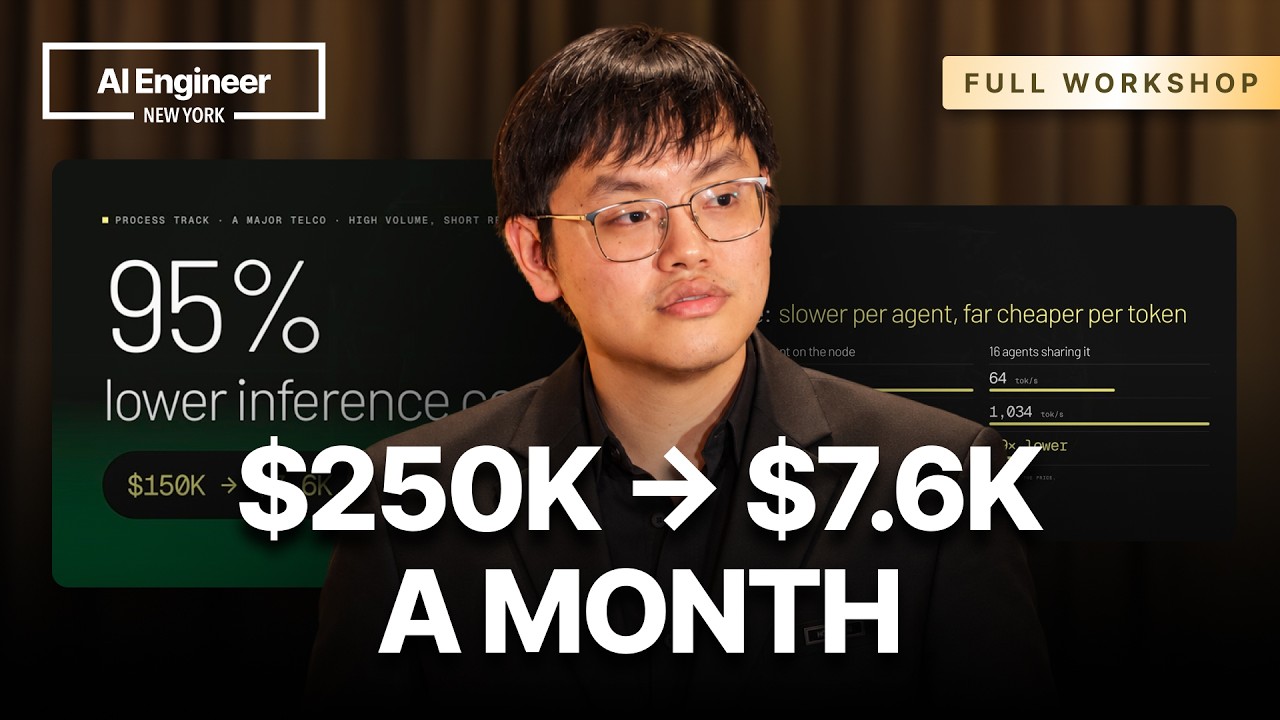
Eugene Cheah, CEO of Featherless AI, presents a four-step framework for cutting AI inference costs at scale: measure token spend by team and workload, right-size models through evals, classifiers, and fine-tuning, buy GPU capacity with an understanding of the speed-versus-cost tradeoff, and check whether organizational processes can absorb the extra output.
Why Building an AI Agent Is Easier Than Deploying One

Why Building an AI Agent Is Easier Than Deploying One

Vladimir Keil, co-founder and CEO of Lio, joins Seema Amble and Elena Burger to explain why AI-native startups can beat incumbent software vendors even when those vendors own the customer, the data, and the system of record. The discussion covers the work that happens outside systems of record in enterprise procurement, Lio's multi-agent architecture spanning retrieval through principal agents, how buyers learn to trust agents with consequential negotiations, and what happens when suppliers and buyers both run agents.

Box's Aaron Levie: On Reinventing Yourself in the AI Age and Enterprise Diffusion

Box's Aaron Levie: On Reinventing Yourself in the AI Age and Enterprise Diffusion

Aaron Levie, CEO of Box, details his company's successful pivot to AI, emphasizing the critical role of application companies in bridging raw model capabilities to complex enterprise workflows. He argues that significant value will accrue to "applied AI" solutions that understand domain-specific needs, can handle intricate data permissions, and build specialized agents, rather than relying solely on foundational models. Levie shares insights on the economics of tokens, the rise of open-weight models, and why AI diffusion in coding differs from other knowledge work, predicting that 90% of enterprise tokens will soon be consumed by non-human initiated tasks.

Why AI Agents Fail

Why AI Agents Fail

Abi Aryan discusses the shift from MLOps to LLMOps, framing generative AI deployment as a distributed systems challenge. She highlights the critical role of FinOps due to high model costs, the need for custom tooling over generic agent frameworks, and the importance of a 'decision layer' for agent autonomy. Observability is re-conceptualized as anomaly detection, and she points to dynamic RL environments and strong data engineering as future research priorities and essential skills for AI engineers.

Realtime multiplayer, automation, and you! — Idan Gazit, GitHub

Realtime multiplayer, automation, and you! — Idan Gazit, GitHub

Idan Gazit, head of GitHub Next, discusses the future of AI in software development, moving beyond personal productivity to enabling group collaboration and advanced automation. He introduces two prototypes: "Agentic Workflows" for autonomous, secure code upgrades and task execution using natural language, and "ACE," a real-time collaborative development environment designed to integrate AI into team workflows, addressing the 95% of development work beyond mere typing.

How to Build a Self-Improving Company with AI

How to Build a Self-Improving Company with AI

YC General Partner Tom Blomfield explains how to move beyond the 'copilot' mindset and restructure companies as series of recursive, self-improving AI loops. He details how to make company knowledge legible to AI, creating systems that improve overnight with minimal human intervention, ultimately rendering traditional middle management obsolete.