Ethical Hacking War Stories: Zero Trust, IAM & Advanced C2 Tactics
Jeff Crume and Patrick Fussell from IBM's X-Force team share a real-world ethical hacking war story, demonstrating an attack from an 'assume breach' perspective. They break down how vulnerabilities in Identity and Access Management (IAM) and legacy systems can lead to a full compromise, starting from an insider threat and escalating to domain administrator privileges through advanced C2 attacks and lateral movement.
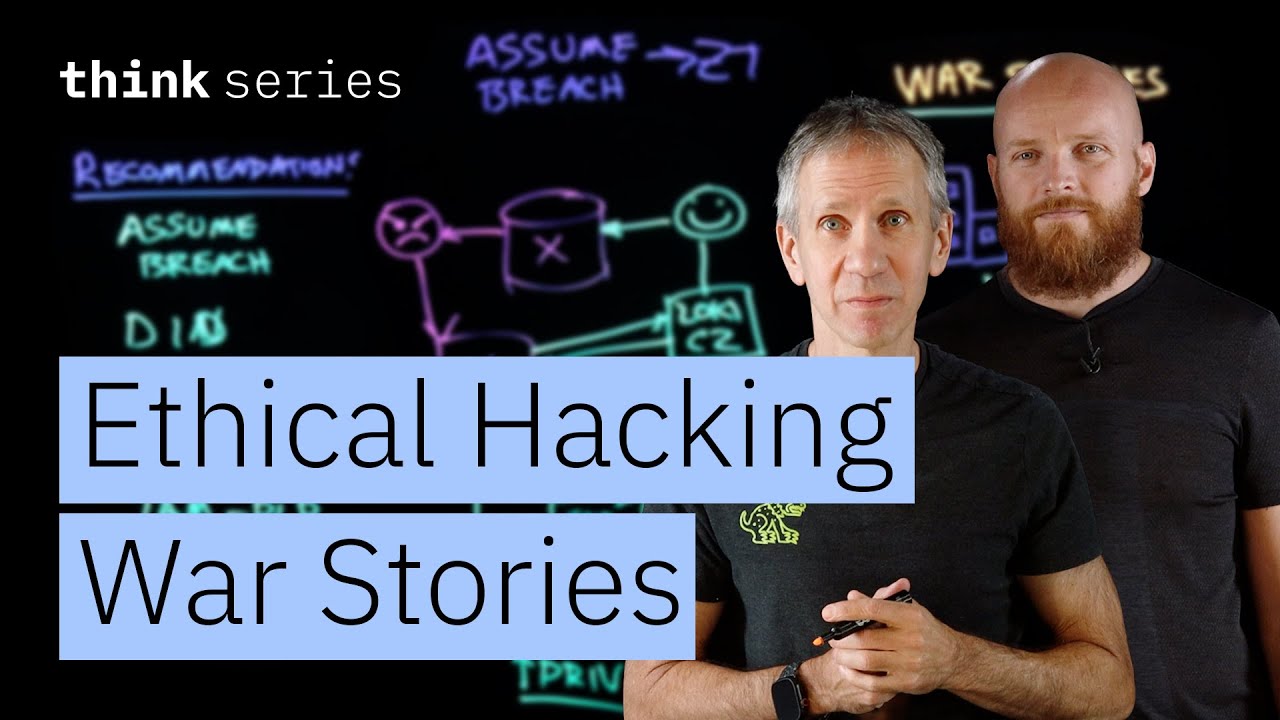
The “Assume Breach” Mindset in Cybersecurity
The most effective way to test and improve a company’s defenses is through the “judicious use of war stories” and real-world ethical hacking exercises. Patrick Fussell, Global Head of Adversarial Simulation for IBM’s X-Force team, emphasizes that ethical hacking serves as a sparring partner for a company’s blue team.
A critical modern security paradigm is the “assume breach” model, a core concept of Zero Trust. Instead of focusing solely on perimeter defense, this approach assumes an attacker is already inside the network. Security measures are then designed with this internal threat in mind, which fundamentally changes the defensive strategy. As Patrick notes, “it’s not a matter of if you get breached, but when.”
Anatomy of an Ethical Hack: A Real-World Example
This exercise demonstrates how an attacker can move from an initial foothold to complete network compromise.
1. Initial Access: The Trusted Insider and C2 Framework
The attack began with a trusted insider running a payload, a realistic scenario reflecting internal threats.
- Payload Delivery: The payload was hosted in a public software store, where the insider downloaded and executed it.
- C2 Implant: Running the payload installed an “implant,” a piece of software from a Command and Control (C2) framework. This implant calls out to an attacker-controlled server on the internet, establishing a communication channel.
- Evading Defenses: The team used a custom C2 framework (“low key C2”) designed to evade security controls like Endpoint Detection and Response (EDR) and antivirus software.
2. Reconnaissance and Lateral Movement
Once inside, the focus shifts from breaching to understanding the environment to find pathways for expansion.
“A lot of hacking is actually a lot like detective work. We started one place where we know nothing, and we wanna learn as much as we can about the system, the user, the organization.”
- Discovery: The team scanned file shares and centralized data stores like SharePoint to gather intelligence on people, processes, and technology.
- Critical Finding: The first major breakthrough was discovering hardcoded credentials within a script from a legacy Active Directory process. This is a common but critical vulnerability, often overlooked in older, functioning systems.
- Expansion: These credentials granted access to several production SQL servers, allowing the attackers to move laterally across the network using the SMB protocol.
3. Privilege Escalation: The Keys to the Kingdom
With access to the SQL servers, the goal became escalating privileges to gain higher levels of control.
- Credential Dumping: On the SQL servers, the team performed “credential dumping”—extracting credentials stored in memory and on disk.
- SCCM Compromise: This process uncovered credentials for the System Center Configuration Manager (SCCM), a powerful enterprise management framework. Gaining control of SCCM is often a critical step, as it provides the ability to manage countless other workstations and servers.
- Domain Admin: With SCCM access, it became “almost trivial” to find and leverage credentials for a Domain Administrator account. This represents a “game over” scenario, as it grants the attacker complete control over the network domain, allowing them to achieve their final objectives.
Key Recommendations and Defensive Strategies
The exercise revealed several fundamental areas for security improvement.
Start with Foundational Principles
- Defense in Depth: Don’t rely on a single security mechanism. Create an “obstacle course” for attackers so that if one control fails, others are in place to stop or slow them down.
- Identity and Access Management (IAM): Many organizations focus on advanced threats while neglecting basic IAM hygiene.
- Eliminate Hardcoded Secrets: Credentials should never be hardcoded in scripts or applications. Use a secure vault for managing secrets, where they can be dynamically checked in and out. Credentials should be rotated regularly to make them a moving target.
- Principle of Least Privilege: Grant users and systems only the permissions necessary to perform their jobs. Revoke unneeded access promptly. Overprivileged accounts are a prime target for attackers looking to escalate their capabilities.
“If all organizations that we tested for could really master these two bits [IAM and Least Privilege], as simple as they seem, they would make hackers’ lives drastically harder.”
Adopt a Proactive, Continuous Approach
- Validate Your Controls: Don’t just install security tools and assume they are working correctly. Continuously test and validate that your controls are as effective as you believe them to be.
- Monitor for Malicious Behavior: Implement monitoring to detect suspicious activities like lateral movement or unusual data exfiltration.
- Incident Response: Have a well-defined incident response plan in place. Knowing what to do when a breach occurs is just as important as trying to prevent one.
Security is a process of continuous improvement. As one of the speakers aptly puts it, “if you’re satisfied with your security, so are the bad guys.”