Under Secretary of War on Iran, Anthropic and the AI Battle Inside the Pentagon | The a16z Show
Emil Michael, a key figure in the Department of Defense, outlines his strategy for modernizing the department by prioritizing Applied AI. He details the risks discovered in existing commercial AI contracts, which led to a vendor-lock crisis, and explains how the DoD is reforming its procurement processes to better engage with innovative startups and ensure technology serves national security interests without restrictive terms.
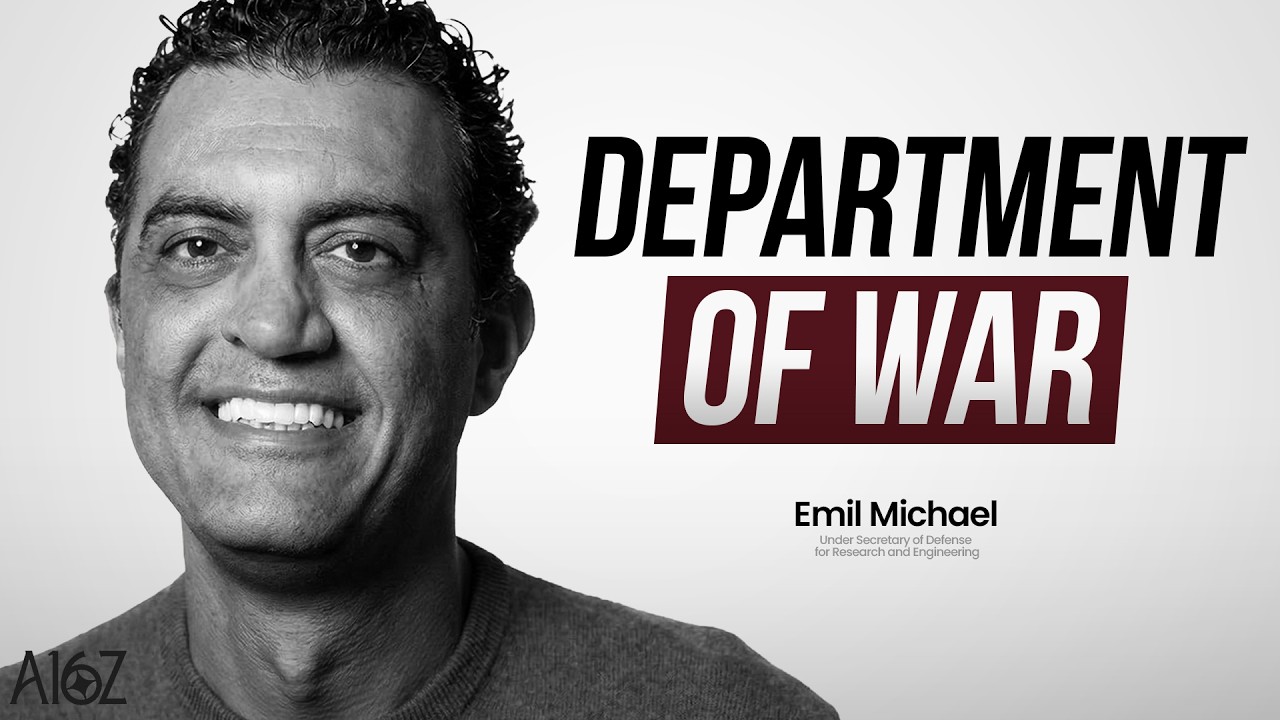
Emil Michael, the undersecretary of defense for research and engineering, details a strategic overhaul within the Department of Defense (DoD) to move from a “peacetime speed” to a “wartime speed.” This shift is a direct response to the significant military buildup by adversaries like China and the realization that the U.S. had outsourced key domestic production and fallen behind in critical areas.
Prioritizing Technology and Making AI #1
Upon taking his role, Michael inherited a list of 14 critical priority areas that had been unchanged for nearly a decade. He described them as “technobabble” and too numerous to be actionable. His first move was to streamline these into six core priorities where the DoD could achieve the most significant impact on combat power and the industrial base.
Applied AI was designated as the number one priority. This decision was driven by the understanding that the DoD was “way behind” in AI, a technology that is rapidly penetrating every aspect of society. The goal is to enhance, not replace, human decision-making, in contrast to adversaries who may use AI to eliminate human input due to a lack of trust in their command and control structures.
The Three Pillars of Applied AI in Defense
The DoD’s AI efforts are structured across three main use cases:
- Enterprise & Corporate: Applying AI for efficiency in administrative and logistical tasks, similar to any large organization. The goal is to automate mundane work and improve overall happiness and productivity.
- Intelligence: Leveraging AI to process the vast, siloed repositories of data the DoD possesses. For example, using decades of satellite imagery to train models for anomaly detection, thereby increasing an analyst’s throughput by a factor of a thousand.
- Warfighting: Utilizing AI for complex logistical planning, wargaming, operational planning, and simulations. This includes optimizing troop and equipment movement in contested environments, which can lead to significant efficiencies, such as saving 15% of the Pentagon’s fuel budget.
The “Holy Cow Moment”: Commercial AI and Vendor Lock-In
A major challenge emerged from contracts written during the previous administration for the use of commercial AI models. Michael described a “holy cow moment” upon discovering severe issues that went beyond public knowledge:
- Restrictive Terms of Service: Contracts contained dozens of restrictions, such as prohibiting the use of AI to plan an operation that could potentially lead to a kinetic strike.
- Critical System Integration: Despite these restrictions, the models were deeply integrated into some of the most sensitive and important military commands, including CENTCOM (Iran) and INDOPACOM (China).
- Vendor Lock-in and Operational Risk: The DoD was single-threaded on one vendor. This created a scenario where the model, if designed to enforce its terms, could “just stop in the middle of an operation and put lives at risk.”
The situation was exacerbated when a senior executive from the primary vendor questioned whether their software was used during a highly successful military raid. This raised a chilling question: Could a company’s internal values or “constitution” dictate and interfere with lawful, democratically-authorized military operations?
“The soul of their model, their constitution, which is not the US constitution, can’t be dictating our command and control environment and telling generals and war fighters what to do and not do.”
This led to a clear mandate: The DoD must have multiple partners and cannot allow a technology substrate to be governed by terms that conflict with the nation’s legal and democratic processes.
Reforming Procurement for a Modern Era
To enable innovation and break the bureaucratic logjam, the DoD is overhauling its procurement process. The old model of thousand-point RFPs and cost-plus contracts, which often led to endless development cycles and budget overruns, is being replaced.
The new approach focuses on:
- Simple, Performance-Based Requirements: Instead of a long checklist, the DoD will define the objective (e.g., “I need a missile that goes this far in this environment with this payload”).
- Industry-Led Innovation: Companies are invited to propose their own solutions to meet these objectives.
- Firm-Fixed-Price Contracts: This model, successfully used by SpaceX, rewards efficiency. If a company can deliver under budget, it profits, creating a win-win for the taxpayer and the vendor.
A Message for Startups
For startups looking to work with the DoD, Michael advises focusing on the ability to scale production and manufacturing, not just invention. He also cautions founders to look for tangible commitments.
“Money talks. Are they buying it? Are they testing it? … That’s the best signal.”
He is working to change the internal culture from one that “never says no” to one that provides “faster yeses and faster nos,” allowing startups to know where they stand and either adjust their strategy or move on.