Alex Karp on Palantir, AI Weapons, & American Domination | The a16z Show
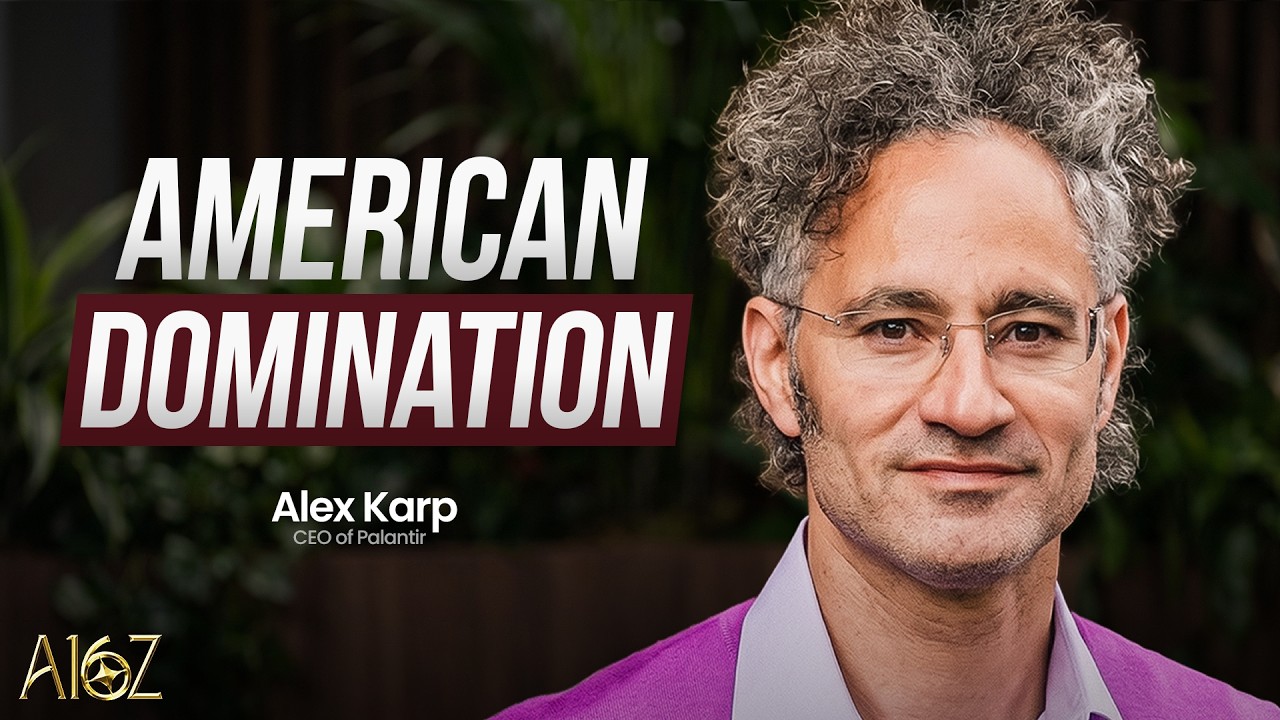
Alex Karp, CEO of Palantir, discusses the critical role of technology in national defense, warns Silicon Valley of a political backlash if it fails to support the military, and argues that America's key advantage in the AI race is its ability to cultivate and protect neurodiverse, unconventional talent.
The Moral Imperative of Supporting the Warfighter
The foundational purpose of advanced technology companies should be to ensure that American warfighters are significantly more likely to return home safely. This involves creating systems that not only protect them but also project a clear and decisive threat to adversaries, thereby deterring conflict. There is a moral obligation for the tech industry to support the individuals who sacrifice for national security, who are disproportionately from the middle of the country. A failure to recognize and act on this duty is a profound societal mistake.
This mission is deeply connected to the core principles of American freedom. The United States is unique because it’s a place where individuals who are “divergent in ideology, thought, religion, or quite frankly neurologically” can find freedom. This freedom is protected by a framework of inalienable rights—from the First and Fourth Amendments, which protect the ability to think and express freely, to the Second Amendment, which ensures the ability to defend those freedoms. These rights are not granted by bureaucrats but are inherent.
Technology as the Foundation of American Deterrence
Recent global events demonstrate that America is once again exerting a powerful deterrent capability that had previously been eroded. This is not just a function of military personnel and leadership; it is fundamentally a technological advantage. Warfighting is technology. The United States’ ability to dominate on the modern battlefield is a direct result of decades of innovation in a hybrid of software, hardware, and AI.
In this world, it’s us or China or Russia. I literally believe we’re doing the work of a higher purpose by making sure, and not just for America, but for the whole world that we are the power that actually has the decisive vote. And there is only one way to do that and that is with military superiority.
This superiority is rooted in the meritocratic nature of the Department of War, which has historically been one of the most integrated and revered institutions in the nation. It has provided opportunities for people from all demographics, fostering a culture of excellence that is critical for national defense.
A Warning to Silicon Valley: The Threat of Nationalization
Silicon Valley is on a dangerous trajectory. If the tech industry is perceived as a force that is simultaneously eliminating white-collar jobs through AI while refusing to support the military, it will inevitably face a severe political backlash.
If Silicon Valley believes we are going to take away everyone’s white collar job… and you’re going screwed the military. If you don’t think that’s going to lead to nationalization of our technology, you’re [mistaken].
This could create a “horseshoe effect” in politics, where the far-left and far-right find common ground in the belief that the tech industry is no longer serving the national interest and should be nationalized. The industry must find a way to demonstrate its value and patriotism beyond the confines of Palo Alto. While there are legitimate and complex questions about privacy and the Fourth Amendment in an age of powerful AI, these must be navigated carefully. The industry must proactively engage in these discussions, or a blunt political instrument will do it for them.
Bridging the Cultural Divide
To win the AI race and avoid this political backlash, the tech community must bridge the vast cultural and linguistic gap between itself and the military.
- Self-Regulate: Much like Hollywood created its own rating system to preempt government censorship, the tech industry must come together to create ethical frameworks for the use of AI on the battlefield and its impact on the domestic economy.
- Gain Empathy: Founders and CEOs need to leave their bubble. They should visit military bases, go to states like Iowa, and have genuine conversations with soldiers and their families to understand their perspectives and earn their trust.
- Acknowledge Your Limits: A common failure mode in Silicon Valley is the assumption that being intelligent in one domain (e.g., building LLMs) translates to intelligence in all domains (e.g., negotiating government contracts). Founders must be honest about their aptitudes and not assume they are the smartest person in every room.
America’s Superpower: Cultivating Neurodiverse Talent
Ultimately, America’s single greatest competitive advantage is its ability to cultivate and protect unconventional, neurodiverse talent. This is the core philosophy behind Palantir’s success. The goal is not to force brilliant individuals to follow a pre-written playbook but to help them develop their own.
If we are going to outperform the rest of the world, our single advantage is to augment neurodivergent, highly individual people to be their absolutely unique best and protect their First, Second, Fourth, and Fifth Amendment rights so that they don’t get screwed.
Leadership in this context is like being an artist; the job is to identify people who are uniquely capable of solving a specific problem and create an environment where they can do the one thing in the world that only they can do. This requires recognizing that outlier IQ is itself a form of neurodivergence, not unlike autism, where problems are deconstructed in a completely different way. The success of crucial national security projects like Maven is a direct result of concatenating this kind of “otherwise maybe not fully functional talent” to build something revolutionary. This is how America wins.