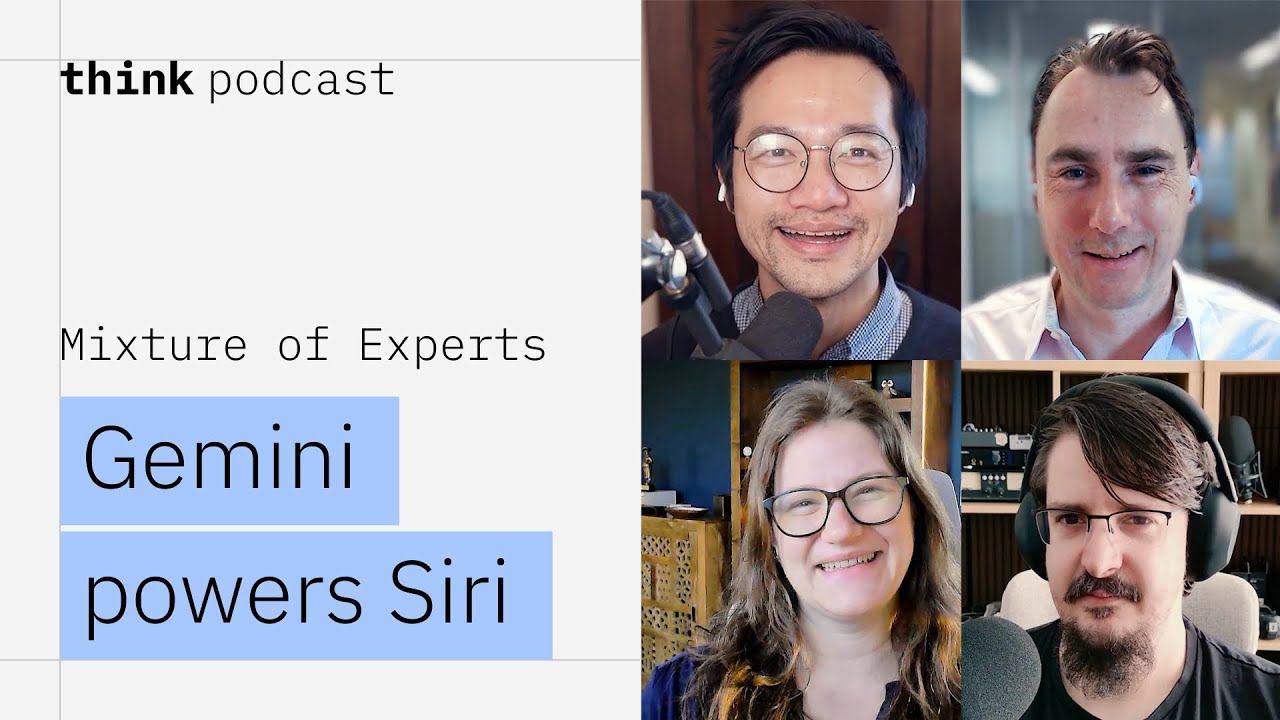
Claude Cowork analysis & Apple picks Gemini
The panel discusses Anthropic's Claude Cowork and the challenge of user trust in AI agents for everyday tasks. They then analyze the Apple-Google partnership to integrate Gemini into Siri, debating its implications for edge AI, privacy, and hardware limitations. Finally, they explore Linus Torvalds' use of AI for "vibe coding," considering its impact on hobbyist programming and entrepreneurship versus the current limitations in producing production-ready software.
Claude Cowork: AI Agents on the Desktop
The introduction of Claude Cowork by Anthropic is seen as a significant step in making agentic AI accessible to a non-technical audience. It effectively moves the capabilities of Claude Code from a developer-focused command-line interface to a more intuitive desktop application, removing barriers like dependency installation and terminal usage.
However, the panel raises critical questions about user trust and the readiness of the average person to allow an AI agent to operate on their personal files.
- User Experience and “Rough Edges”: An experiment to organize a 70GB downloads folder revealed the system’s current limitations. While it successfully categorized many files, it also created strangely named folders and, more critically, failed to preserve file metadata like timestamps. This highlights a key challenge: the smooth user interface can mask underlying imperfections, and non-technical users may not know to check the AI’s work or how to “baby it” when it makes mistakes.
- Consumer vs. Enterprise Readiness: The strategy of releasing such tools to consumers first is likely intentional, as consumers are generally more forgiving of errors than enterprise clients in highly regulated industries. The current utility is high, but the technology is far from the perfection required for critical business applications.
- Security and Scalability Risks: The panelists express significant skepticism about the long-term security of AI-driven OS interfaces. An agent’s effectiveness is limited by file metadata and task complexity; it struggles with poorly structured or binary files. The most alarming risk is prompt injection, where a malicious file could instruct the agent to delete files or exfiltrate sensitive data. Securing against these threats requires robust sandboxing and non-AI guardrails that are not yet standard.
Ultimately, Claude Cowork is viewed as a strategic move by Anthropic to establish itself as the new user interface for desktop operations, forcing OS vendors and app developers to integrate similar conversational AI capabilities.
Apple’s AI Strategy: Partnering with Google for a Smarter Siri
Apple’s announcement to integrate Google’s Gemini models into the next generation of Siri marks a major strategic shift, moving away from previous reports of a deal with OpenAI. The decision is largely seen as a necessary move to address Siri’s outdated capabilities.
The discussion delves into the tension between this partnership and Apple’s long-held commitment to privacy and on-device processing.
- The Edge AI Dilemma: While Apple has championed on-device AI for privacy, current hardware limitations present a major hurdle. Features like live captions already demonstrate significant lag, making real-time, complex on-device processing impractical.
- A Model-Agnostic Architecture: It’s argued that Apple isn’t abandoning its privacy stance. Its published AI architecture is model-agnostic and features a “model router” that intelligently decides whether a task can be handled by a small on-device model or needs to be sent to a larger, more powerful model in Apple’s secure cloud. The partnership with Google is about changing the “bits”—the model itself—that run within this secure framework.
- Economic Incentives: Apple has a strong economic motivation to perform as much processing on-device as possible. Unlike a subscription service, every request sent to a data center costs Apple money and reduces the profit margin on the hardware it sold.
- A Disappointing Lack of Creativity: One panelist expressed disappointment, arguing that Apple is uniquely positioned to be an AI leader. With its custom silicon (M-series chips) optimized for inference and massive cash reserves, Apple could have developed its own models or pursued more innovative solutions, such as a mesh network that offloads inference from an iPhone to a user’s more powerful Mac at home, preserving privacy within the user’s own ecosystem. The deal is seen as prioritizing a quick business solution over engineering excellence.
Linus Torvalds and the Rise of “Vibe Coding”
The news that Linux creator Linus Torvalds, a notable AI skeptic, used an AI agent for a personal coding project is seen as a watershed moment, signaling that AI coding tools have become useful even for the programming elite. Torvalds himself once defined “vibe” coding as “very inefficient but entertaining.”
This development sparks a broader conversation about the impact of AI on software development and beyond.
- Lowering the Barrier to Entry: Torvalds’ use case is typical for many developers: using AI to quickly build a small, one-off project in an unfamiliar programming language. This capability is reviving a “homebrew computing” culture of hobbyist experimentation.
- Democratizing Entrepreneurship: The implications extend beyond hobby projects. Non-technical individuals are now empowered to build entire applications and businesses, drastically reducing the cost of testing for product-market fit from hundreds of thousands of dollars to potentially a few hundred.
- Current Limitations of Agentic AI: Despite the excitement, the panel emphasizes that AI is not a magic bullet.
- Non-Functional Requirements: Agents are currently poor at handling critical aspects like security, performance, scalability, and observability.
- Scalability Issues: While effective for small projects that fit within a model’s context window, they struggle to maintain consistency on larger codebases.
- Agent Quality Varies: Different AI agents exhibit different behaviors. Some are “lazy” and overly congratulatory, while others are more thorough. Achieving production-quality code often requires a complex workflow of using multiple agents to plan, build, test, and iterate, a process that can be as slow as a traditional developer.
The consensus is that while AI is democratizing creation and enabling a massive wave of experimentation, it is not yet capable of autonomously producing the secure, robust, and scalable applications required for serious production environments.