⚡️ Competing with ChatGPT and Sierra, building a $10M ARR company — Yasser Elsaid, Founder, Chatbase
Yaser Al, founder of Chatbase, shares his journey of bootstrapping the company from a side project to a $10M ARR business. He details his product-led growth strategy, the evolution of the tech stack from early RAG to a multi-model harness, and his vision for AI agents as 'Chief Customer Officers'.
The Origin Story: From Side Project to Viral Launch
Yaser Al began his journey as a computer science student in Canada, constantly tinkering with side projects with the goal of making money online. After building over 20 projects, with three generating revenue, he stumbled upon the nascent capabilities of GPT-3 in late 2022. His initial idea was to build an essay-writing tool for students. While developing this, he discovered the technique of providing custom data to a foundation model’s context window—a concept now widely known as Retrieval-Augmented Generation (RAG).
Recognizing the immense value of “GPT with custom data,” he dropped all other projects, stopped attending school, and dedicated a month and a half to building the first version of Chatbase. He was driven by a sense of urgency, believing the idea was so compelling that someone else would build it if he didn’t move quickly.
“I think what also helped was this belief that like if someone else does the idea, I can’t do it… I had the same mindset and that made me like go a lot faster, which is a good thing. But of course, that mindset is is not true.”
He launched the first version with a simple tweet to his 16 followers. The demo, built on LangChain, Pinecone, and OpenAI, showcased a chatbot that could answer questions about a specific dataset, a novel concept at the time that captured significant attention.
From Viral Tweet to $1M ARR in 117 Days
While many viral AI demos faded after their initial hype, Chatbase converted its momentum into a sustainable business. The key differentiator was a relentless focus on foundational business practices. Instead of just posting a demo and waiting for revenue, Yaser immediately began talking to users, conducting sales calls, and doing demos.
This period coincided with the peak of AI hype, particularly on LinkedIn. The platform became a powerful acquisition channel. A single post from a large AI influencer could result in an immediate $3,000 MRR spike as businesses were eager to adopt AI.
The initial product catered to the external use case: a simple AI chatbot that could be trained on a company’s documentation and embedded on its website. This was a major leap from the limited, flow-based chatbots that dominated the market. Success with this external use case naturally led to demand for internal ones, such as Slack integrations, demonstrating that a successful initial adoption makes it easier to expand into more use cases within a company.
A Bootstrapper’s Playbook: PLG and Profitability
Chatbase’s growth was entirely bootstrapped, a decision born out of necessity rather than ideology. The product gained traction so quickly that there was simply no time to create a pitch deck or seek VC funding. Early on, this meant running the entire operation on a personal credit card, which was once maxed out at $25,000 from OpenAI API bills.
The core of Chatbase’s success is its Product-Led Growth (PLG) model. Without the capital to hire a large sales team, the company was forced to build a powerful and intuitive self-serve product. This constraint became a significant advantage, allowing them to attract a diverse range of customers from unexpected industries—from Chuck E. Cheese and various theme parks to non-profits like the UN, which uses Chatbase for its Facebook Messenger support in specific regions.
Now, with a strong foundation of 10,000 active customers, Chatbase is moving upmarket to serve mid-market and enterprise clients. The intuitive nature of the self-serve product makes this transition smoother, as even large companies appreciate a tool that is easy to set up and use.
The Go-to-Market Manifesto
Yaser’s growth strategy is a blend of modern content marketing and traditional B2B sales tactics:
- Do the B2B Stuff: Emphasizes the necessity of sales calls, demos, outbound, and cold outreach. A viral demo is not a business.
- Content Marketing: The goal is to build a consistent brand, not just create one-off viral hits. Good content enhances the effectiveness of all other channels, including paid ads and outbound sales.
- Employee-Generated Content (EGC): Described as the “new influencer marketing,” EGC involves building a culture where the entire team actively posts on social media, leveraging personal accounts to build a broader brand presence.
- Warm Outbound: This strategy combines PLG with direct sales. The team reaches out to users who have already signed up or interacted with the brand, offering to build them a custom demo. This “last push” has proven to be incredibly effective.
- AEO (Answer Engine Optimization): Similar to SEO, this involves optimizing for users who ask AI models like Claude or ChatGPT for product recommendations. The focus is on ensuring Chatbase is well-represented in the sources these models use for their research, such as Reddit and technical blogs.
Under the Hood: The Tech Stack and Model Strategy
Chatbase operates a multi-model strategy. While they started with OpenAI, the workload is now split roughly 50/50 between OpenAI and other providers, primarily Anthropic and Google. Anthropic’s usage, in particular, has been growing.
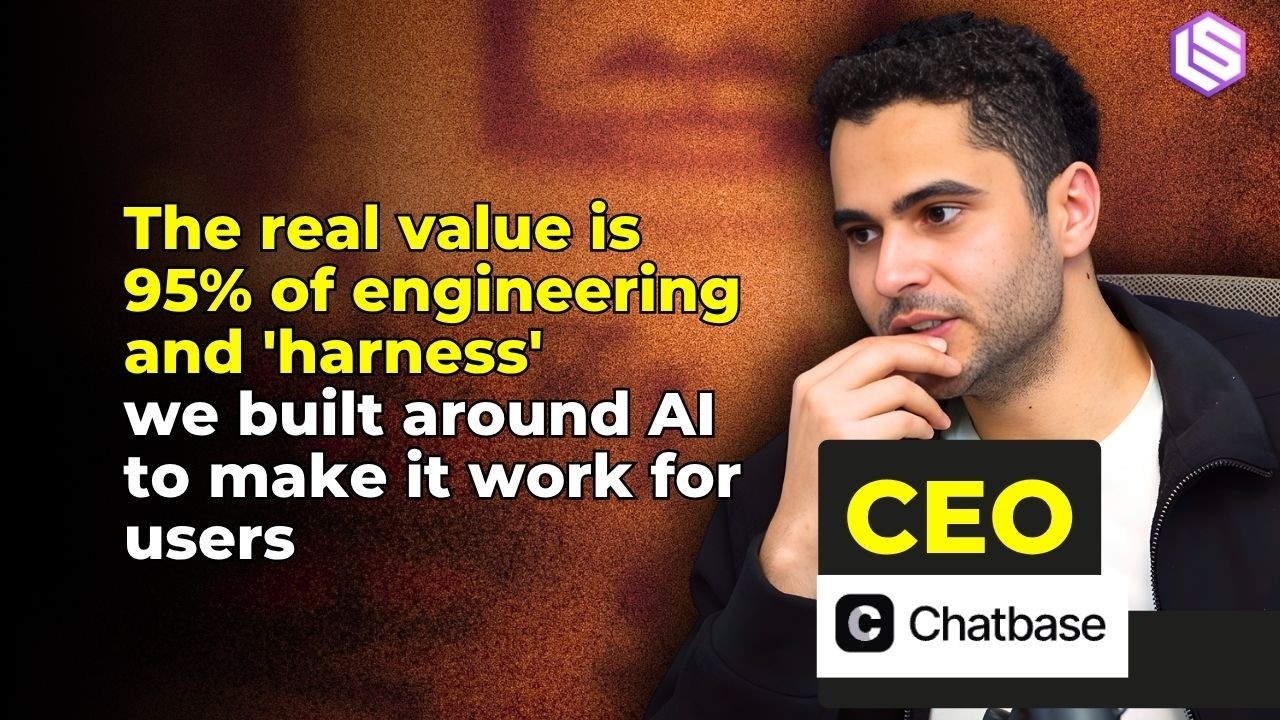
Yaser argues that for customer service, the “harness”—the agentic scaffolding, instructions, and pre-processing around the model—is far more critical than the model’s raw intelligence. He estimates that 95% of the limitations in AI customer service come from the harness, not the model.
Key technical insights include:
- Model Switching Costs: Contrary to the belief that switching between LLM providers is frictionless, it carries a significant cost. Each model requires a slightly different harness, and switching can break carefully tuned guardrails and response patterns, a critical issue in customer support.
- Open Source Models: While there was an initial spike in interest for open-source models, usage has largely reverted to the major closed-source providers for production use cases.
- Fine-Tuning: Offered as an enterprise feature for specific edge cases that cannot be solved with prompting alone, but it is not a widespread need.
The Future: From Support Bot to AI Chief Customer Officer
The vision for Chatbase extends far beyond simple customer support. The goal is to evolve the AI agent into a “brand ambassador” or a “Chief Customer Officer” for a business.
This future agent will be responsible for the entire conversational customer experience, including sales, onboarding, and support. Because the agent is trained on all of a company’s internal documentation and interacts with its customers all day, it sits on a “gold mine of information.”
The roadmap involves two key thrusts:
- Expanding the Agent’s Role: The agent will proactively assist users throughout their entire journey, not just when they have a problem. This involves personalizing interactions based on the user’s history and prompting them toward valuable actions.
- Surfacing Business Insights: The agent will analyze its vast repository of customer conversations to provide actionable insights to the business, identifying common feature requests, points of friction, and opportunities for growth.
This strategy positions Chatbase to replace entire helpdesk systems like Zendesk, first by integrating as an “agentic layer” on top and eventually facilitating a full migration.