How to Build a Self-Improving Company with AI
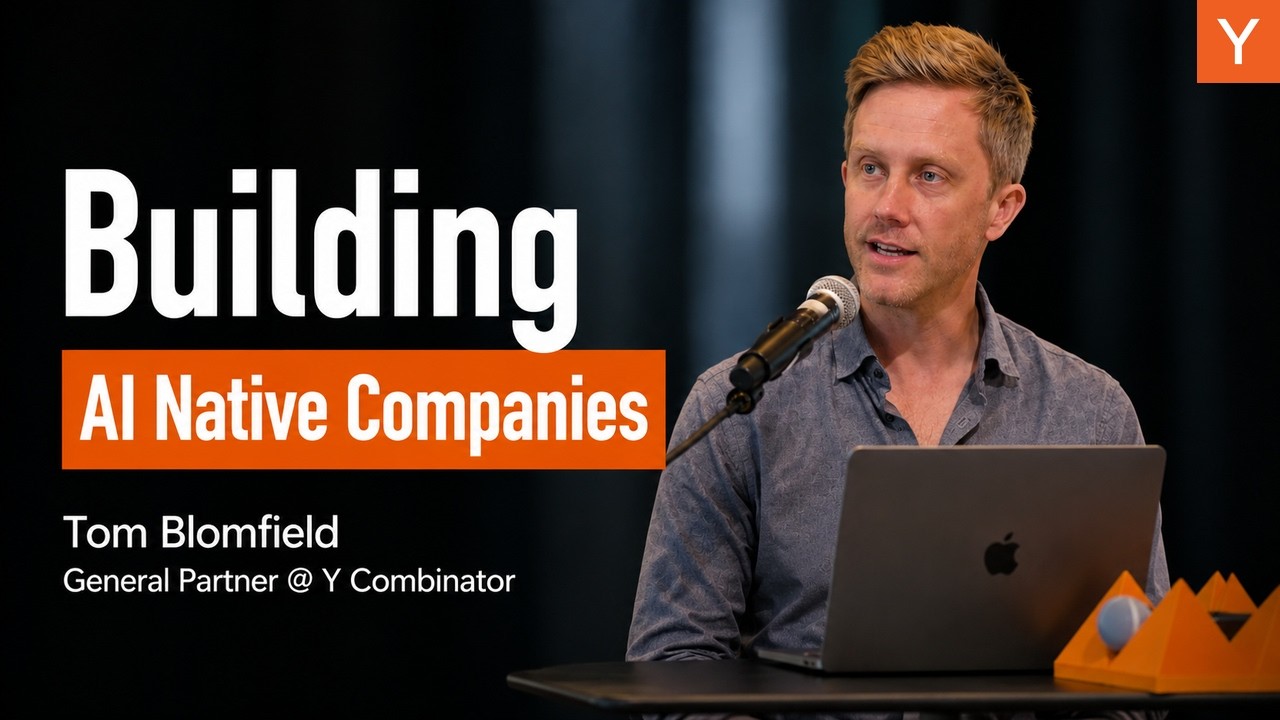
YC General Partner Tom Blomfield explains how to move beyond the traditional hierarchical company structure and build a self-improving organization using AI. He introduces the concept of recursive, self-improving AI loops that can optimize a company's operations, products, and knowledge base while the founders sleep.
Traditional companies are structured like Roman legions—nested hierarchies with humans acting as the primary conduits for information. This model is being fundamentally broken by AI. The initial view of AI as a “copilot” to make employees incrementally more productive is a flawed mental model. It’s merely bolting a more powerful engine onto an old way of working. The real opportunity is to completely reimagine what a company is and how it operates.
The Recursive Self-Improving Loop
Instead of a hierarchy, a company can be envisioned as a set of recursive, self-improving AI loops. The goal is to build systems that get better automatically, even while you’re sleeping. This is achieved by extracting the domain knowledge from people’s heads, Slack messages, and documents, making it legible to an AI, and building loops around it.
A complete loop consists of several layers:
- Sensor Layer: Gathers data from the outside world (e.g., customer emails, support tickets, product telemetry, subscription cancellations).
- Policy/Decision Layer: A set of rules defining what the system can do, when it needs human permission, and what it must log.
- Tool Layer: A set of deterministic APIs and skills the AI can call (e.g., query a database, check a calendar, write code).
- Quality Gate: A checkpoint for evaluation, using heuristic checks, safety filters, or human review for high-risk actions.
- Learning Mechanism: The system interacts with the world, identifies failures or areas for improvement, and feeds that learning back into the top of the loop.
When every step of this loop can run with minimal human intervention, the company begins to improve on its own.
A Real-World Example: The YC Agent
The “holy shit moment” at YC came from an agent built to help partners. Initially, it was a simple sidekick that could query a database for information. The breakthrough occurred when a monitoring agent was added on top.
This meta-agent observes every query from every employee. When a query fails, it doesn’t just log the error; it asks why it failed and determines what’s needed for it to succeed. It then autonomously takes action:
- Identifies the need for a new deterministic tool, a database view, or an updated skills file.
- Writes the necessary code to implement the fix.
- Submits a merge request to the YC codebase.
- Has another agent review, merge, and deploy the code.
The result is that when a human comes in the next day and asks the same query, it now succeeds. The system improved itself overnight without human intervention. This is not a 20% productivity gain; it’s a fundamental shift in how the organization operates and improves.
Implications for Building a Company
Adopting this model has several profound implications for founders:
- Burn Tokens, Not Headcount: Companies are already achieving significantly more revenue per employee. The primary constraint will soon shift from headcount to token usage. Measuring token consumption, while currently a blunt instrument, is directionally correct for identifying who is effectively leveraging AI.
- Middle Management is Over: AI can handle the coordination and information flow problems that middle management traditionally solved. The new organization consists of Individual Contributors (ICs) and Directly Responsible Individuals (DRIs). Everyone is a builder or operator.
- Make Everything Legible to AI: This is the most crucial prerequisite. You must record everything: emails, Slack DMs, and especially meetings. If an interaction isn’t recorded, it effectively “did not happen” for the company’s collective intelligence. This raw data must be diarized and synthesized to be useful.
- Software is Ephemeral, Context is Valuable: The business context, skills, and data are the company’s durable assets. The software and dashboards built on top of this data are disposable. As models improve, you can simply regenerate better, more efficient software on demand to perform a function.
The Regenerated YC User Manual
A powerful example of making knowledge legible is the regeneration of the YC User Manual. By feeding ~2,000 hours of recorded partner office hours into a model, a new, 150-page user manual was generated over a weekend. It’s dramatically better and more up-to-date than the previous version. More importantly, it can now be updated monthly, becoming a living, self-improving brain of YC’s collective advice.
Where Humans Still Matter
In this new structure, humans operate at the edge of the company brain, interfacing with the real world where models can’t yet go. Their role is to handle:
- Novel situations and ambiguity.
- Ethical considerations.
- High-stakes, high-emotion moments (e.g., co-founder disputes).
- In-person interactions like sales conversations and conferences.
Humans are the essential connection point where the company’s intelligence makes contact with reality. For new companies, there is no excuse not to build in this new shape from day one.