Boris Cherny: Building Claude Code
Boris Cherny, creator of Claude Code, discusses the transformative capabilities of Opus 5, highlighting its prompt injection resistance and long-task execution. He delves into Claude Code's empirical development philosophy of "unhobbling" AI by constantly adapting to new model generations, and shares insights on how to build advanced AI products using higher-level tasks, self-verification, and dynamic workflows to orchestrate thousands of agents.
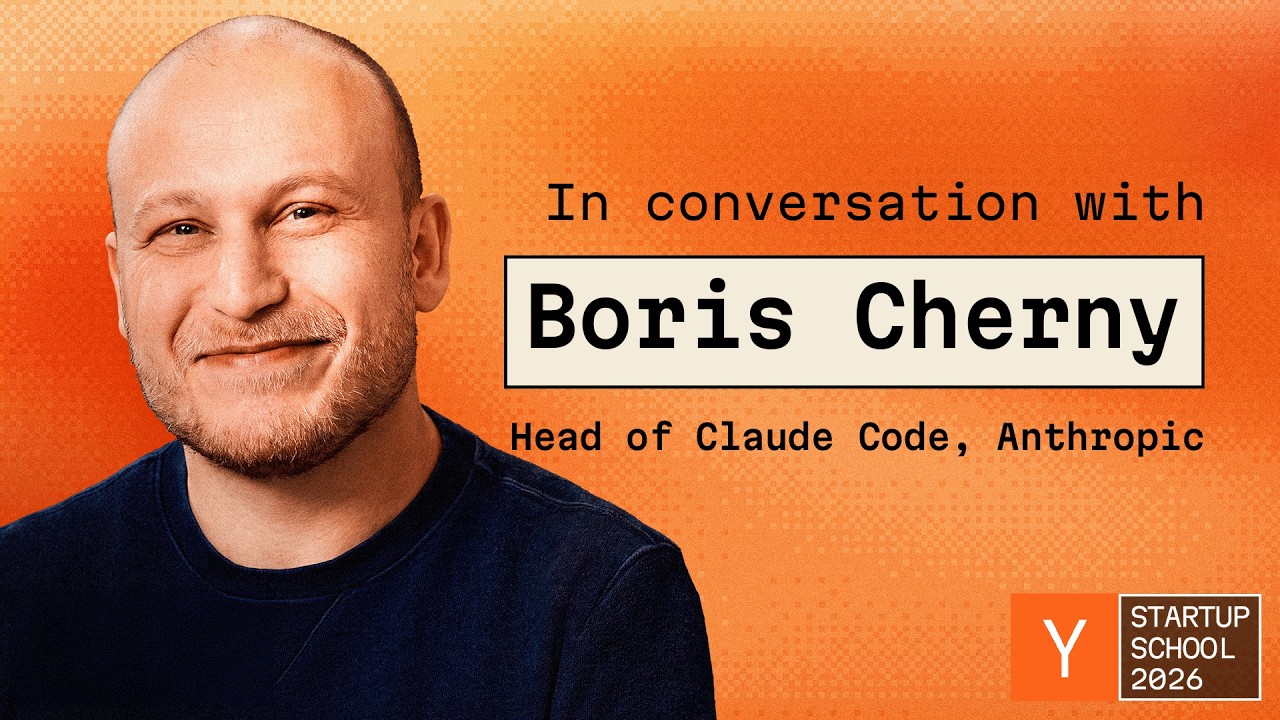
Boris Cherny, creator of Claude Code, discusses the capabilities of Opus 5 and the evolving approach to building AI products.
Opus 5: A Leap in Capabilities
Opus 5 represents a significant advancement, particularly in its ability to handle long-running tasks, executing for days, weeks, or even months, especially when combined with auto mode, eliminating the need for extensive scaffolding. A groundbreaking feature is its enhanced resistance to prompt injection. Achieved through a combination of a well-aligned model, a prompt injection classifier (leveraging Chrisola’s mechanistic interpretability to detect “neurons in the model’s brain” that signal injection), and an auto mode classifier, prompt injection is now nearly impossible to demonstrate. This marks a new frontier for agent and product design, where previous models might have complied with malicious instructions.
The Evolving Nature of Claude Code Development
The development of Claude Code exemplifies an agile and empirical approach. With each new model release, a substantial portion of the system prompt (up to 80% for Opus 5), tools, and tool prompts are deleted or rewritten. This is because every model generation has distinct characteristics and intelligence. For Opus 5, much of the previous corrective prompting became redundant as the model inherently understood and performed tasks better.
Cherny encourages developers to adopt this “press delete” mindset. He suggests an ablation process: remove the entire system prompt, then reintroduce elements line by line to determine their actual impact. This empirical method, akin to a scientific experiment, involves using the model, identifying its struggles, and only then adding specific instructions. This contrasts sharply with traditional software engineering, where upfront design and extensive unit testing are paramount. The model is treated as a “living creature” with a unique “personality” in each generation, requiring continuous adaptation of the harness. Even for users, he recommends periodically deleting cloudmd files, skills, and hooks to discover new model capabilities.
Unhobbling AI and Addressing Product Overhang
Cherny introduces the concepts of hobbling and product overhang:
- Hobbling occurs when the product or harness unintentionally restricts the model’s inherent abilities.
- Product Overhang refers to the gap between a model’s existing capabilities and what products currently allow it to do.
The birth of Claude Code itself was an act of “unhobbling.” While previous models like Sonnet 3.5 were capable coding agents, existing products limited them to autocomplete or read-only chat. Claude Code “unhobbled” Sonnet 3.5 by providing direct terminal access, enabling it to write entire functions and files, thus realizing its full potential. Cherny emphasizes that significant product overhang still exists, representing a vast opportunity for new startups to build products that unlock these untapped model capabilities.
Giving Claude Harder Problems and Harnessing Verification
A common mistake is providing overly specific, step-by-step instructions. Instead, users should provide higher-level tasks, defining the goal, guardrails, and exit criteria, and then “let the model cook.” Opus 5, for instance, can now:
- Rewrite entire codebases from one language to another (e.g., Bun’s Zig to Rust, a task that ran for 11 days via a single prompt and dynamic workflow, and is now in production).
- Perform creative tasks like drawing portraits or landscapes using OpenCV, a capability discovered through playful experimentation rather than direct training.
The key to successfully tackling complex tasks is enabling the model to verify its own work. Cherny illustrates this with a two-week-long project where Claude is rewriting an Electron desktop app into Swift. The prompt instructs Claude to screenshot the Electron app, compare it pixel-by-pixel to the Swift version, and not stop until complete. This task, still running, showcases the model’s ability to persist and self-correct over extended periods, even “live-blogging” its progress with screenshots in a Slack channel.
Running Thousands of AI Agents
To achieve such high-leverage tasks, developers can orchestrate thousands of agents through:
- Dynamic Workflows: A feature in Claude Code that allows users to simply say “use a workflow,” and Claude will autonomously orchestrate numerous agents within a Bun sandbox. This enables complex, multi-stage tasks involving sequence and parallel execution, representing a new form of “test time compute.”
- Loops and Routines: For repetitive, non-context-sharing tasks. Loops run locally, while routines run in the cloud. An impressive example is Claude maintaining its own codebase: daily routines run across all Anthropic codebases to clean dead code, ship experiments, write/delete tests, and even unify duplicated abstractions (“abstraction police”). These routines perform the work of dozens or hundreds of engineers, freeing them for more creative tasks.
The Future of Coding and CS Education
Cherny posits that coding is (almost) solved for many common tasks, particularly for his own work, though complex areas like deep systems, distributed systems, and pixel-perfect UI still pose challenges. The most successful builders in this new era possess an empirical mindset, readily abandoning old assumptions and treating the model like a co-worker. Success comes from observing the model’s behavior, identifying its struggles, and iteratively adjusting.
For computer science students, Cherny advises focusing on practical application rather than pure theory. Drawing from his own experience (learning to code on TI-83 calculators to solve math problems), he stresses the importance of learning to apply CS knowledge to build products, develop design and business acumen, master data science, and engage with users. This combination of technical and soft skills is what truly creates value.
- Tags:
- AI Agents
- Code Generation
- Agentic AI
- Prompt Injection
- Large Language Models
- Feature
- Mechanistic Interpretability
- Anthropic
- Claude Code
- Y Combinator
- LLM Development
- Rust
- Opus 5
- System Prompt
- Ablation
- Product Overhang
- Unhobbling AI
- Dynamic Workflows
- Code Rewrite
- Bun
- Zig
- Test Time Compute
- Empirical AI Development
- CS Education
- AI Product Building