Anthropic's Boris Cherny: Why Coding Is Solved, and What Comes Next
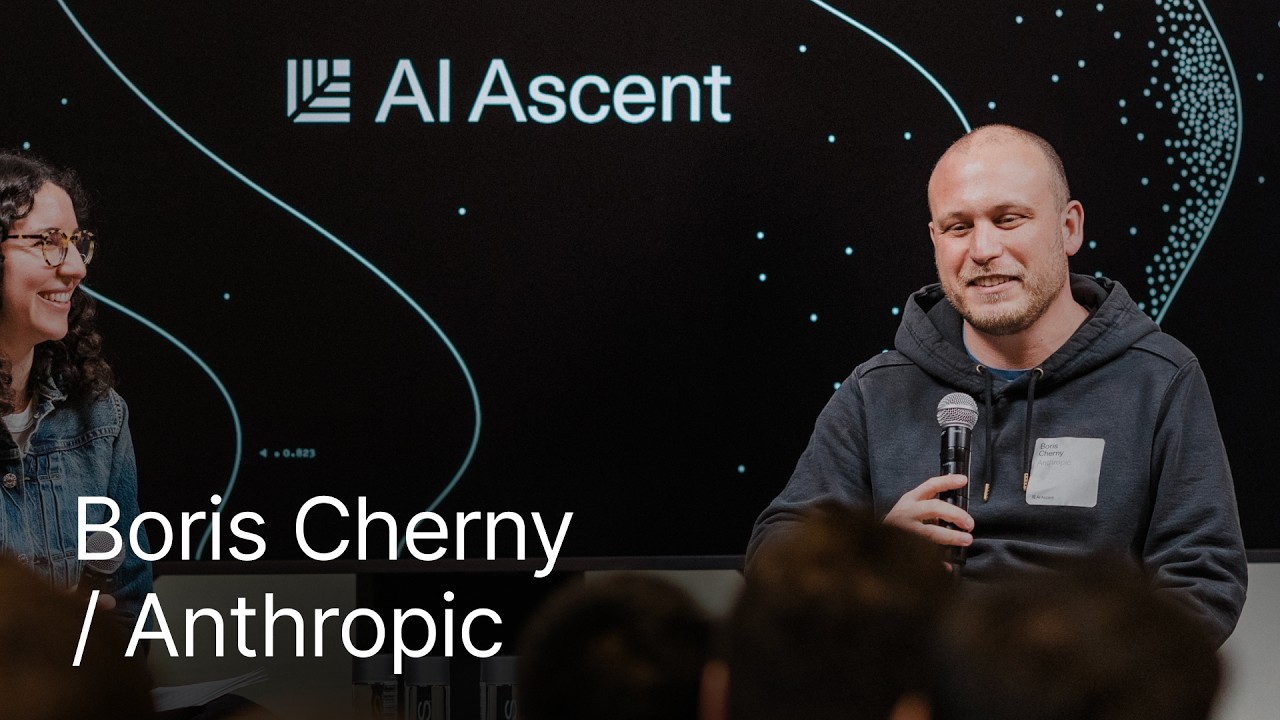
Boris Cherny, creator of Claude Code, discusses the future of software development at AI Ascent 2026. He argues that coding is effectively a solved problem, detailing his personal workflow of shipping dozens of PRs daily from his phone. Cherny explores the shift from typeahead to autonomous agents, the rise of cross-disciplinary generalist teams, and uses the printing press as an analogy for the coming democratization of software creation for all.
The End of Manual Coding
For certain well-structured codebases, such as the TypeScript and React stack used for Claude Code itself, coding is effectively a solved problem. The key was choosing a tech stack that is “on distribution” for the model, making it easier for the AI to generate high-quality code. This has led to a workflow where the model writes 100% of the code.
My personal workflow has shifted entirely away from traditional IDEs and towards managing AI agents, primarily from a mobile device.
- High-Volume Output: I now ship several dozen pull requests (PRs) per day, with a personal record of 150 PRs in a single day.
- Agent-Centric Workflow: My primary interface is the Claude app on my phone, where I manage 5-10 active sessions, which in turn control a few hundred agents. Overnight, I often have thousands of agents performing deeper work.
From Typeahead to Autonomous Agents
The creation of Claude Code was driven by the concept of “product overhang”—the gap between a model’s latent capabilities and the products available to leverage them. In late 2024, the state-of-the-art was single-line “typeahead” completion. We felt the models were ready for the next step: having an agent write all the code.
The development strategy was to build for the next generation of models, not the current one.
- Building Ahead of the Curve: The initial version of the agent was built six months before it had true product-market fit (PMF). It was barely usable, and I only used it for about 10% of my own coding tasks.
- The Inflection Point: The tool saw exponential growth with the release of the Opus 4 model, as the product was already built to harness its advanced capabilities. This growth has continued to inflect upward with each subsequent model release (4.5 through 4.7).
The Future is Loops and Parallelization
The most powerful emerging workflow primitive is the slash}loop, a simple command that instructs Claude to use cron to schedule a recurring job. This enables the creation of persistent agents that automate continuous tasks.
I sort of feel like loops are the future at this point. If you haven’t experimented with it, highly highly recommend it.
Examples of current use cases include loops for:
- PR Management: An agent that babysits PRs, fixing CI failures and performing auto-rebasing.
- CI Health: A dedicated agent that monitors for flaky tests and proactively fixes them.
- Information Synthesis: An agent that scrapes feedback from Twitter, clusters it, and delivers a summary report every 30 minutes.
As models improve, they will begin to initiate these loops proactively. For instance, upon being asked to pull a data query, Claude 4.7 might notice the data changes frequently and offer to start a loop to provide a report every 30 minutes via Slack.
The Rise of the Cross-Disciplinary Generalist
The future of technical teams lies with cross-disciplinary generalists. Today, a “generalist” engineer might work across web, mobile, and backend. The new generalist will be an expert in a non-engineering discipline—like design, product, or data science—who is also a proficient coder.
On the Claude Code team, every member writes code, including the engineering manager, product manager, designers, and user researcher. This creates a more integrated and efficient building process.
AI’s Impact on Business and Startups
The “SaaS apocalypse” is a misconception. AI won’t destroy the value of software but will instead reshape the strategic moats that define a business’s success, based on the “Seven Powers” framework.
- Weakened Moats:
Switching Costsare reduced as AI can easily port data and workflows.Process Poweris diminished because models like Claude 4.7 can “hill climb” to figure out and optimize any business process. - Enduring Moats:
Network Effects,Scale Economies, andCornered Resourcesremain largely unaffected and as important as ever.
The most significant change will be a 10x increase in disruptive startups. New companies can build with an AI-native organizational structure from day one, allowing them to compete head-to-head with large incumbents who face internal resistance and the massive challenge of retraining their workforce and evolving legacy processes.
The Printing Press Analogy: Democratizing Software
The current moment in AI is analogous to the invention of the printing press in the 15th century.
- Before: Literacy was a specialized skill held by ~10% of the European population.
- After: In the 50 years following its invention, more literature was published than in the previous millennium, and the cost of books fell by 100x. Over the next few centuries, global literacy rose to ~70%.
Software development will follow a similar path, transitioning from a specialized skill to a universal one, like sending a text message. This will empower domain experts to build their own tools.
The best person to write accounting software, I think maybe even today, is not an engineer, it’s a really good accountant because they know the domain really well and coding is the easy part. It’s knowing the domain that’s the hard part.
Anthropic’s Internal Advantage: Process, Not Models
Anthropic’s internal teams use the same production models available to the public. The competitive advantage is not access to better technology but a radically different organizational process built entirely around AI.
- Universal Automation: All code and SQL queries are written by models. There is no manually written code.
- Inter-Agent Communication: Agents running in loops communicate with each other via Slack to resolve dependencies and figure out unknowns without human intervention.
- Dogfooding as a Platform: This deep integration is possible because Anthropic is building a platform and is committed to using its own tools for everything. The real gap between Anthropic and the rest of the world is in this AI-native organizational structure, an advantage that startups can more easily replicate.