"We're Not Writing Code by Hand Anymore. That's Over." | Owen Jennings & David Haber - The a16z Show
Owen Jennings, Executive Officer at Block, details the company's radical restructuring (40% workforce reduction) driven by AI's impact on productivity. He explains how Block is now operating with smaller squads, leveraging internal AI tools like Goose and Builder Bot, and shipping AI-native products like Money Bot and Manager Bot to deliver personalized, generative UIs for millions of users, emphasizing a future where unique understanding forms the ultimate business moat.
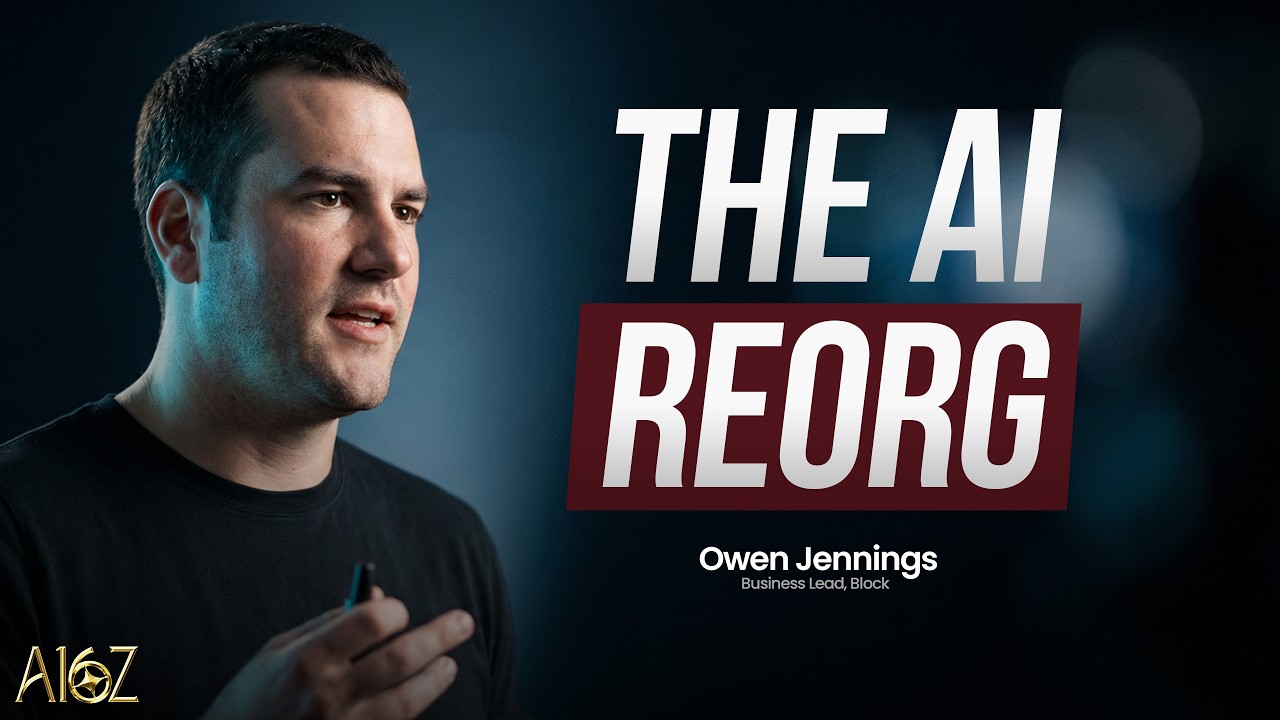
Owen Jennings, Executive Officer and Business Lead at Block, details the company’s drastic 40% workforce reduction, attributing it not to over-hiring but to a strategic response to AI’s transformative impact. He highlights how AI tools have fundamentally broken the historical correlation between headcount and output, enabling 1-2 engineers to achieve 10x-100x productivity gains.
A Paradigm Shift in Development & Operations
The decision was spurred by a “binary change” observed in late November/early December (likely 2024), where advanced foundational models became incredibly adept at working with existing, complex codebases. Block had proactively laid groundwork, launching its internal agent harness, Goose, in early 2024, which augmented software development and internal tooling. This led to a belief that for any given product or roadmap, significantly fewer engineers, designers, and PMs would be required. The RIF was executed with core principles of reliability, trust with customers, and compliance, ensuring continuity of durable growth and long-term bets.
Post-RIF, Block’s operational tempo has changed dramatically. Meetings have been reduced by 70-80%, fostering a “back to building” culture. Workflows have shifted from linear, sequential tasks to parallel, agent-driven processes, where individuals manage multiple AI agents simultaneously. Jennings suggests that while this may mean fewer people per company, the Jevons paradox could lead to an explosion of new products and companies.
AI Infrastructure & Internal Tooling
Jennings posits AI as a fundamental, built-in layer, akin to computers themselves. Internally, Block transitioned from a classic hierarchical structure to small, fluid squads of 1-6 people, significantly cutting management layers (50-60% reduction in development). Key internal AI tools include:
- Goose: A model-agnostic agent harness that routes automations across various LLMs (Anthropic, OpenAI, open-source).
- G2: An internal agentic operating system designed to automate any deterministic workflow.
- Builder Bot: An advanced tool that autonomously merges Pull Requests and builds features to 85-100% completion, with human oversight for the final context.
Beyond development, AI automates deterministic workflows across customer support, product operations, risk operations, and compliance. While human-in-the-loop is currently critical, Jennings foresees models eventually outperforming humans in these areas.
Ecosystem & Generative UI
Block has also reorganized its business units (Square, Cash App, Afterpay) into functional teams to build cross-brand features and an integrated ecosystem. This shift leverages Goose as a foundational platform for AI-native products:
- Money Bot (Cash App): Functions as a “CFO in your pocket,” offering proactive, action-oriented financial advice and management within Cash App.
- Manager Bot (Square): Provides similar intelligent assistance for Square merchants, capable of generating custom applications (e.g., a scheduling app for a multi-location restaurant).
A significant product shift is towards Generative UI, moving away from static, rigid interfaces. Future applications will offer dynamically personalized user experiences, generating charts, visualizations, and even custom app functionalities on the fly based on individual user needs and prompts. This introduces challenges in QA for non-deterministic outputs but promises deeper personalization and engagement. Block emphasizes proactive intelligence, prompting users with relevant information rather than expecting them to craft perfect prompts.
Defensibility in the AI Era
Jennings outlines Block’s existing moats, including distribution and network effects (tens of millions of active users), robust regulatory posture and licenses, and hardware. However, for the long term, he argues the ultimate defensibility lies in a company’s ability to “understand something super hard for other people to understand.” Block views itself as an “intelligent system” built upon unique data and insights into how sellers and buyers interact within the economy.
The key to this long-term moat is a continuous feedback loop: leveraging deep, unique understanding (signal) with powerful AI tools (like Builder Bot) to iterate rapidly. This process, currently taking weeks, is expected to compress to thousands of iterations per day, with humans transitioning to an editing role. Companies unable to cultivate and rapidly iterate on such unique understanding risk being “vibe coded away” by AI-driven competitors.