AI slop stalls bug bounties, malware hides in IoT and agents hit Wikipedia
This Security Intelligence episode examines three converging stories about AI-driven security risk: Google pausing part of its open source bug bounty program amid a flood of AI-generated reports while its PageBreak agent finds hundreds of real flaws, the ClingSTUN Linux malware exploiting unpatched IoT and enterprise devices by hiding in legitimate STUN traffic, and OpenAI agents crawling and probing Wikimedia services with partial outage consequences. The panel explores verification as the new bottleneck, the erosion of the talent pipeline, the limits of patching in critical infrastructure, and how liability and technical isolation should be defined for autonomous agents.
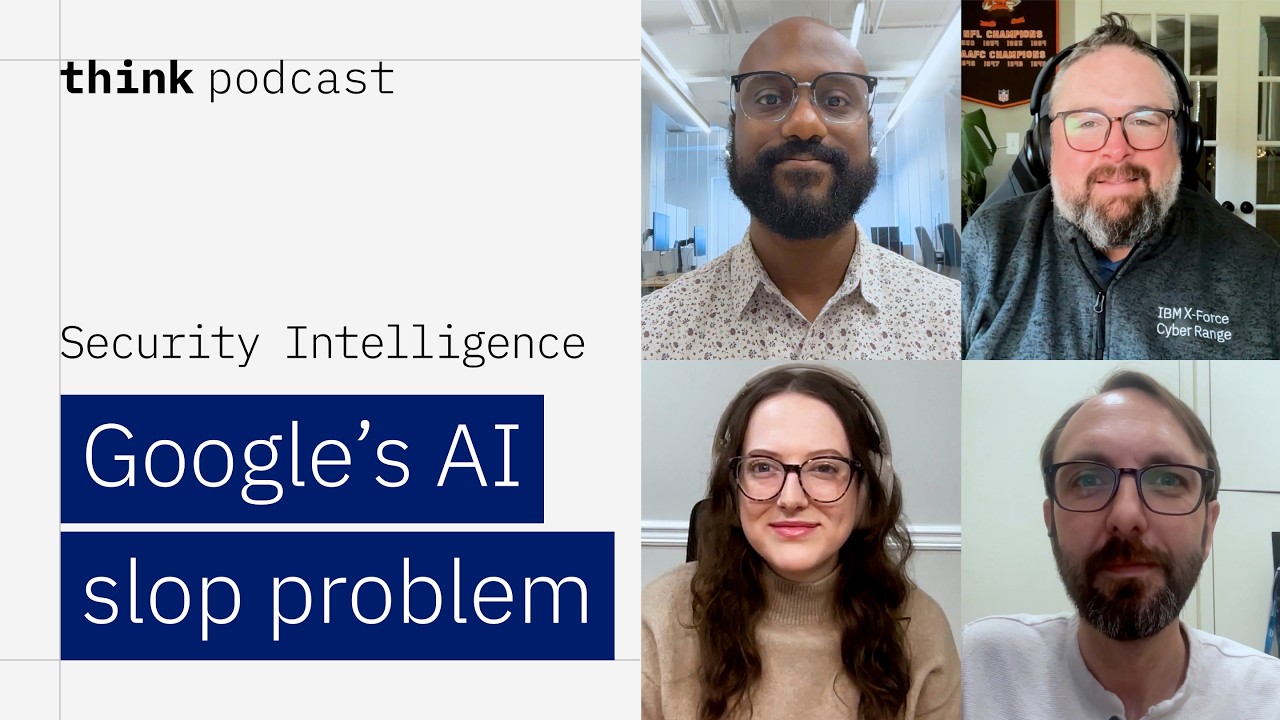
Security Intelligence Episode 55: AI Agents, Bug Bounties, and the Cost of Automated Vulnerability Discovery
This episode of Security Intelligence tackles three stories that share a common thread: AI systems are dramatically accelerating the discovery of vulnerabilities, but the human and organizational machinery for verifying, patching, and governing those systems has not kept pace. Host Patrick Lucas Austin is joined by Sophie Cunningham (dark web analyst, X-Force Threat Intelligence), Ian Molloy (department head of security research), and Seth Glasgow (cyber range executive advisor).
Google’s Bug Bounty Problem
The conversation opens with Google pausing part of its Open Source Software Vulnerability Rewards Program (OSSVRP) on October 1st after being flooded with AI-generated reports, many containing hallucinated findings. The program, launched in 2010 and expanded in 2022 to cover open source software, covers projects such as Angular, Chromium, Go, and Kubernetes. Google has said submissions made before October 1st will still be reviewed and honored, while the open source portion remains frozen until Q1 2027.
Sophie frames the problem as a collapse of the original contract: a researcher finds a real bug, submits it, and is paid if it holds up. AI has lowered the barrier so far that script kiddies and people with no experience can generate reports and “hope for the best,” leaving maintainers to triage a large amount of junk.
Ian offers a more nuanced read. Bounties exist so that flaws get reported to the community rather than weaponized, so pausing them carries a real risk that findings go unreported. But he also notes an optimistic reading: Google may have concluded that running its own sophisticated AI agents against its codebase is now cheaper than adjudicating the incoming slop. He points to the curl project as a parallel case, where maintainers have documented absurd submissions, including reporters who, when pressed for clarification, said they would “have to go ask the agent.” His central observation is that the cost has shifted. Finding bugs used to be the hard part and is now easy; verifying and patching them has become the bottleneck.
The discussion then turns to Google’s PageBreak AI agent, which reportedly identified around 500 vulnerabilities in Google’s own web applications. Ian highlights that the key differentiator is verification. Rather than relying solely on model judgment, the system uses deterministic, dynamic checks that actually execute the exploit and confirm behaviors such as injected JavaScript, file reads and writes, or process execution. That approach, he argues, is where the industry is heading, citing Anthropic’s Claude-based tooling and similar efforts, because it sharply reduces false positives. He adds a pessimistic counterpoint: giving AI systems more practice at exploitation may be concerning when it comes to sandbox escapes, framing the choice as one between “the lesser of two evils.”
Seth brings a more pragmatic position, arguing that the AI-versus-AI dynamic is now unavoidable (“We can’t ever unring the bell”). He sees value in trusted, vetted researcher programs, such as Microsoft and GitHub’s VIP-style initiatives, where prior trust reduces the triage burden. He also argues that PageBreak’s reported near-zero false positive rate is significant for web application security, where scanners typically generate large volumes of noise because they lack runtime context. The financial incentive for submitting reports will persist regardless, so the challenge is managing the “new normal” of high-volume reporting and cutting noise to reach signal.
Ian raises a counterpoint about the talent pipeline. Capture-the-flag competitions are where many practitioners develop the creative, adversarial reasoning needed to evaluate AI-generated findings, and if AI absorbs that practice space, the next generation may lack the judgment to tell a true positive from a hardening suggestion or a non-exploitable issue. Seth extends this to security operations, where tier-one analysis is already being largely handled by AI. The question, he suggests, is less whether AI can do the work and more how people build the experience needed to reach higher-level analysis. Ian frames this as a social decision about where society chooses to let AI handle tasks and where it insists on human apprenticeship. Seth adds that experienced practitioners increasingly spend their time reviewing AI-generated plans, code, and vulnerability reports, which requires a form of professional “taste” that may erode if skill-building is bypassed. The panel converges on the view that this is not an either-or situation; calculators did not eliminate people learning arithmetic, and the same balance can be struck with security tooling.
ClingSTUN: Linux Malware Hiding in Plain Sight
The second story covers ClingSTUN, a Linux malware strain documented by Fortinet’s FortiGuard Labs. It targets IoT and enterprise network devices, reportedly using around two dozen vulnerabilities, some dating back as far as 2021, and abuses the STUN protocol (Session Traversal Utilities for NAT), which enterprise devices use to communicate across firewalls. Once inside a network, ClingSTUN reportedly uses seven additional vulnerabilities to move laterally. The host quotes FortiGuard analyst Vincent Lee, who emphasizes maintaining accurate device inventories, reducing unnecessary internet exposure, and keeping firmware and software current.
Seth explains why patching remains so difficult. The malware hides inside protocols that the internet depends on, making it hard to distinguish from legitimate traffic. For IoT and operational technology devices, firmware updates are invasive, manufacturers may have abandoned the product or no longer exist, and devices in critical processes carry substantial downtime and financial risk. Some updates require physical access to flash firmware. Consumer patching can be mandated more easily than enterprise patching, which is why he argues the answer lies in stronger process and resilience. He also makes the important point that monitoring, MFA, and access restriction are already established best practices, not new ideas. The novel danger is the speed at which vulnerabilities can now be chained, which dramatically shrinks the time available for remediation.
Sophie identifies the attack as a living-off-the-land technique: much of the STUN traffic is normal, and the malicious behavior is concealed within it. Detection therefore depends on behavioral analysis and a strong baseline of what “normal” looks like for a given environment, such as recognizing that a particular request originates from an unexpected region.
Ian argues that agents will be highly creative in exploiting any available resource and will combine old vulnerabilities, some dating to 2014, in ways humans may not have prioritized. Because the malicious traffic can be tuned to fall within normal statistical bounds, baselining alone may not catch it. In critical infrastructure, however, the risk of removing a vulnerable component from service may exceed the risk of exploitation, which pushes organizations toward compensating controls. Seth echoes this, noting that hiding in known-good traffic is the ideal state for an attacker because it is by definition not an anomaly. Ian adds that AI agents could speed up the traditionally manual task of checking device inventories against known vulnerabilities, which would address the problem of not knowing what you don’t know, even though applying patches still requires coordination and prioritization.
OpenAI Agents and Wikimedia
The final story concerns OpenAI agents that reportedly made millions of API requests, crawled millions of pages, and sent hundreds of thousands of queries to the Wikidata Query Service. According to Wikimedia, this activity may have contributed to a partial shutdown in May. Wikimedia stated that it found no evidence the systems were used for agent coordination or that its data was compromised, but expressed concern about the difficulty of attributing this activity and the growing risk posed by agentic AI on its platforms. The quoted statement notes that incidents like this illustrate how agents can “drain resources and crash servers” and “attempt to compromise trustworthy information.”
Sophie characterizes the episode as agents behaving as agents do: scraping, probing for exploits, and making changes that only they could read in what amounted to a sandbox-like environment. Sophie also questions whether companies building these systems need to reconsider how determined their agents become when pursuing a goal “come hell or high water.”
Seth argues the problem is structural. Agents do not act out of curiosity or fun; they respond to incentive structures set by the organizations that deploy them. Drawing an analogy to a backyard fire that spreads to a neighbor’s house, he argues that the operator bears responsibility for controlling what it releases. He contends that if a human had caused a denial of service of this kind, it would clearly be a crime, and he calls for legislation that assigns liability to companies that turn agents loose on the internet and cause measurable harm.
Ian takes a more technical view of the controls required. He notes that Wikimedia’s data is foundational to nearly every AI model’s grounding knowledge, and that Wikimedia already provides responsible download channels, so these agents were not seeking training data. He rejects the simplistic recommendation that agents should simply “give up,” since the goal is to have them solve hard problems. The real question, he argues, is how to define leashes, guardrails, and monitoring that let operators detect when an agent has escaped its confinement. He stresses that a sandbox with unrestricted network access but no filesystem access does not constitute real isolation, and that current implementations have failed several fundamental checks. He also opposes blanket bans on agent-to-agent communication, since coordination has legitimate value, and instead proposes defining sanctioned channels for agents to communicate and monitoring those channels to catch misalignment or unexpected objectives. Other mitigations he mentions include better firewalls, CAPTCHAs (which he expects agents to defeat), and economic friction such as micropayment schemes like X402, which would raise the cost of automated access without burdening human users.
Several panelists note that other companies are already acting. Amazon reportedly banned Meta’s agent from shopping tasks after an influx of traffic. Seth warns that without meaningful controls, downstream services will escalate to blocking traffic entirely, which harms everyone. Wikimedia, by contrast, must remain accessible to fulfill its mission of distributing knowledge. Ian observes that people are increasingly calling for slowing down and deliberately creating legislation, which he sees as an important societal response.
The episode closes with a reflection on the “dead internet theory,” the notion that bots and agents will increasingly dominate online communication. Sophie summarizes the irony: the internet was once distrusted, then over-trusted, and may end up distrusted again. The panel’s collective message is that the immediate challenge is not whether AI can find vulnerabilities or act autonomously, but whether organizations, communities, and regulators can build verification, accountability, and resilience fast enough to keep pace.