What Are Hierarchical AI Agents? Solving Context & Task Challenges
Explores the challenges of single AI agents, such as context dilution and tool overload, and introduces hierarchical AI agents as a solution. This summary details the structure, benefits, and limitations of multi-agent systems for more scalable and efficient AI workflows.
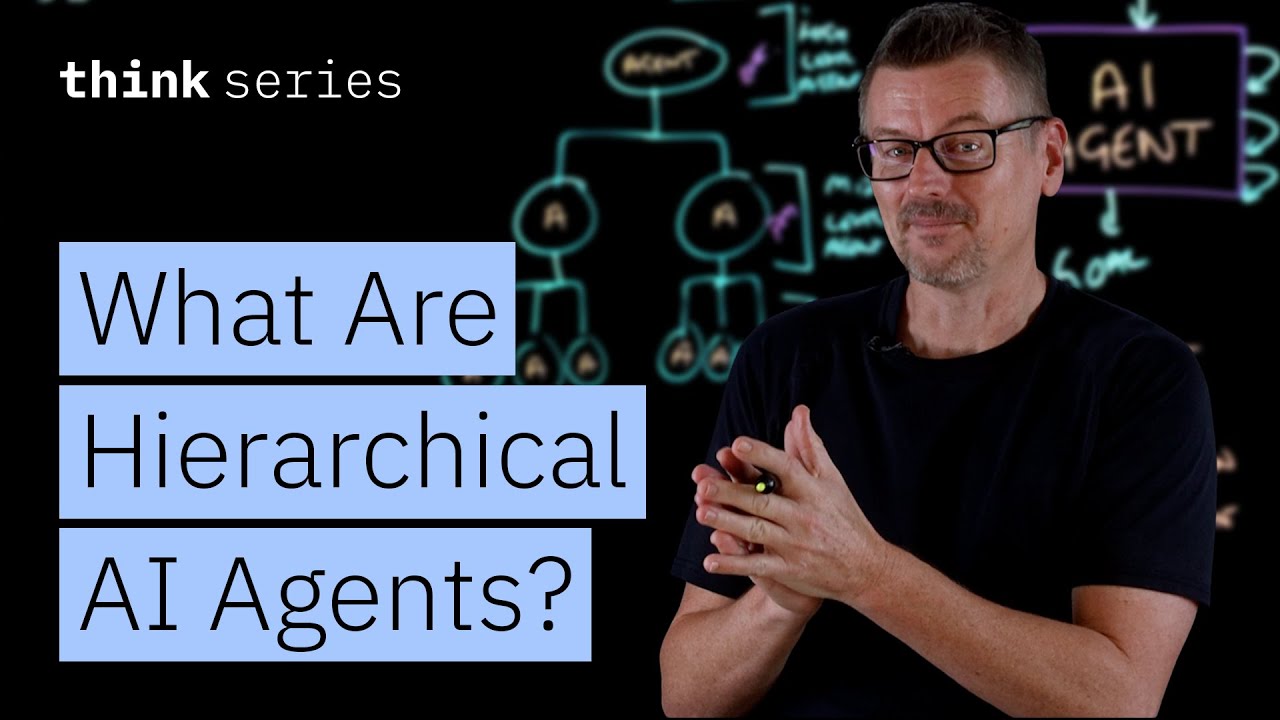
Single AI agents, while autonomous, struggle with long-horizon tasks and often fall into predictable failure modes. To overcome these challenges, a trend is emerging in agentic workflows to adopt a hierarchical structure, applying the classic software engineering principle of “separation of concerns” to AI.
The Problem with Monolithic AI Agents
A single-agent architecture, where one agent acts as the planner, implementer, and quality assurance, faces several key issues:
- Context Dilution: As a task progresses, the original goal’s signal can be lost in the noise of intermediate steps.
- Tool Saturation: Providing an agent with numerous tools increases the difficulty of correct tool selection, leading to a higher chance of errors or invalid arguments.
- “Lost in the Middle” Phenomenon: Large language models (LLMs) tend to underweight instructions buried in the middle of a long context window, even if they are crucial.
The Hierarchical AI Agent Structure
A hierarchical system organizes agents into layers, much like a corporate org chart, to distribute responsibilities effectively.
- High-Level Agent: At the top sits a single agent, the “top dog,” analogous to an executive. Its role is strategic, focusing on the big picture, performing high-level task decomposition, and managing processes.
- Mid-Level Agents: This layer consists of agents that act like project managers. They receive directives from the high-level agent, implement plans, further decompose tasks, and coordinate the teams of agents below them.
- Low-Level Agents: These are the specialized “doers.” Each low-level agent is trained for narrow tasks and given access to a limited set of specific tools. They execute their directives and report results back up the chain.
This structure ensures that mid- and high-level agents use the feedback from the lower levels to inform the next steps, creating a continuous loop of execution and validation.
Advantages of the Hierarchical Approach
Separating work across a hierarchy overcomes the limitations of a single-agent system in several ways:
- Solves Context Dilution: Instead of feeding the entire conversation history into every prompt, the system uses “contextual packets.” The high-level agent maintains the global state but sends only a pruned, relevant slice of context to each subordinate agent. An agent tasked with formatting a JSON file doesn’t need the initial 4,000-word strategy document, which keeps the signal-to-noise ratio high.
- Reduces Tool Saturation: By applying the IT principle of “least privilege,” the hierarchy enables tool specialization. A security agent gets access to a vulnerability scanner, while a DevOps agent gets the CI/CD pipeline tool. Limiting each agent to a small, purpose-built toolbox makes tool selection more accurate and efficient.
- Enables Model Flexibility: A monolithic agent often requires an expensive, high-reasoning frontier model for all tasks. In a hierarchy, you can use the powerful model for the high-level agent’s complex planning and deploy much lighter-weight, cost-effective models for the modular, self-contained tasks of the low-level agents.
- Other Benefits: The system is inherently modular, allowing agents to be tested and updated independently. It supports parallelism, with multiple agents working on different parts of a problem simultaneously. It also provides a recursive feedback loop, where supervisors act as a quality gate, monitoring output and triggering retries if necessary.
Limitations and Considerations
Despite its advantages, the hierarchical model presents its own set of challenges:
- Task Decomposition is Hard: The entire system’s effectiveness hinges on the high-level agent’s ability to break a complex goal into the right subtasks in the correct sequence. Current LLMs can be inconsistent at planning, sometimes missing dependencies, underestimating complexity, or over-decomposing simple tasks. An initial mistake in decomposition will cascade through the entire system (“garbage in, garbage out”).
- Orchestration Overhead: Architecting the entire system requires significant effort. This includes designing state management, defining handoff logic between agents, and building retry loops. If the logic governing agent communication is brittle, the system can fall into recursive error loops.
- The “Telephone Game” Effect: Just as instructions get distorted as they pass through layers of management, the same can happen in an agent hierarchy. If task decomposition is slightly off or the wrong context is pruned, a specialized agent can end up perfectly executing the wrong task.
Ultimately, while hierarchical AI agents can prevent a system from getting “lost in the middle,” they can still get “lost in the org chart.” The key is to treat the hierarchy as a production system that requires thoughtful design, rigorous validation, and the understanding that the top-level plan may not always be perfect.