AI on campus
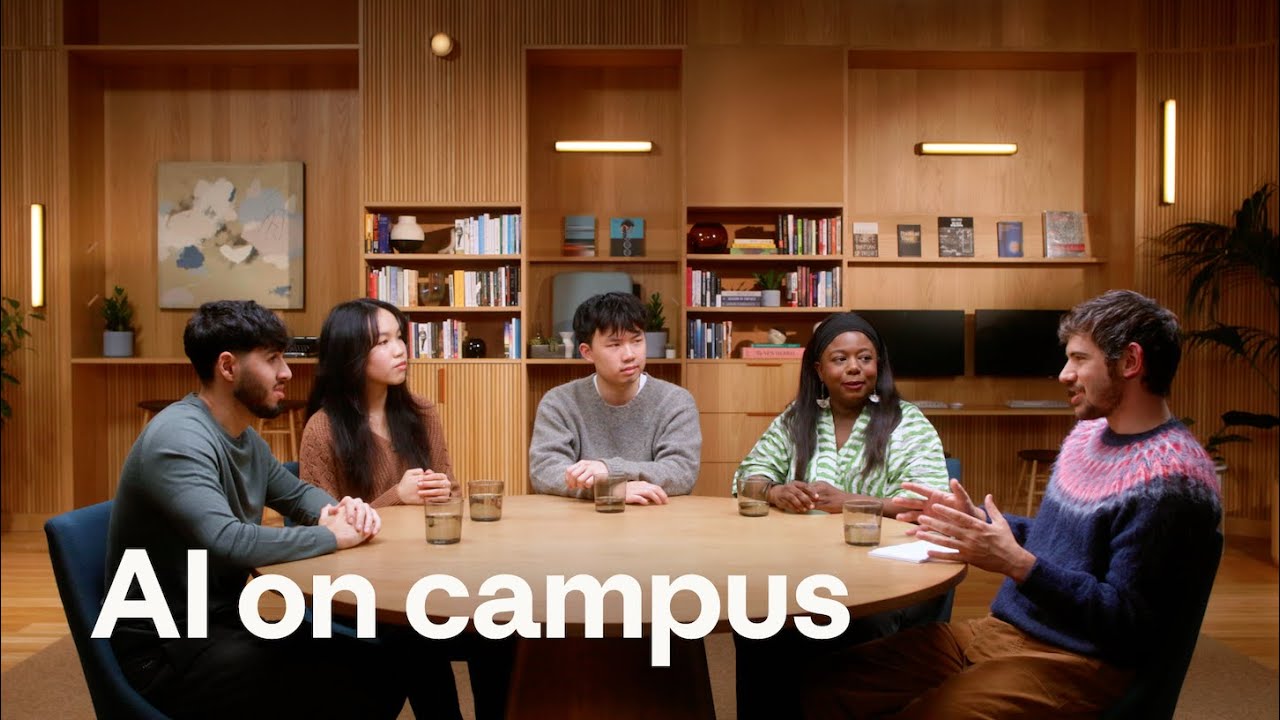
A panel of university students from LSE, Princeton, Berkeley, and ASU discuss the real-world impact of AI on campus life. They cover how AI is used as both a powerful learning tool and a crutch, the innovative projects students are building, how universities are adapting, and the challenges of navigating cheating, job applications, and 'AI slop' in a rapidly changing educational landscape.
The Campus Vibe: Chaotic, Energetic, and Polarized
The integration of AI on university campuses is described as a chaotic but energetic “gray-zone.” A survey mentioned by one student indicated that over 90% of students use AI in their daily workflows for tasks like summarizing lectures, getting feedback on assignments, and answering problem sets. This widespread adoption has forced universities to react, resulting in a patchwork of policies where some courses ban AI while others actively encourage it, leaving students to navigate the ambiguity.
A notable polarization is emerging. Students in humanities and some social sciences are often more hesitant, with some “completely opting out” due to the nature of their close-reading and research-intensive work. Conversely, in fields like computer science, using AI coding assistants is still considered taboo in the classroom, even though it’s standard practice for building projects outside of it.
Lowering the Barrier to Entry for Building
A significant breakthrough highlighted by the students is how AI has dramatically lowered the barrier to entry for software development and project creation. Students from non-technical backgrounds, such as political science or finance, are now comfortable using tools like the terminal and building functional applications.
Examples of this empowerment include:
- A finance student with no CS background becoming comfortable in the terminal.
- Student societies, which previously only had basic Instagram pages, are now building full-fledged websites with more information.
- Freshmen roommates with a simple human insight winning a “Vibe-a-thon” by gamifying a campus bucket list.
Innovative Student-Built Applications
Students are moving beyond simple Q&A and are building practical tools to solve campus-specific problems:
- Lecture Annotator: An application that takes lecture slides and adds professor-like annotations and context in the margins, preemptively answering questions and defining key terms.
- Course Registration Sniper (“Courseer”): A tool that alerts a student the moment a seat opens up in a high-demand, full class, allowing them to register immediately.
- Study Space Finder: An app that scans university data to identify and direct students to empty classrooms when the library is full.
- Healthcare Prototypes: In hackathons, students are exploring advanced use cases, such as combining computer vision with an LLM API to interpret signs of a stroke or dementia from a camera feed.
The Dilemma: AI as a Tool vs. a Crutch
A central theme is the tension between using AI as a learning accelerant versus a crutch that hinders critical thinking. The students agree that how an individual uses AI is highly revealing of their core motivation for being at university—whether it’s to genuinely learn, to secure a job, or to socialize.
“We have the tools now, to be honest, to get through university without actually learning much. It’s our responsibility now as students to use this tool to achieve your own individual outcomes.”
Students are becoming more sophisticated in their usage, moving from single-shot questions to creating dedicated projects in platforms like Claude for each class. They upload syllabi and course materials to build a contextual knowledge base, enabling more of an extended, Socratic dialogue rather than just asking for answers. This intentionality is key to using AI as a tool. The line is drawn at ownership; if you cannot defend, explain, and feel comfortable with the work you’ve produced, you’ve used it as a crutch.
Institutional Adaptation: Progress and Pitfalls
While students are rapid adopters, universities and professors are seen as being “a little bit behind.” However, some innovative adaptations are taking place:
- Progressive Curriculum: A course at the London School of Economics (LSE) now explicitly teaches students how to use Claude effectively. It requires them to engage in a conversation, assign the AI a persona, and submit the entire conversation log for evaluation, shifting the assessment from the final output to the quality of the interaction.
- Custom Chatbots: Some professors are building their own course-specific chatbots trained on lecture notes to answer student questions. However, this is sometimes seen as a “band-aid approach,” as it doesn’t prevent students from using more powerful, external models.
- Pro-AI Stance: Arizona State University (ASU) has fully embraced AI, creating a “prompt bank” for career services and launching new, in-demand courses like “Artificial Intelligence Chip Strategy and the Future of Work.”
Downsides: Cheating, Ownership Shame, and “AI Slop”
Cheating remains a primary and undeniable use case. The interface of a chatbot, waiting for a question, makes it incredibly easy to input a homework problem and receive a direct answer.
A more nuanced downside is the emergence of “ownership shame.” Students who use AI constructively for brainstorming and iteration often downplay their own contributions, defaulting to “Claude did everything.” This stems from a lack of vocabulary and frameworks to properly credit the human-AI collaboration, blurring the line of intellectual ownership.
Students are also becoming adept at spotting “AI slop”—generic, low-quality output characterized by a recognizable AI voice, overuse of em-dashes, and a lack of genuine insight. They find that for complex, context-rich assignments, AI is often “pretty bad at cheating.”
The Job Market and Group Projects
The sentiment about entering the job market is mixed.
- The Bad: The recruiting process is becoming increasingly dehumanized, with AI screening candidates (leading to instant rejections) and conducting pre-recorded “Hirevue” interviews where applicants talk to a screen.
- The Good: AI fluency is now a sought-after skill, particularly in consulting and business. AI also serves as a powerful personal tool for practicing interviews and tailoring resumes.
In group projects, AI introduces new dynamics. The panel shared strategies for navigating this, such as using AI to create an initial outline, dividing the sections, and then allowing individuals to use AI as they see fit. However, they stressed the importance of face-to-face collaboration to ensure alignment and prevent individuals from simply pasting in unedited AI output.