Leah Belsky on how AI is transforming education — the OpenAI Podcast Ep. 4
OpenAI's Head of Education, Leah Belsky, and students Yabsera and Alaap discuss how AI, particularly ChatGPT and its new Study Mode, is transforming education. They cover global adoption, the shift from policing AI to integrating it, its role as a personal tutor for building confidence and skills, and the evolving nature of learning, work, and critical thinking in the age of AI.
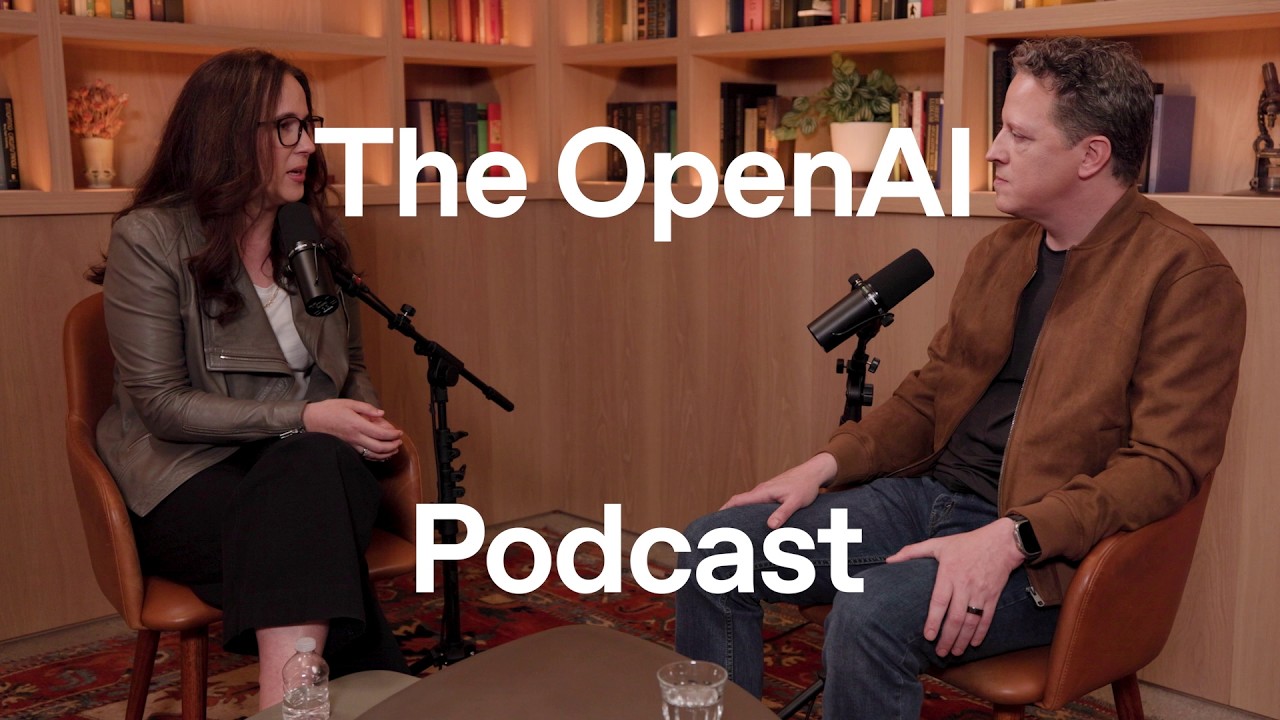
Leah Belsky, OpenAI’s Head of Education, articulates a vision where AI serves as a transformative “moonshot” for human potential, acting as a personal tutor and lifelong companion. The core mission is to make these advanced capabilities universally accessible, moving beyond AI’s role as a simple answer-provider to a tool that enhances learning and critical thinking.
Global Adoption and Institutional Response
Learning is one of the top use cases for ChatGPT, making it one of the world’s largest learning platforms. Belsky notes a significant global demand, with entire countries like Estonia reaching out to integrate AI as core infrastructure within their educational systems. This push is driven by a dual focus: improving educational outcomes and developing an “AI-ready workforce” to remain economically competitive.
Universities that adopt AI widely often do so with a sense of pride in equalizing access for all students, ensuring that financial status doesn’t dictate who can use the best models. However, a key challenge is building trust. Students from the “COVID generation” are often wary of school-provided technology due to experiences with intrusive monitoring. Institutions are learning that to foster adoption, they must be transparent and assure students their interactions are private.
Initially, many institutions reacted by trying to police AI use with ineffective detectors, creating a fraught relationship with students. The conversation is now shifting from “how to ban it” to “how to use it.” Educators are redesigning assessments to move beyond simple recall, focusing instead on application, critical thinking, and larger, more complex projects that leverage AI as a tool.
Study Mode: From Answers to Understanding
To address the concern that AI can hinder learning if used merely as an “answer machine,” OpenAI developed Study Mode. This feature was born from observations in India, where families spend a significant portion of their income on tutoring. The goal was to build a tutoring experience directly into ChatGPT.
Study Mode is designed to:
- Respond Socratically: Instead of giving direct answers, it asks guiding questions to help the student arrive at the solution themselves.
- Personalize Learning: It adapts to the user’s level of understanding and the context of their studies.
- Encourage Deeper Engagement: It asks follow-up questions, offers quizzes, and prompts the user to explore topics more thoroughly.
The development involved creating a schema based on learning science and pedagogy, then training the model with “golden examples” of ideal tutoring interactions. Belsky sees this as a first step, envisioning a future where the mode can use multimodal outputs (like interactive diagrams) and proactively re-engage students on topics over time, integrating principles like spaced repetition.
Student Perspectives: From Fanfiction to Advanced Prompting
College students Yabsera (Business Analytics) and Alaap (Electrical Engineering & Computer Science) provide a practical view of how AI is used. Their first “aha” moments ranged from the academic (generating a To Kill a Mockingbird essay) to the creative (writing Shrek fanfiction), illustrating the model’s versatility.
They confirm the shift in academia. Professors are adapting by offering separate project tracks for students using AI versus those not, with the AI track demanding more complex work and a reflection on the process. Assessments are moving toward open-ended questions that test application over definition.
When testing Study Mode, the students found it challenged them far more than the standard mode. It forced them to clarify their learning goals and actively recalled concepts, creating stronger neural connections. Yabsera noted that for a research project on rave culture, Study Mode effectively narrowed the parameters through conversation, making the learning more rigorous without needing to pre-feed the model with sources.
The students shared several advanced prompting techniques:
- Persona Prompting: Assigning the model a critical persona (e.g., “act as a consultant at a top firm” or “a skeptical professor”) to get more honest, less overtly positive feedback.
- Argument and Counterpoint: Asking the model to generate arguments from different political or ideological viewpoints to build a more holistic understanding of a topic.
- Personalization: Providing detailed personal instructions (e.g., “no fluff, be brutally honest”) or personal context (dietary needs, physical limitations for a workout plan) to get highly tailored, useful outputs.
The “Brain Rot” Debate and Future of Work
Belsky directly addresses the “brain rot” concern, stating that AI is a tool, and its impact depends on how it’s used. If a student uses it to bypass the necessary struggle of learning (like using a calculator for long division before understanding the concept), they won’t learn. The goal of features like Study Mode is to guide students to use AI in a way that expands critical thinking.
In the workforce, AI literacy is becoming a critical skill. Data shows that employees who use AI are significantly more productive, and employers increasingly prefer candidates with AI skills, sometimes over those with years of traditional experience. Belsky argues that basic coding is also re-emerging as a core literacy. As AI makes writing code easier, the ability to understand, create, and debug it becomes even more valuable for everyone, not just specialist engineers.
Both students and Belsky believe AI’s greatest gift is giving people confidence and time. It acts as an infinitely patient tutor for a student struggling with a concept or an accessibility tool for a child with dyslexia, unlocking a world of information. For daily tasks, it’s an optimization engine, capable of creating the most efficient route through a bookstore or acting as a learning companion during a commute via voice mode. The future of education is envisioned as a hybrid model, where AI handles standardized content delivery and acts as a personalized tutor, freeing human teachers to focus on mentorship, ethics, and fostering social and critical thinking skills.