Digital Freedom, AI Regulation, and the Fight for the Western Internet | The a16z Show
Under Secretary for Public Diplomacy Sarah Rogers discusses the critical intersection of AI, free speech, and national security. She outlines the shift from promoting internet freedom to combating censorship, the threat of foreign regulations to American tech, and the strategic importance of developing "AI with a Western soul" grounded in democratic values and the rule of law.
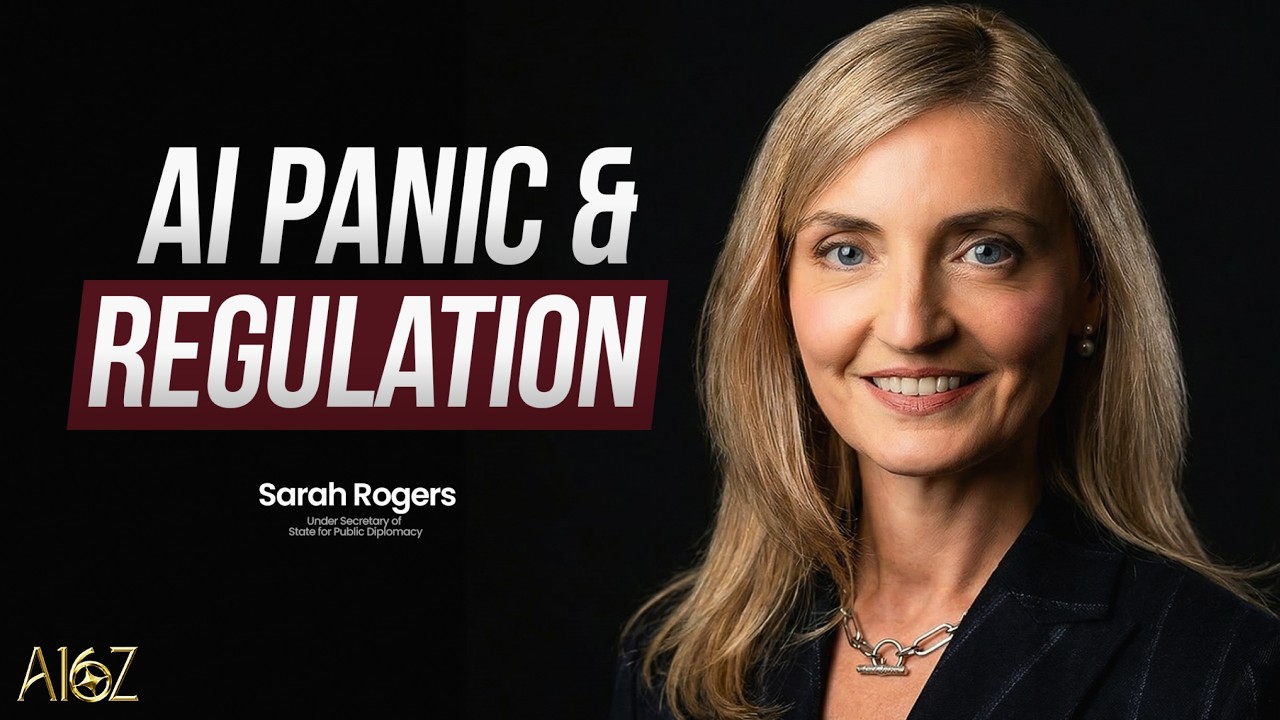
Public Diplomacy in the Information Age
Public diplomacy, as distinct from traditional diplomacy between governments, is the relationship between the American government and foreign publics. This includes educational and cultural exchanges like the Fulbright program, but increasingly involves engaging with the global information environment.
Under Secretary Rogers’ role now includes the Digital Freedom Office. Previously, this office was involved in efforts that led to the State Department contacting social media platforms to request the removal of content deemed disinformation. Under her tenure, the office’s mission has been reversed to focus on transparency, truth, and reconciliation regarding prior censorship, making freedom of expression a primary goal of public diplomacy.
The Evolution of Internet Freedom
The U.S. government’s stance on internet freedom has evolved significantly. During the Arab Spring, the foreign policy establishment was enthusiastic about the internet’s power to disintermediate communication and challenge authoritarian regimes. However, following events like the 2016 U.S. election and Brexit, anxieties about domestic populism grew. This led to a shift where many government initiatives pivoted from promoting internet freedom to “disinformation curation” and suppressing “adverse narratives.”
This reaction is a common historical pattern whenever a new technology revolutionizes communication, from the printing press to the telegraph. There is a natural urge for legacy institutions to control the new technology. The current administration’s position is that restricting technology is inconsistent with American values; instead, it should be used to “make people free.”
The Threat of Foreign Regulation to Free Speech
While authoritarian regimes like Russia and China simply firewall their internet, a more insidious threat to free speech comes from regulations in allied nations, particularly the European Union. These regulations are often applied extraterritorially, affecting American companies and users.
A key example was a letter from European Commission official Thierry Breton to Elon Musk in August 2024. The letter threatened regulatory penalties if X hosted an upcoming interview with Donald Trump, even before the interview occurred. It also linked this to a separate, ongoing investigation into X’s compliance with other regulations, creating a chilling effect.
“The kind of viewpoint skewed enforcement of ostensibly content-neutral regulations is both insidious and it’s inevitable when you have something that’s this politically pitched.”
These laws, which can make it illegal to insult a politician (Germany) or blaspheme (as argued by some UK prosecutors), are being transposed onto the transnational internet. American companies face fines of up to 6% of their global revenue for transgressing them, forcing a critical international conversation about the future of online expression.
The Imperative for “AI with a Western Soul”
The proliferation of AI is a pivotal moment for technology and national security, akin to the Project Maven moment that linked tech innovation with defense. The concept of “AI with a Western soul,” a term coined by economist Tyler Cowen, is the greatest soft power tool the U.S. can possess. This means developing AI that reasons in an individualistic, rules-based way and prioritizes principles like user consent.
“The proliferation of a western AI stack should be a top priority for anyone who cares about freedom.”
This “Western soul” is crucial because AI will become the underlying reasoning model for a significant portion of the world’s communication and commerce. Ensuring it is built on a foundation of liberty is a top national security priority.
Navigating the AI Regulatory Landscape
Several troubling regulatory trends are emerging globally that could stifle AI innovation and compromise security:
- Copyright: While U.S. courts have largely upheld the training of AI models on copyrighted data as “fair use,” other jurisdictions like the EU are considering more restrictive approaches that could be devastating to LLM development.
- Forced Transparency: Regulations demanding transparency could force companies to disclose proprietary information, such as model weights, which would compromise the American competitive edge by allowing foreign adversaries to reverse-engineer the technology.
- Content Liability: Vague and sweeping regulations, like those in Europe that mandate “risk assessments” for “hate speech” or content that could harm “civil discourse,” are being considered for AI. Draft legislation has proposed strict criminal liability if an LLM is even capable of generating certain types of content, degrading the protections similar to those provided by CDA 230 and creating a chilling effect on creative model training.
Rule of Law and Fostering Free Speech
Critical debates about AI’s application in national security—such as its use in autonomous weapons—must not be decided by the “fiat of Silicon Valley executives or tech workers.” Instead, these decisions should be made through established democratic and legal processes, such as courts and legislatures, which have served the U.S. for centuries. The rule of law must be the touchstone for navigating these complex issues.
To encourage the private sector to protect free speech, the U.S. government can:
- Avoid Creating “Regulatory Cudgels”: Government should foster a crisp, principled regulatory environment where compliance rules are clear, rather than creating vague regulations that can be wielded in a capricious or viewpoint-discriminatory manner.
- Favor Viewpoint Neutrality: Any regulation of tech should be designed to favor viewpoint neutrality, a core concept from First Amendment law. This doesn’t prevent companies from offering users tools to curate their experience based on non-viewpoint criteria, such as filtering spam, pornography, or content with foreign provenance.
- Defend American Companies: The U.S. government must stand up for its companies when they are threatened by foreign governments for protecting American political freedoms. Just as the French government would defend its companies, the U.S. must send clear signals that it will not tolerate foreign censorship of American platforms.