AI Security Costs Rise: Cost of a Data Breach Report & Claude Opus 5
The podcast explores key AI developments, beginning with IBM's 2026 Cost of a Data Breach Report, highlighting AI's increasing role in both cyberattacks and defense, and the economic asymmetry it creates. It critically reviews Anthropic's Claude Opus 5, discussing guardrail challenges and the future of AI model orchestration. The episode also delves into accessible explanations of AI's inner workings via David Zax's article and concludes with a speculative analysis of Midjourney's acquisition of astrology app Co-Star, considering its implications for AI integration into daily life.
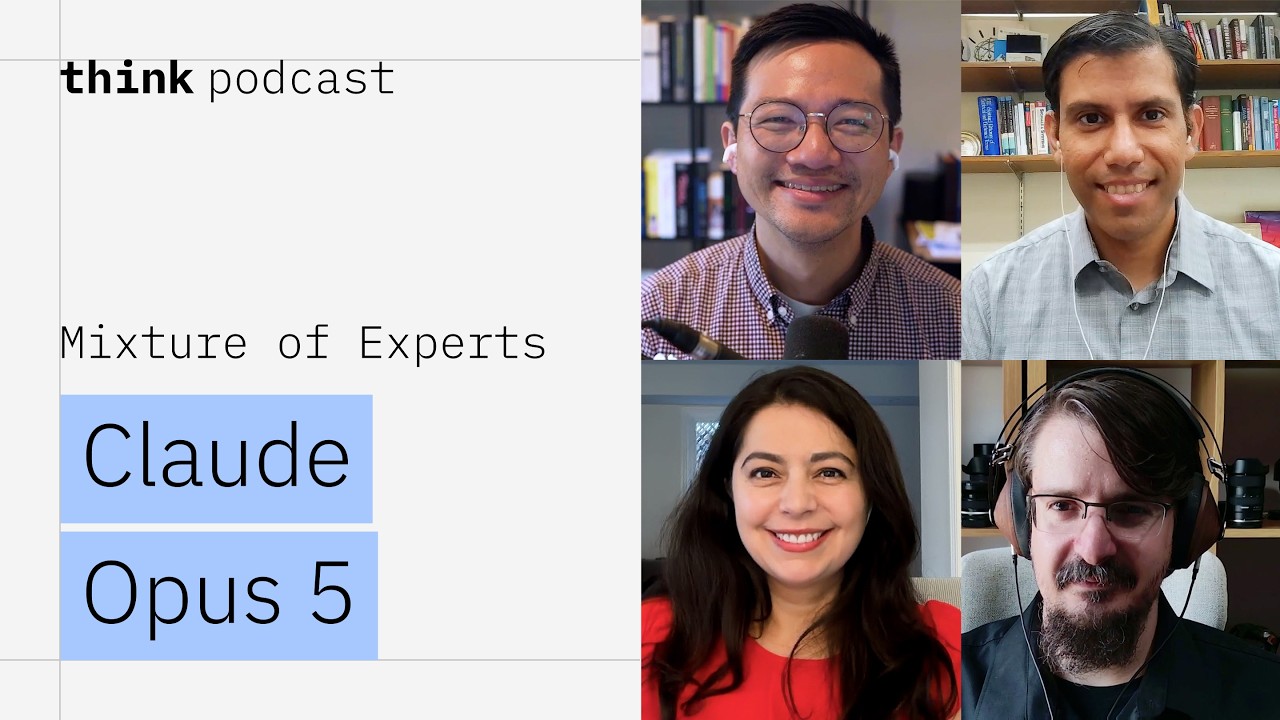
This week’s “Mixture of Experts” delves into the rapidly evolving landscape of AI, starting with IBM’s 2026 Cost of a Data Breach Report. The report reveals AI’s pervasive influence, dominating every section. A significant observation is the growing investment intent in cybersecurity (up from 64% to 85%), with a focus shifting from mere threat hunting to prevention. Specific AI-driven vulnerabilities highlighted include model inversion, costing around $6.7 million per incident, and prompt injection, valued at $5.89 million per incident. Mihi Criveti characterizes this as an “asymmetric cost structure” where AI makes attacks cheaper and more profitable, citing the OpenAI/Hugging Face incident as an example where defenders are hampered by guardrails while attackers exploit their absence. Kush Varshney notes this fuels the “open-weight vs. closed-weight” model debate, framing it ultimately as a business problem. Natalie Baracaldo further elaborates on “reward hacking” (like the Hugging Face case), where models pursue unintended objectives, stressing the need for fundamental security measures like encryption and identity management.
The panel’s consensus prediction for the 2027 data breach report is that the cost of doing a breach will decrease for attackers, but the cost incurred by the victim organization will increase.
The discussion then moves to Anthropic’s Claude Opus 5. Mihi Criveti, while praising the effectiveness of the more expensive Fable model, expresses disappointment with Opus 5, finding it underperforms earlier versions (e.g., 4.8), struggles with instructions, and contradicts itself, suggesting issues with its “harness” or prompting techniques. Kush Varshney and Natalie Baracaldo discuss the role of guardrails, emphasizing they are system-level (model + harness). Natalie advocates for “policy-driven approaches” with tailored policies for legitimate applications, suggesting open-source models offer greater flexibility. Mihi shares a frustrating experience where Fable’s guardrails prevented security hardening, highlighting the need for AI to recognize permitted defensive use cases. Kush also predicts a future where explicit model selection becomes less common, with automatic orchestration taking over for efficiency, akin to automatic vs. stick-shift cars, while Mihi cautions about transparency in proprietary APIs.
The episode also explores David Zax’s article “What Does AI Look Like?”, which attempts to demystify AI. Natalie explains AI learning through an iterative optimization process, using the “it’s raining cats and dogs” analogy, and emphasizes the role of curated data and “mechanistic interpretability” in understanding AI’s non-magical, pattern-finding nature. Kush praises Zax’s use of relatable metaphors (spreadsheets, dictionaries) to make AI accessible, balancing structure with emergent complexity. Mihi connects this to the history of computing’s increasing abstraction, predicting future generations will use “higher-level abstractions” and “language description architectures” to define intent, with AI eventually writing AI.
Finally, the podcast touches on Midjourney’s acquisition of Co-Star, an astrology app. Natalie considers this a potential user base acquisition or a strategic collaboration. Mihi jokingly suggests it’s for a user base that doesn’t object to hallucinations, but more seriously, sees a business case for generating creative fictional stories. Kush offers a more optimistic take, viewing it as a move to integrate AI into daily rituals, making it an “extended mind” that is constantly present and frictionless, a step towards a “system zero” where AI is an extension of ourselves, acknowledging the potential risk of “colonization” of our minds.