Microsoft’s new AI models & bots dominate the internet
This episode explores how AI agents now dominate web traffic, the implications for content and advertising, Microsoft's new foundation models (MAI-Thinking-1 and MAI-Image-1) focusing on safety and cost efficiency, and the emergence of AI-generated films at the Tribeca Film Festival, debating AI's role as a creative tool and its impact on the future of art.
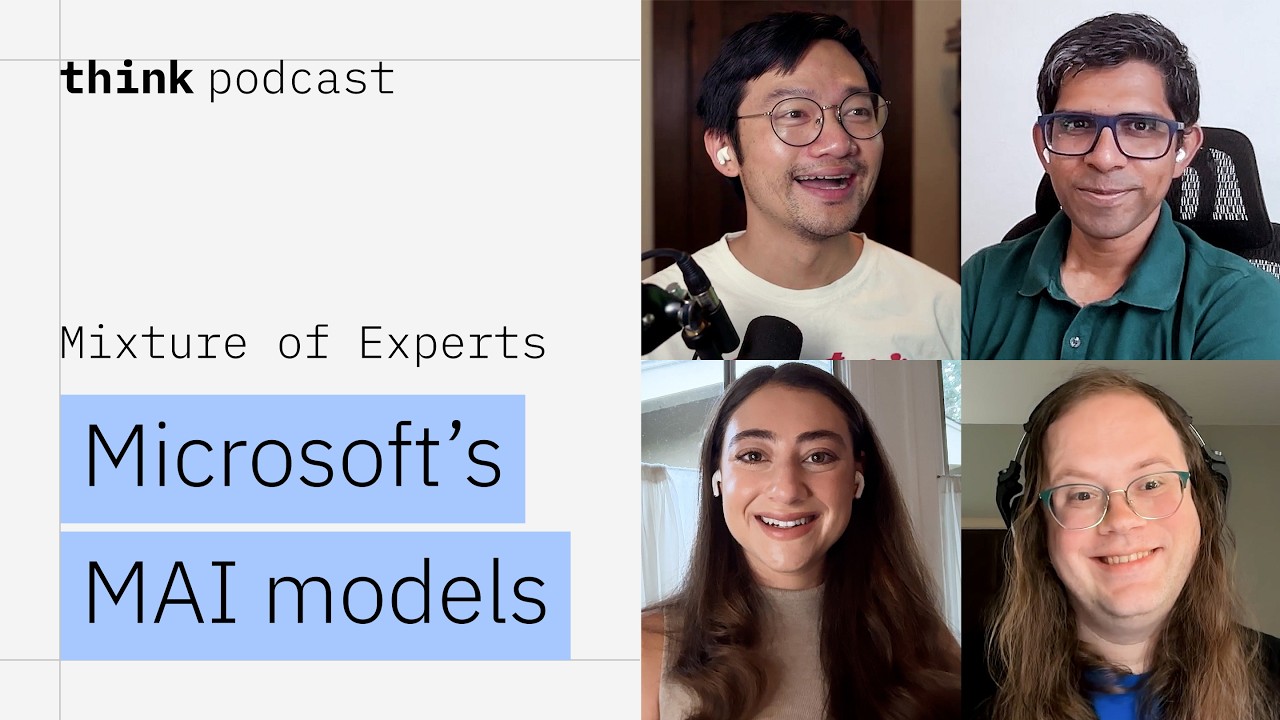
This episode of Mixture of Experts, featuring Tim Hwang, Ambi Ganesan, Sandy Besen, and Ren Whitnah, delves into three significant developments in the AI landscape:
AI Agents and Web Traffic Dominance
The discussion kicks off with a Cloudflare study revealing that agentic AI bots now generate 57.4% of web requests globally, with humans accounting for 42.6%. The experts dissect whether this is a fundamental shift or an evolution of existing internet dynamics.
- Ren Whitnah contextualizes this, noting that bots (like web scrapers and search engine indexers) have long outnumbered humans. The new factor is the rise of “agentic AI bots” performing complex research tasks, which changes how users interact with information (e.g., receiving summaries from AI agents rather than visiting sites directly). He views this as an evolution rather than a “seismic shift.”
- Sandy Besen concurs on the shifting user experience (UX). She explains that while traditional web scraping was human-initiated, modern AI agents conduct multi-faceted searches across many sites. She highlights the emergence of
.LLM.extfiles, allowing LLMs to directly consume content without parsing HTML, signaling an adaptation of web design for AI. Sandy questions if this is inherently negative, positing that human communication will simply evolve. - Ambi Ganesan categorizes the impact into two areas: serving information (the current trend) and future “agentic e-commerce” (where agents perform tasks like shopping). He emphasizes that the current bot dominance is largely within information serving. The most immediate and profound commercial impact, he argues, will be on the ad ecosystem. Ambi notes the lack of clear answers on how this “very fast evolving situation” will reshape advertising.
- Whitnah further elaborates on the funding models for content creators (e.g., news and journalism) that rely heavily on advertising. He raises the critical, unresolved question of how agents will compensate the sources of the content they consume.
- Besen contemplates the future of information access and advertising across “AI-native browsers” versus the traditional web, pondering if these paradigms will converge or remain distinct.
Microsoft’s Strategic AI Model Releases
The panel then turns to Microsoft’s significant entry into the foundation model space, announcing MAI-Thinking-1 (a trillion-parameter Mixture of Experts model, activating 35 billion parameters per task) and MAI-Image-1 (an image generation model).
- Sandy Besen suggests Microsoft is strategically targeting a market segment focused on safety, regulation, and clean, licensed data. This approach, she argues, provides an “extra safeguard” against legal liabilities (e.g., copyright issues) particularly appealing to highly regulated or litigious industries.
- Ren Whitnah clarifies MAI-Thinking-1’s MoE architecture, noting its substantial size. He points out that Microsoft’s move reflects its evolving relationship with OpenAI, necessitating its own proprietary models. Whitnah stresses the importance of indemnification and clean data lineage, stating that it’s “great to see more people actually leaning into this idea of clean data going into these models… people who generated that data got paid.” He deems MAI-Thinking-1 a “frontier-ish” model and an “interesting experiment” balancing safety with performance. The discussion also touches on cost optimization, contrasting the strategy of initially using cheaper models versus a “one-shot” approach with more expensive, capable models.
- Ambi Ganesan welcomes the increased choice, which he believes will lead to commoditization and ultimately lower costs across the ecosystem. While MAI-Thinking-1 may be “9 months to a year probably behind” the absolute state-of-the-art, it is “still pretty good for an overwhelming majority of the tasks.” He highlights the growing importance of cost economics and model routing, where tasks are directed to models of appropriate capability and cost. Ambi emphasizes that “cost is on the top of minds of a lot of enterprises” due to issues like budget overruns from token consumption.
- The experts differentiate between a small segment of the market where “cost is no object” and the “vast median” of cost-conscious customers. Ren Whitnah introduces another lever for market success: minimizing human adaptation to new workflows, echoing the software development principle that a programmer’s time is more expensive than a computer’s. This implies prioritizing ease of use for engineers.
- Ambi Ganesan reinforces that cost is a universal concern for major enterprises. He sees Microsoft’s strategy as a “cost and safety equation,” offering “almost frontier capability” with guaranteed clean lineage and competitive pricing, aiming for a “sweet spot” in the market.
AI in Filmmaking at Tribeca Film Festival
The conversation shifts to the Tribeca Film Festival, where AI-generated films debuted, challenging the prevalent “AI slop” reputation of short-form video.
- Sandy Besen foresees the eventual creation of separate categories for AI films at festivals. She points out that AI (e.g., CGI) is already an integral part of modern filmmaking. Besen distinguishes between AI as a “developer tool” to refine human artistry and purely prompt-driven generation, advocating for a “mixture of experts” approach where AI assists creative endeavors.
- Ren Whitnah draws a parallel to the “rising levels of abstraction” in software development, applying it to artistic creation. He acknowledges the significant “backlash” against AI-generated art. Whitnah questions whether AI filmmaking represents the “same art form” or a “new class of experience,” using the analogy of a DJ leveraging AI without replacing the human element, retaining the “art form of DJing” with its improvisational aspects.
- Ambi Ganesan posits that both new art forms and an evolution of existing art forms will emerge. He suggests new forms could combine “AI generated video form plus world models plus maybe… the metaverse,” drawing comparisons to how surrealism emerged with the advent of cameras. The “zany” early examples from tools like Sora, he notes, might be precursors to these new art forms. Ganesan also highlights the acceleration of existing filmmaking workflows, where directors can rapidly translate ideas into “tangible output,” still requiring human “craft” for storytelling and polish.
- Ren Whitnah extends the software development analogy further: AI compresses the “build phase” (execution), but without adequate planning and alignment (between human creators and AI agents), the “review phase” can become “most infuriating.” He emphasizes the necessity of a “shared understanding” of the artistic vision early in the process to mitigate later complications.