[404] – Developer Not Found: The Continuing Developer Evolution • Derek Bingham • YOW! 2025
Derek Bingham explores the rapid evolution of developer tools with AI, from coding assistants to autonomous agents. He emphasizes the shift from prompt engineering to context engineering, introduces Spec-Driven Development (SDD) as a framework for quality AI-generated code, and dispels fears about AI replacing developers, arguing instead for increased demand and the necessity of new skills like ethical and systems thinking.
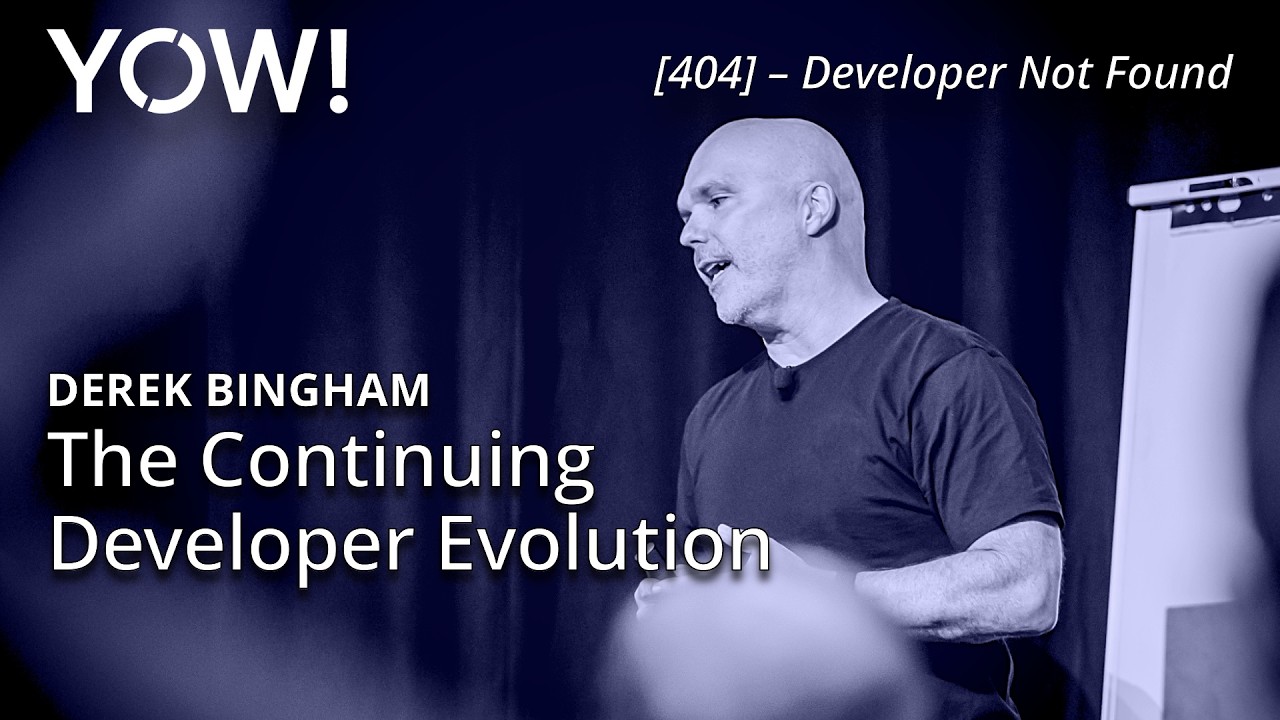
Derek Bingham’s presentation at YOW! Australia 2025, “Developer Not Found: The Continued Developer Evolution,” addresses the profound transformation in the developer landscape driven by AI. Bingham, a Senior Developer Advocate at AWS, shares his 18-month journey of navigating this change, emphasizing that while developers have traditionally been disruptors, they are now being disrupted.
The Rapid Evolution of Developer Tools
Bingham recounts his early days of software craftsmanship, using tools like Vim to write Java code, highlighting a period of slow evolution from basic UI craftsmanship to IDEs with syntax highlighting. However, the last 18 months have seen an unprecedented acceleration in tool development, moving from simple AI-assisted coding to multi-agent code generators. This rapid shift, initially in CLI form, demands a new understanding of how these tools function.
Understanding AI Agents and Context Engineering
At the core of these new tools are AI agents. Bingham defines an agent as a system that takes a prompt (task), processes it through an “Agenty framework” with access to an LLM, uses “chain of thought reasoning” to satisfy the task, and utilizes built-in tools to return a response. The agent’s capabilities can be extended via MCP (Multi-Agent Communication Protocol) if more tools are needed.
Crucially, Bingham distinguishes between prompt engineering and context engineering. While prompt engineering was initially hyped, he argues that context engineering is the real key to achieving better outcomes from AI agents. He illustrates this with a graph showing that code quality peaks at an optimal “context size” within the LLM. Beyond this sweet spot, “context creep” leads to a decline in code quality. To manage this, he provides “Context Management 101” rules:
- Be ruthless with chats: Treat each chat window as a point in time; if an agent’s output goes awry, close the chat to reset the context.
- Always use chunking: Break down problems into smaller, focused tasks to avoid “boiling the ocean.”
- System/project prompts: Utilize these for common, recurring requirements (e.g., specific framework versions).
- Ask to summarize: When an agent’s output diverges, ask it to summarize its current understanding of the task. Copy the summary, close the chat, and paste it into a new one to reset context.
- MCP (Multi-Agent Communication Protocol): Be aware of “dragons” related to security and the potential for MCP servers to quickly fill up the context window.
- Monitor your context window: Always be aware of the context size your agent and model are utilizing.
Dispelling “False Fears” and the Rise of Spec-Driven Development
Bingham directly addresses common fears surrounding AI in development:
- “AI will replace developers.”: He debunks this using the Dunning-Kruger effect, noting that AI agents often provide incorrect outputs that require human correction, demonstrating human expertise. He warns against the “lazy developer” paradox, where over-reliance on AI without critical review can lead to disastrous outcomes (e.g., an AI mistaking aluminum smelters for cookie machines when assessing risks).
- “AI-generated code is inferior.”: He counters that code quality is directly tied to the context provided. Without proper context, AI will generate nonsense.
- “Learning to code is pointless.”: Bingham invokes Jevons Paradox, where increased efficiency (via AI) leads to increased demand. AI will make developers more efficient, but this will simply create more opportunities and a greater need for developers to build the new things now made possible.
To ensure AI-generated code is high quality, Bingham introduces Spec-Driven Development (SDD). This methodology involves defining clear features, languages, and architectures upfront, giving the AI agent the best chance for a correct outcome. The SDD process entails:
- Generate requirements: Starting with EARS (Easy Requirements Syntax) format.
- Iterate and review requirements: Collaborating with the agent to refine requirements.
- Generate design: Working with the agent to create a design document.
- Generate tasks: Breaking down the design into discrete tasks. Each task is then executed with a fresh context window, reading in relevant specification and design files. Bingham highlights Kiro as an example of an IDE incorporating SDD principles with specs, steering files, and MCP integration.
Opportunities, Challenges, and Future Skills
Bingham outlines a five-step process for efficient AI-assisted development:
- Plan: Utilize SDD or prompt-driven development, with constant review.
- Implement: AI excels at boilerplate, but core business logic should be self-written or reviewed intensely.
- Cleanup: AI is excellent for formatting, refactoring, and finding duplicates.
- Iterate: Be aware that tools and models are constantly evolving.
The advent of AI also brings new challenges and demands new skills. Developers must shift from simply can we build it? to should we build it?, considering ethical implications and environmental costs (heat, water usage). Necessary skills include:
- Ethics: Understanding the broader impact of AI development.
- Systems thinking: Focusing on high-level architectural design.
- Problem formulation: Clearly defining problems for AI agents.
- Collaboration: Working effectively with AI and human teams.
Bingham concludes by emphasizing that junior developers are not obsolete, quoting AWS CEO Matt Garman and Kent Beck. He likens this era to the mainframe developers of the past who, despite new technologies, thrived because they understood the underlying fundamentals. Humans are extraordinary, and machines only do what they are told. Therefore, it’s up to developers to tell AI the right things, verify its outputs, and build innovative solutions.