The Four Types of Memory Every AI Agent Needs
AI agents utilize four distinct types of memory, analogous to human cognition, to move beyond simple chatbot responses. This summary explores the CoALA framework, detailing working, semantic, procedural, and episodic memory and how they enable agents to learn, recall skills, and leverage past experiences.
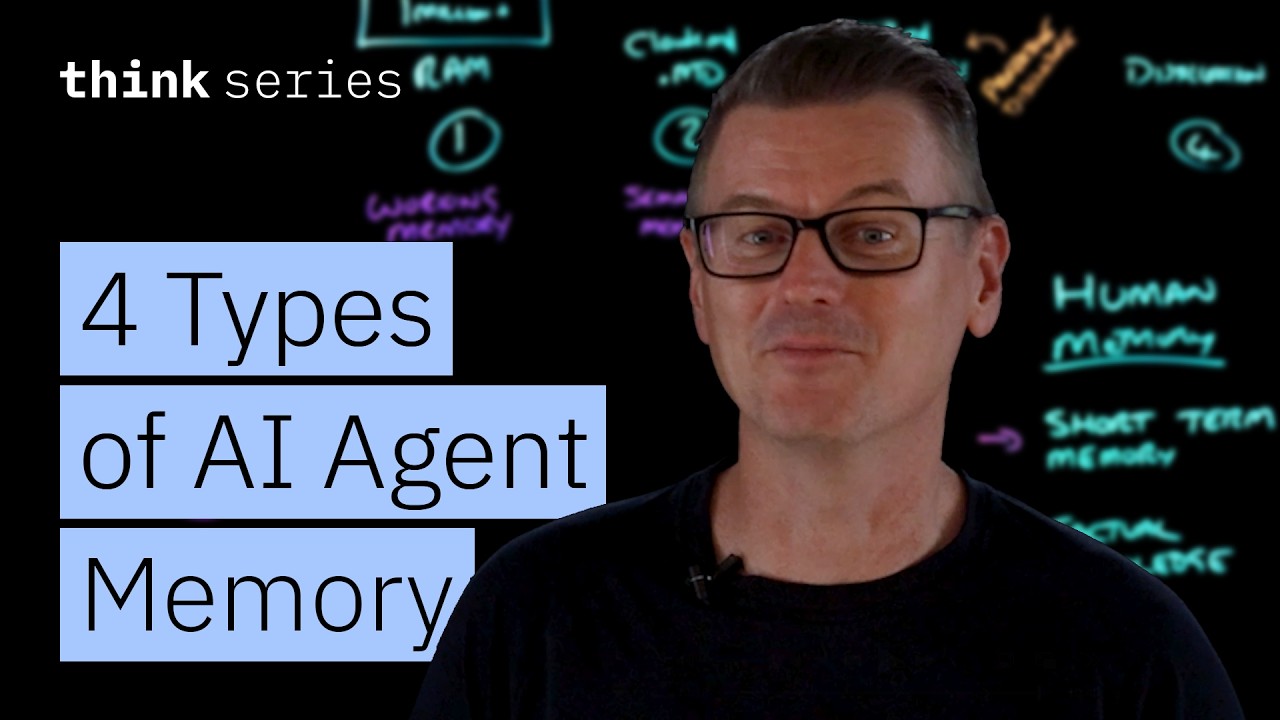
AI agents, much like humans, possess different memory systems for various purposes. While a simple chatbot relies on a single form of memory, a well-designed AI agent leverages a multi-layered memory architecture. This concept is formalized in the CoALA (Cognitive Architectures for Language Agents) framework developed by a Princeton research team, which maps out four distinct types of memory that are crucial for sophisticated agentic systems.
1. Working Memory: The Context Window
Working memory is the agent’s short-term memory, directly analogous to a computer’s RAM. It represents everything the agent is actively aware of at a given moment.
- Content: It includes the current conversation, system instructions, and any data or files loaded into the prompt. It’s the agent’s immediate “scratch pad.”
- Characteristics: This memory is fast and instantly accessible but is also volatile—it disappears when the session ends.
- Limitations: Working memory is finite. Even with modern context windows reaching a million tokens or more, there is a ceiling. Overloading the context window can degrade performance, as the model may lose track of information “buried in the middle.” Every agent and chatbot has working memory, but it’s the other memory types that enable more advanced capabilities.
2. Semantic Memory: The Knowledge Base
Semantic memory provides the agent with a persistent, long-term knowledge base of facts, rules, and documentation.
- Purpose: It stores general knowledge the agent needs to perform its tasks consistently, such as company security policies or project-specific coding conventions. This prevents the agent from repeating the same mistakes.
- Implementation: While academic literature often discusses vector databases or knowledge graphs, many production systems use a simpler approach: Markdown files.
- Example: A coding agent might use a
claude.mdfile in the project root. This file contains the project architecture, build commands, frameworks to use, and things to avoid. This file is loaded into the working memory at the start of each session, ensuring the agent always has the foundational knowledge it needs.
3. Procedural Memory: The Skill Set
Procedural memory is the agent’s knowledge of how to do things. It’s a library of learned skills it can execute.
- Standard: An open standard called agent skills uses a
skill.mdfile format. A skill is a folder containing a Markdown file that describes the skill and provides step-by-step instructions for its execution (e.g., creating a PowerPoint presentation or running a code review). - Progressive Disclosure: To manage the working memory budget, agents don’t load all skills at once. Instead, the agent sees a lightweight index with just the name and description of each skill. When a task matches a skill’s description, the agent loads the full instructions into its working memory. Additional resources like templates or scripts are only pulled in when required during execution. This on-demand loading mechanism is a key difference from semantic memory, where knowledge is always present in the context.
4. Episodic Memory: The Learned Experience
Episodic memory is the agent’s record of past interactions, decisions, and the lessons learned from them. This is where memory begins to resemble genuine learning.
- Function: Instead of naively saving full conversation transcripts, effective systems distill or compress experiences. The agent decides what information is worth remembering based on its potential utility in future conversations.
- Example: A useful piece of episodic memory would be a distilled note like, “Last time we debugged the auth module, the issue was in the middleware layer,” which is far more valuable than a full 45-minute debugging transcript.
- Challenges: This is the most difficult type of memory to implement correctly. A key engineering problem is “forgetting”—determining when information becomes obsolete and should be deleted.
Memory Architecture in Practice
Not all agents require all four memory types. The complexity of the agent determines its memory needs:
- A simple reflex agent (e.g., a thermostat) might only need working memory.
- A narrowly focused support agent (e.g., for password resets) would need working memory and procedural memory (the password reset skill).
- A sophisticated coding agent requires all four: working memory for the immediate task, semantic memory for project knowledge, procedural memory for coding skills, and episodic memory to learn from past debugging sessions.
Ultimately, this layered memory architecture is what elevates a chatbot to an agent. It allows the system to provide responses shaped by persistent knowledge and accumulated experience, ensuring it doesn’t repeat mistakes—a lesson the author learned after “three hours debugging a Kubernetes cluster only to discover… I was pointing at the wrong cluster the entire time.”