Why Agentic AI Fails: Infinite Loops, Planning Errors, and More
Agentic AI failures are often predictable system design flaws, not random hallucinations. This summary explores the top three failure modes—infinite loops, hallucinated planning, and unsafe tool use—and provides practical strategies for designing more reliable and robust AI agents.
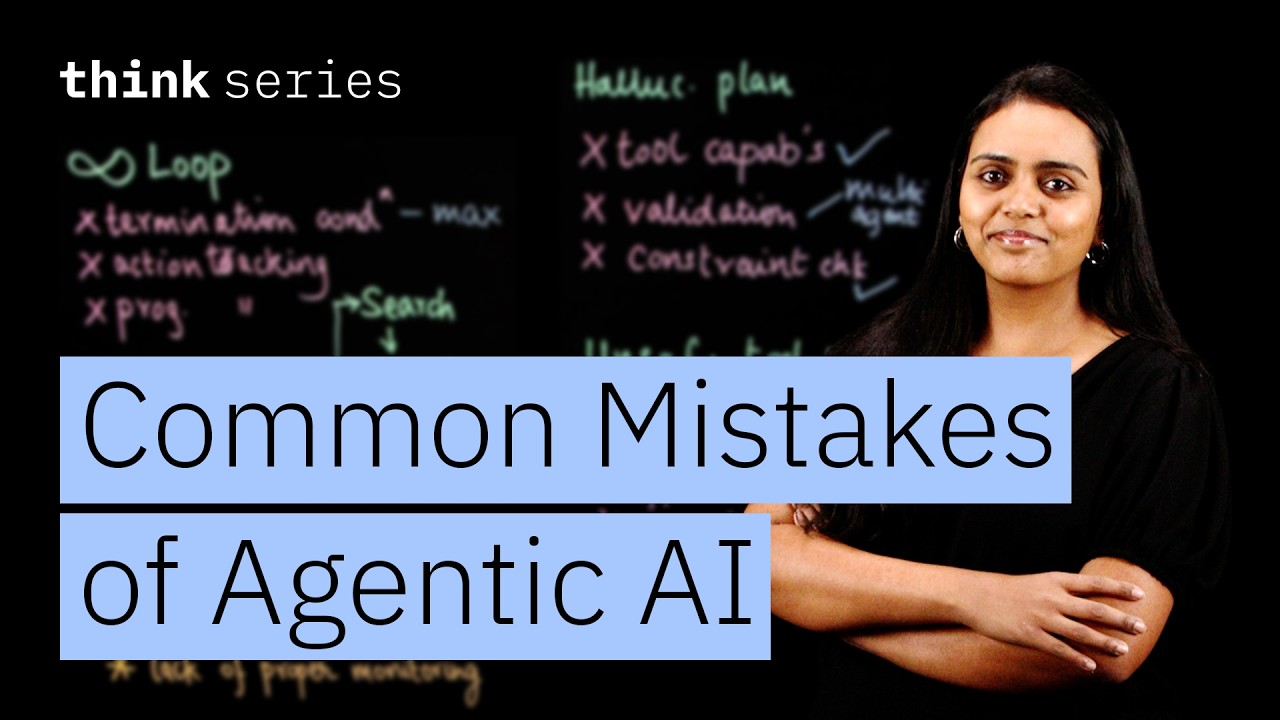
While it’s common to attribute Agentic AI failures to model hallucinations, the reality is that flaws in system design are more often the culprit. Unlike simple chatbots, agentic systems are complex, cyclical, and iterative, which introduces new potential points of failure. Understanding these failure modes is key to building reliable agents.
1. Infinite Loops
An infinite loop occurs when an agent repetitively performs the same or similar tasks without making meaningful progress toward its goal. This often happens when the agent doesn’t have a clear signal to stop.
-
Example: An agent is tasked to find a document that does not exist. It will search, evaluate the vague results, re-plan its search strategy, and try again. Because the document is non-existent, the agent gets stuck in a cycle of
search -> evaluate -> re-plan -> searchwithout ever reaching a conclusion. -
Causes:
- No Termination Condition: The agent doesn’t know when to stop trying.
- No Action Tracking: The system doesn’t track if the agent’s retries are fundamentally different from previous attempts. If each search is nearly identical, no progress will be made.
- No Progress Tracking: The system fails to measure whether each retry is yielding better or different results.
-
Mitigation Strategies:
- Set Termination Conditions: Implement limits such as maximum retries, a maximum number of steps, or a runtime limit to prevent endless loops and wasted resources (compute, API costs).
- Track Actions: Compare the agent’s actions with previous ones to ensure that new attempts are significantly different and not just re-runs of a failed strategy.
- Track Progress: Monitor the outcomes of each retry to determine if the agent is getting closer to a successful result. If not, the process can be terminated.
2. Hallucinated Planning
Hallucinated planning happens when an agent devises a plan that seems plausible on the surface but is impossible to execute in reality. The agent essentially plans for capabilities it doesn’t possess.
-
Example: An agent is asked to book a flight to Milan for under $500. It creates a perfect plan: use a travel booking API, filter by price, book the flight, and send a confirmation email. However, the plan fails because the agent was never given access to a travel API or an email tool.
-
Causes:
- Poorly Defined Tools: The agent doesn’t have a clear understanding of what its available tools can and cannot do.
- No Plan Validation: The system attempts to plan and execute in a single step, without a crucial validation phase to check if the plan is feasible.
- Assuming Capabilities: The agent assumes it has certain capabilities or access to tools instead of checking its actual constraints.
-
Mitigation Strategies:
- Clearly Describe Tools: Provide detailed descriptions and schemas for all tools, explicitly defining their capabilities and limitations.
- Separate Planning and Execution: Implement a multi-agent architecture where a “verifier agent” or a “human in the loop” validates the plan before it is executed.
- Specify Constraints: Instruct the agent on what it can and cannot do, and encourage it to ask for clarification before making assumptions.
3. Unsafe Tool Use
This failure mode occurs when an agent executes an action that, while technically valid, is risky, destructive, or has unintended negative consequences.
-
Example: An agent designed to delete outdated records from a database mistakenly deletes active, important records. Another example is an agent sending automated emails with unreviewed or inappropriate content.
-
Causes:
- Overprivileged Tools: The tools given to the agent have more permissions than they need to complete their tasks (e.g., delete access when only read access is required).
- No Approval Workflow: There is no process in place, especially for high-risk actions, to get approval before execution.
- Ambiguous Access Levels: The distinction between read, write, and delete permissions for tools is not clearly defined or enforced.
-
Mitigation Strategies:
- Principle of Least Agency: Grant tools only the minimum privileges necessary for their function.
- Implement Approval Workflows: For high-risk tasks, require a review step, often with a human in the loop, before the agent can proceed.
- Tier Tool Access: Clearly separate tools based on their access levels (e.g., read-only tools vs. tools with write/delete capabilities) to prevent a tool from performing an action it shouldn’t.
Conclusion
Agentic AI failures are predictable consequences of system design, often stemming from too much autonomy, too few constraints, or inadequate monitoring. Building reliable and safe agents requires a strong foundation of engineering discipline to anticipate and mitigate these common failure modes.