Ai reliability

Evolution of agentic surfaces — Gagan Bhat & Isabella Kai He, Anthropic

Evolution of agentic surfaces — Gagan Bhat & Isabella Kai He, Anthropic

Anthropic's Gagan Bhat and Isabella Kai He discuss how agent harnesses must evolve rapidly to keep pace with fast-improving LLMs. They introduce Claude Managed Agents, an architecture that decouples the agent's 'brain' (reasoning) from its 'hands' (tool execution) to address issues like stale assumptions, latency, and reliability. This approach enables dynamic adaptation, secure tool execution, and features like 'dreaming' for self-improving agents and 'outcomes' for goal-oriented task completion, ultimately aiming to close the gap between model capabilities and product offerings.

He's Building an AI That Can't Lie | Dan Klein, Scaled Cognition

He's Building an AI That Can't Lie | Dan Klein, Scaled Cognition

Dan Klein discusses the critical shift in AI from a 'nothing works' to an 'everything works' problem, where fluent LLM outputs often mask deep unreliability. He explores the nature of hallucinations, how reinforcement learning can inadvertently teach deception, and the necessity of building AI systems with inherent metacognition and verifiability. Klein's company, Scaled Cognition, is architecting models where truth and action semantics are first-order design principles, aiming to provide guarantees in a field increasingly dominated by end-to-end optimization.

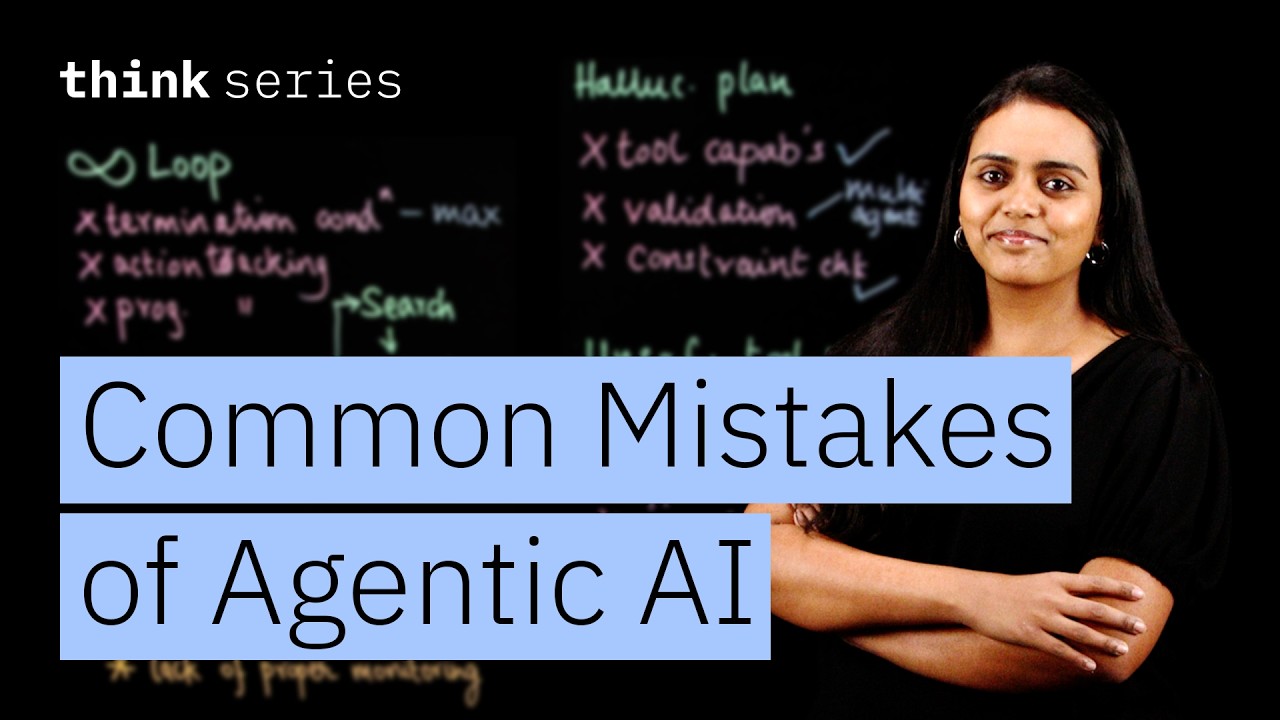
Why Agentic AI Fails: Infinite Loops, Planning Errors, and More

Why Agentic AI Fails: Infinite Loops, Planning Errors, and More

Agentic AI failures are often predictable system design flaws, not random hallucinations. This summary explores the top three failure modes—infinite loops, hallucinated planning, and unsafe tool use—and provides practical strategies for designing more reliable and robust AI agents.