How I became a StoryTeller (and how YOU can too)
Distinguished Scientist Sumit Gulwani shares his personal journey from a skeptical researcher to a passionate advocate for storytelling, revealing how narratives built on human connection are more powerful than statistics. He breaks down the science behind why stories work and provides a toolkit of practical techniques—from crafting a strong start to knowing your audience—to help technical professionals transform their communication, research, and even their lives.
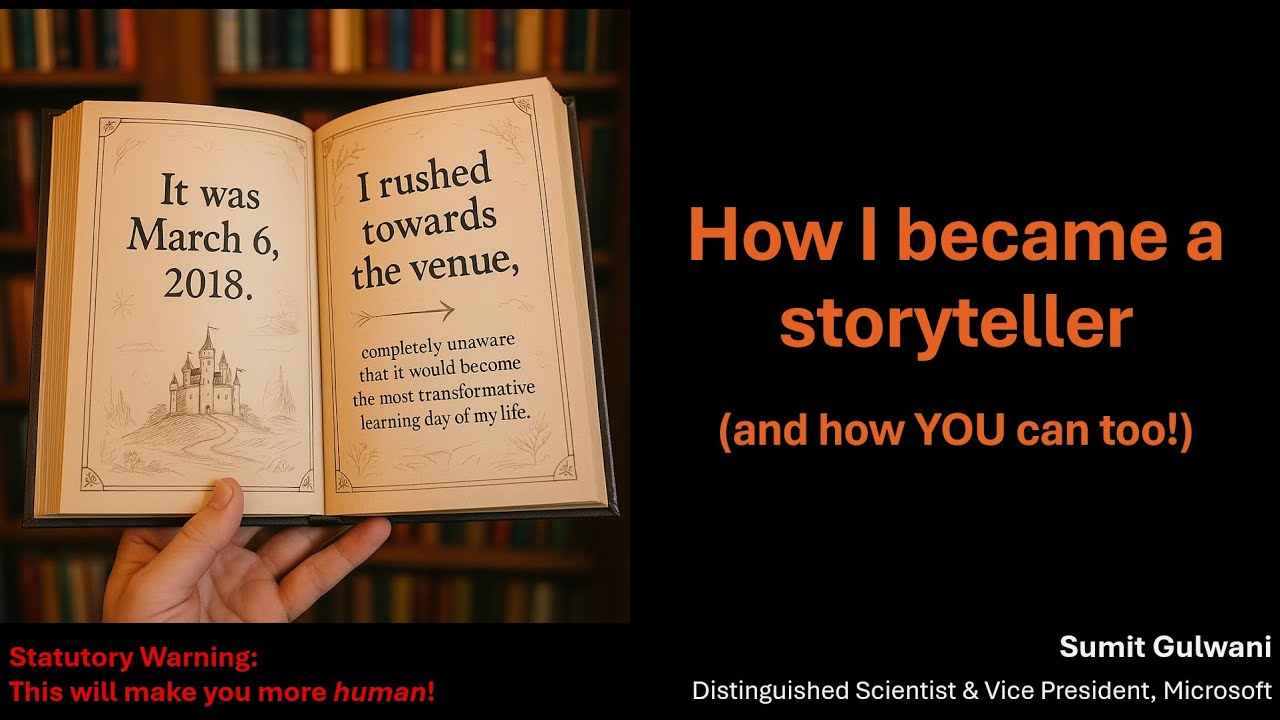
In a talk that is itself a masterclass in storytelling, Sumit Gulwani, a Distinguished Scientist at Microsoft, charts his transformation from a researcher skeptical of “soft skills” to a firm believer in the power of narrative. He argues that for technical professionals, storytelling isn’t a distraction from the data; it’s the most effective vehicle for conveying its meaning, inspiring action, and forging human connection.
The Transformation: From Skeptic to Storyteller
Gulwani begins by recounting his experience at a 2018 communication workshop he initially attended just to socialize. The workshop, led by coach Mario Juarez, fundamentally changed his perspective. The first exercise was to refine a standard, jargon-filled project pitch into a compelling two-minute story.
- Before: A typical research presentation, focused on technical details.
- After: A narrative centered on customer empathy, audience interaction, and a protagonist with a real-world problem.
This experience demonstrated that a story-based narrative is far more powerful because it reveals the why behind innovation through a human lens, making the message more memorable and influential.
Why Stories Trump Statistics: The Science of Connection
While tech professionals believe decisions are made on facts and logic, Gulwani asserts that they are primarily driven by emotional instincts.
- Memorability: Citing cognitive psychologist Jerome Bruner, he notes that a fact wrapped in a story is 22 times more likely to be remembered.
- Influence: He points to Rob Walker’s “Significant Objects” study, where 200 mundane objects purchased for ~$1 each were resold for an average of $40 after being paired with a compelling story. The story added tangible value.
- Emotional Impact: Comparing a slide of usage statistics for a Visual Studio feature to the story of a single person whose life was improved by it, he shows that data fails to move us emotionally. A story about one individual’s success is far more irresistible and impactful than a statistic about one million users.
The Angel’s Cocktail: The Neurochemistry of Narrative
Every captivating story follows a simple arc: a protagonist, a conflict, and a resolution. This structure hijacks our critical thinking by flooding the brain with a trio of powerful chemicals, which Gulwani calls the “Angel’s Cocktail.”
- Dopamine (The Reward Chemical): Released when a story builds anticipation and suspense. It makes the audience focus, pay more attention, and remember what is said.
- Oxytocin (The Love Hormone): Released when a story sparks empathy through relatable heroes or moments of vulnerability. It fosters trust and a bond between the audience and the storyteller.
- Endorphins (The Feel-Good Hormone): Released through light-hearted moments and humor. It makes the audience feel good and relaxed.
Humor is optional. But heart is non-negotiable. Whether you make someone laugh or you make them cry, it’s the genuine emotion that makes the story unforgettable.
Practical Techniques for Crafting Compelling Stories
Gulwani breaks down the art of storytelling into simple, practical techniques.
- Start Strong: You have about 10 seconds to capture an audience’s attention. Start with a powerful story, an inspiring quote, or a gripping question. This begins before the talk, with a curiosity-sparking abstract and a title slide that sets a tone with a striking visual and a “six-word story.”
- Show, Don’t Tell: Instead of boasting about Flash Fill’s success with statistics, he shows a picture of a middle-school textbook featuring the technology. A powerful dialog or a raw, emotional moment can convey more than any data point.
- Use Audience Interactivity: By playing a (harmless) prank on the audience during a talk on Program Synthesis, he made them experience the frustration of a problem, creating the perfect setup for them to care about the AI-driven solution.
- Find Your Stories: Stories are constantly flowing around you. You must “keep your antennae on” and develop an event listener for moments that are funny, meaningful, or significant. Stories also come from the past—by querying the “archived logs of our lived experiences” and connecting disparate events into a fresh narrative.
- Create Future Stories: Make intentional choices based on which path will create a better story worth sharing in the future.
Core Principles: The Giver’s Mindset and Knowing Your Audience
Two principles are paramount for effective storytelling:
- Know Your Audience: Understand their values, motivations, and worries. A story must fit its “input distribution.” A story about pitting Flash Fill against GPT-4 that resonated with researchers “misfired” with corporate executives because the angle was wrong for that audience.
- Adopt a Giver’s Mindset: Show up to share and inspire, not to seek applause. When you focus on the audience’s success, not your own, you become more likable and confident, and the audience wants to partner with you.
Storytelling as a Superpower
Stories are not just for the stage; they are a “superpower” that can transform professional and personal life.
- Leadership and Influence: Storytelling is crucial for inspiring teams and influencing stakeholders.
- Personal Growth: Life stories allow us to reframe difficult past experiences, turning bitterness into humor or gratitude.
- Deepening the Work: The act of crafting a story can lead to new insights. After creating a talk that pitted Flash Fill against GPT-4, Gulwani discovered new ideas to combine their complementary strengths.
When you tell stories with authenticity and heart, the Universe conspires to finish what you start.
The Art of Delivery
A great story requires a great delivery. The storyteller’s performance creates the experience for the audience.
- Pace and Pauses: Varying your pace increases focus, and a strategic pause commands undivided attention.
- Practice: Memorable performances require practice. Test out ideas on smaller audiences to refine punchlines and delivery, akin to reinforcement learning.
- Body Language: Movement and gestures are a powerful, primal form of communication. Stepping forward increases focus, tilting your head builds empathy, and lowering your posture builds trust.
- Props: Using physical props can create lighthearted moments, build instant rapport, and make a remote presentation feel more engaging.
Finally, Gulwani emphasizes the importance of a strong, sweet ending that circles back to the opening, delivering on the initial promise and leaving a lasting memory. He concludes by urging the audience to see themselves as storytellers, to pay attention to the kernels of stories in their daily lives, and to make choices that will create stories worth sharing.