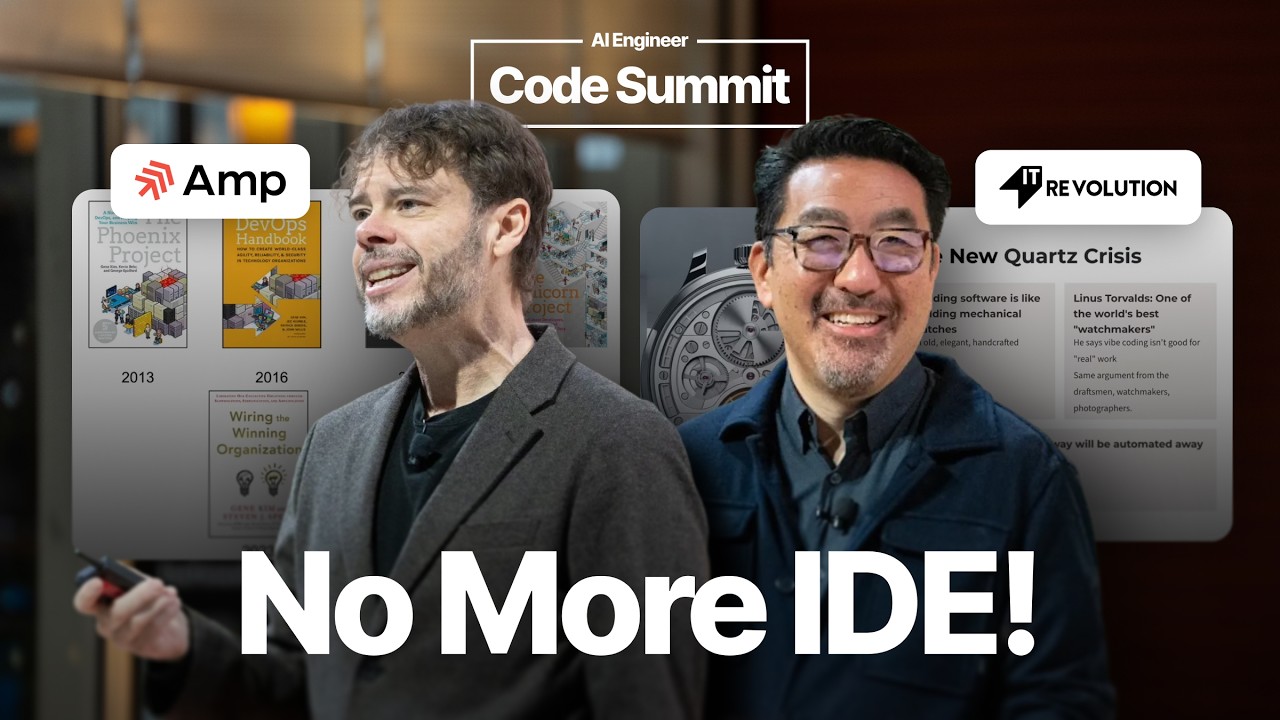
2026: The Year The IDE Died — Steve Yegge & Gene Kim, Authors, Vibe Coding
Steve Yegge and Gene Kim discuss the current limitations of AI coding assistants, predicting a shift from simple code completion "power tools" to sophisticated, agent-based "CNC machines" that will automate the entire software development lifecycle. They explore the cultural resistance from senior engineers, the transformative impact on team structures, and the emergence of "Vibe Coding" as a new paradigm that will reshape technology organizations.
The Limitations of Current AI Coding Tools
Current AI coding assistants, while powerful, are not the ultimate solution and are seeing slow adoption by developers. Steve Yegge compares them to electric drills or saws: incredibly effective for a skilled craftsman but dangerous for the untrained. They require significant cognitive overhead and are prone to “lying, cheating, and stealing,” which deters many developers, particularly senior and staff engineers.
This resistance is creating a massive productivity gap within organizations. At OpenAI, the difference in output between engineers who use AI tools and those who don’t is so staggering that it’s causing alarms during performance reviews. This mirrors the disruption of the Swiss mechanical watch industry by quartz technology, where craftsmen resisted the new, “cheap” methods until it was too late.
The fundamental flaw in today’s tools is their monolithic architecture. Yegge refers to this as building the “world’s biggest ant” instead of an “ant swarm.” Every query, whether complex or trivial, is sent to the same large, expensive model.
The Future: From Power Tools to CNC Machines for Code
The next evolution in AI-driven development will be the move from handheld “power tools” to automated “CNC machines.” Within a year or two, code will be generated by giant, grinding machine-like systems overseen by engineers who no longer inspect the code directly. The new IDE will not be a text editor but a more abstract UI focused on orchestrating these systems.
This future is built on agentic systems. Yegge introduces the “diver metaphor” to explain the problem with today’s large context windows.
Your context window is like an oxygen tank. You’re sending a diver down into your code base… and we’re like, ‘we’re going to give him a bigger tank.’ One million tokens. He’s still going to run out of oxygen… You should send a product manager diver down first and then a coding diver, and then a review diver and a test diver and a git merge diver, etc.
Instead of one giant model (a single diver with a big tank), the future lies in swarms of specialized, smaller agents performing decomposed tasks—successive refinement using components and black boxes, just as engineers have always done.
“Vibe Coding”: A New Paradigm
Gene Kim defines the emerging practice of “vibe coding,” a term coined by Anthropic CEO Dario Amodei, as “the iterative conversation that results in AI writing your code.” It represents a fundamental shift away from manually typing code in an IDE. The motivation for this shift is captured by the acronym FAFO:
- Faster: The most obvious, but also the most superficial, benefit.
- Ambitious: The impossible becomes possible as AI handles complexity, while tedious tasks become free. For example, fixing customer issues on the spot instead of adding them to a backlog.
- Alone / Autonomous: Drastically reduces coordination costs. Developers no longer need to wait for other teams; they can accomplish tasks by themselves. LLMs serve as powerful “intermediation vehicles” for coordinating with other functional specialties.
- Fun: Vibe coding is described as addictive and brings joy back to programming, especially for those who thought their best coding days were behind them.
- Optionality: The ability to conduct many more parallel experiments and take more “swings at the bat” creates immense economic value.
The Human Factor: Resistance, Adoption, and Trust
Despite the potential, there is a significant backlash against AI tools from a large portion of the developer community. Many senior engineers view the output as “slop” and resist its adoption.
However, data from the State of DevOps Research (DORA) study shows a clear trend: the longer a person uses AI tools, the more they trust them. Trust is defined as the ability to predict how the other party will act and react. Early negative conclusions are often based on just a few hours of use, but proficiency and trust are teachable skills that require practice.
Reshaping the Technology Organization
This technological shift is poised to reshape organizations on a scale 100 times larger than Agile, cloud, and CI/CD combined. Adrian Cockcroft’s concept of “NoOps” is being echoed in the new idea of “NoDev,” where designers, support staff, and leaders can ship features themselves.
Case studies highlight this transformation:
- Travelopia: A small team of two (a developer and a domain expert) can now accomplish what used to require a team of eight.
- Fidelity: A technology leader, frustrated by a five-month estimate from his team, personally vibe-coded and shipped a critical internal application in just five days. The application is now maintained by the most junior engineer on the team.
- Cisco: The SVP of security mandated that the top 100 leaders must vibe-code one feature into production within a single quarter to force an understanding of what’s now possible.
This new reality creates novel challenges, such as code velocity becoming so high that teams are forced to adopt a one-engineer-per-repo model to manage merge conflicts, indicating that the new coordination mechanisms are not yet fully understood.