AI Changed Stack Overflow for the Better
Stack Overflow CEO Prashanth Chandrashekar discusses the platform's evolution in the AI era, focusing on licensing its trusted Q&A corpus to major AI labs, expanding beyond Q&A to include discussions and live chat, and the critical role of its enterprise solution in powering internal AI agents. A key insight from their upcoming developer survey reveals that while AI adoption for coding is rising, developer trust in AI-generated output is declining, reinforcing Stack Overflow's position as a vital source of human-curated, reliable knowledge.
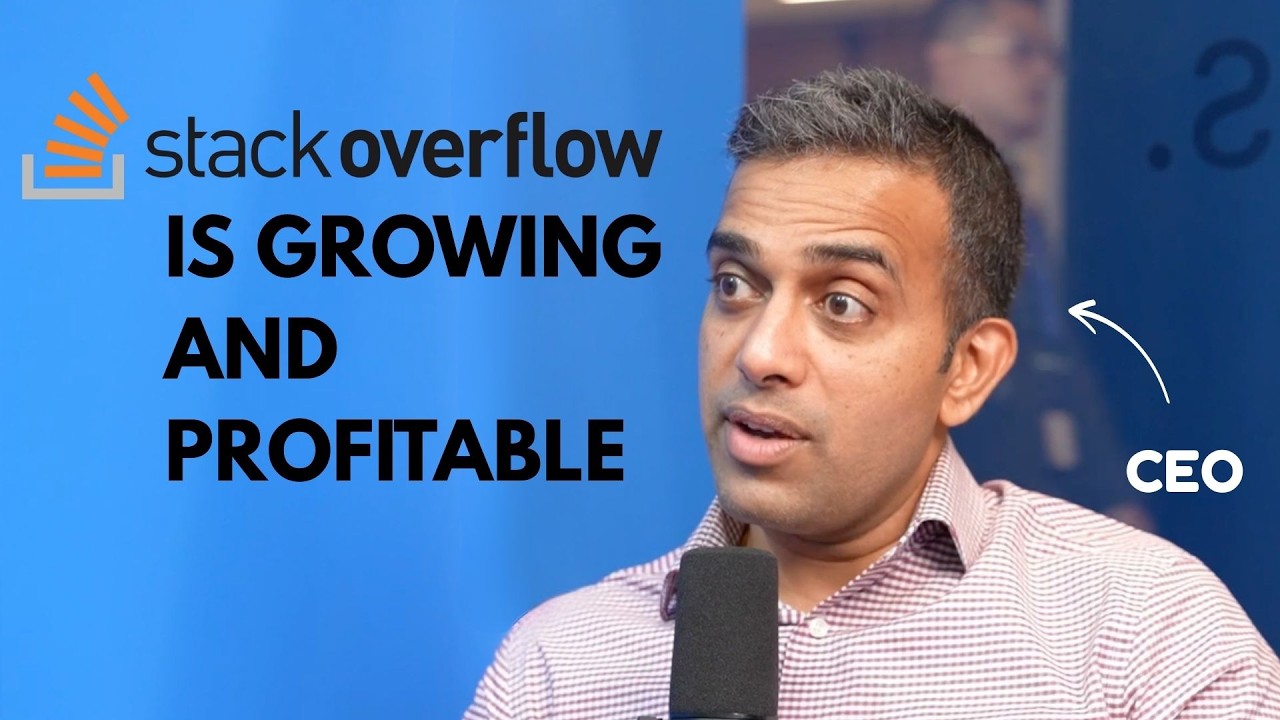
Prashanth Chandrashekar, CEO of Stack Overflow, explains that despite headlines suggesting a decline, the company is growing and profitable. The platform is strategically adapting to the new landscape shaped by generative AI, reinforcing its value as a trusted source of technical knowledge.
Powering the AI Ecosystem Through Data Licensing
A core part of Stack Overflow’s current strategy involves officially licensing its extensive and high-quality Q&A corpus to AI companies and LLM labs, including OpenAI and Google. This move was prompted by the realization that these companies were already using Stack Overflow’s data to pre-train their models.
By formalizing these relationships, Stack Overflow ensures proper attribution back to the original contributors and generates revenue to reinvest into the community and platform. The value of this data is quantifiable; internal tests showed that fine-tuning an open-source model with Stack Overflow’s data resulted in a 30-40% improvement in the accuracy of generated answers. This highlights the unique quality of the human-curated, validated knowledge base that has been built over 16 years.
The Evolving Nature of Questions and the “Complexity Cliff”
While AI tools like ChatGPT are effective at answering simple, common questions, they often hit a “complexity cliff” where they fail on more nuanced, context-specific, or novel problems. This is where Stack Overflow’s role is becoming even more critical. The platform is seeing a shift where it is the destination for these incrementally difficult questions that AI cannot yet handle.
The value of Stack Overflow lies not just in a single answer, but in the depth and variety of solutions, discussions, and evolving perspectives. An answer from six years ago might be technically correct but superseded by a more elegant, modern solution that bubbles up through community validation. This dynamic, up-to-date, and multi-faceted dialogue is something current AI models cannot replicate.
Expanding Beyond Q&A to a Multi-Dimensional Platform
Stack Overflow is consciously expanding beyond its traditional, strict Q&A format to become a more comprehensive resource for technologists. The historical mission of Q&A was to be the “library of congress for all things software programming,” which meant closing duplicate questions to maintain a canonical, pristine corpus.
Recognizing that not all technical conversations fit this format, the platform has introduced new spaces:
- Discussions: A less strict format for opinion-based questions, such as comparing tools (“What are the pros and cons of X versus Y?”), where there isn’t a single correct answer.
- Live Chat Rooms: Hundreds of chat rooms where developers can get real-time help from human experts with established reputations on the platform. This addresses the need for immediate, interactive problem-solving.
- Coding Challenges: Initiatives aimed at helping younger developers learn and build their skills, especially as AI agents begin to handle more junior-level tasks.
This expansion supports the new vision: to be “the most vital source for technologists” by cultivating community, powering learning, and unlocking career growth.
The Enterprise Solution: Powering Internal AI
A significant and growing part of the business is the enterprise version of Stack Overflow, used by thousands of companies as a private, internal knowledge base. This product solves the common problem of “knowledge sprawl,” where crucial information is scattered across Confluence, Jira, Notion, and other disparate systems, often becoming outdated.
The internal Stack Overflow instance serves as a single source of truth, curated and kept up-to-date by a company’s own subject matter experts. A key recent development is that customers are now using this trusted internal knowledge to power their own AI assistants and agents. For example, Uber’s “Uber Genie” is powered by its internal Stack Overflow, allowing it to accurately answer employee questions in Slack channels. This provides a clear ROI for AI deployments by grounding them in a secure, private, and highly accurate knowledge base.
The Paradox: AI Adoption Is Up, But Trust Is Down
A surprising and counterintuitive insight from Stack Overflow’s upcoming 2025 Developer Survey reveals a critical trend:
- AI Adoption: The use of AI tools for coding tasks has risen from ~60% to ~80% over the last three years.
- Developer Trust: However, the level of trust in the output of these AI tools has decreased significantly, from 40% two years ago to just 29% this year.
This “trust gap” highlights the growing awareness of issues like AI-generated “slop” and inaccuracies. It also shows that more experienced programmers tend to be less trusting of AI output compared to their junior counterparts. This trend validates Stack Overflow’s core mission to be the source of credible, authentic, human-curated knowledge in a world increasingly filled with AI-generated content.