No Priors Ep. 130 | With OpenEvidence Founder Daniel Nadler
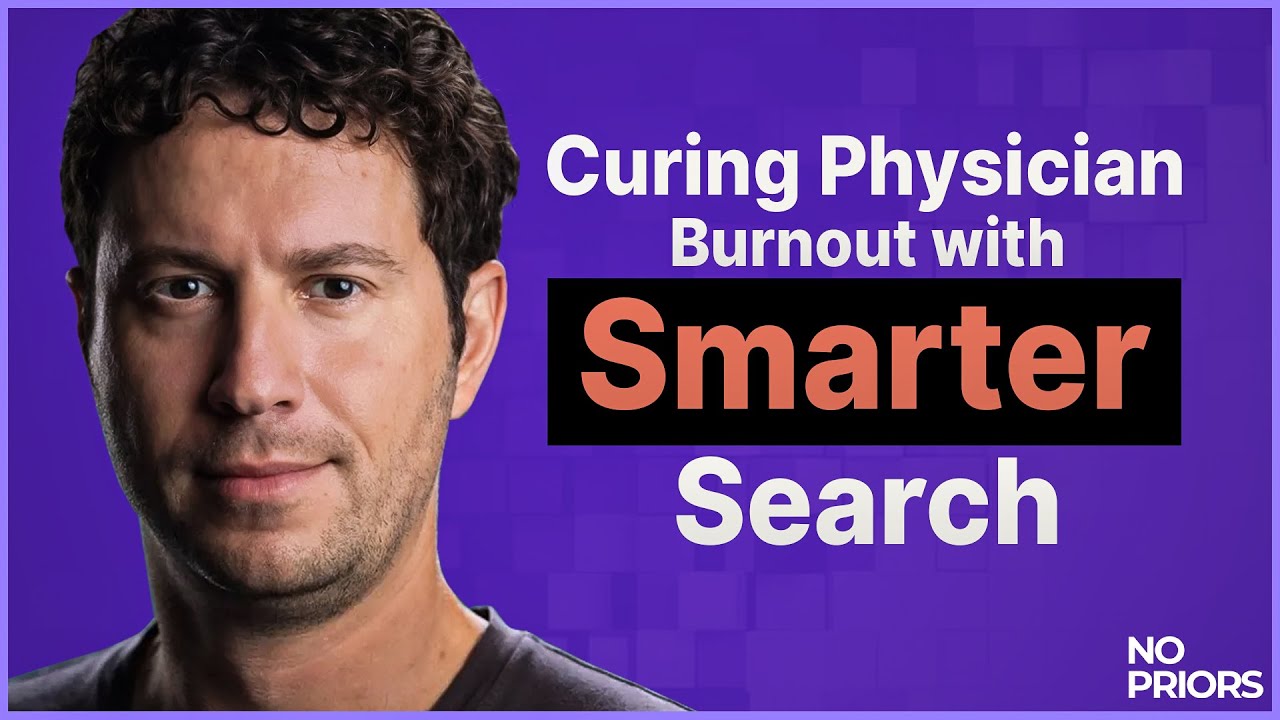
OpenEvidence founder Daniel Nadler explains how his company solved the semantic search problem in medicine, achieving 40% adoption among US doctors in 18 months. He discusses the strategy of treating physicians as consumers, the future of medical education in the age of AI, and his unique philosophy on motivation and recruiting.
The Paradox of Modern Medicine
The “golden age of biotechnology” has inadvertently created a “dark age of physician burnout.” The rate of new medical knowledge is exploding—doubling every 5 years by conservative estimates, and as frequently as every 73 days by others. This makes it impossible for physicians to keep up, leading to a situation where medical error is the third leading cause of death in the United States. OpenEvidence was created to address this fundamental challenge in high-stakes clinical decision support. In just 18 months, it has become the “operating system for clinical knowledge” in the U.S., used by 40% of American doctors.
A Semantic Search Engine for Complex Cases
At its core, OpenEvidence solves a semantic search problem, which is fundamentally different from traditional keyword-based search. A clinical query is not a few keywords, but a complex, multi-sentence patient scenario.
For example:
A 44-year-old female patient has moderate-to-severe psoriasis. The standard treatment might be a cream, but she also has Multiple Sclerosis (MS). The dermatologist, who is not a neurologist, has heard that newer psoriasis treatments (biologics like IL-17 and IL-23 inhibitors) might interact with neurological conditions. These drugs were approved after the doctor finished medical school, so their knowledge is limited. The question is: which inhibitor is safe and won’t aggravate the MS?
This entire paragraph is the search query. A traditional search engine would fail. OpenEvidence is designed to semantically understand this complex query and surface the precise snippets from the 35 million biomedical publications that provide the answer. In this case, it would find the Phase 3 Randomized Controlled Trials (RCTs) showing that IL-17 inhibitors worsen MS, while IL-23 inhibitors are safe.
Building Trust Through Citations
A key to OpenEvidence’s success was making references and citations a first-class citizen from the beginning. The platform was never presented as an “answer engine” but as a powerful search tool—a router that connects the physician’s complex question to the canonical source material, like an RCT in the New England Journal of Medicine.
This built a social contract with users, who are highly trained professionals with an MD to protect. They use the platform to interrogate and audit the source, making it a professional tool analogous to a Bloomberg Terminal for a trader.
Growth Strategy: Treating Doctors as Consumers
The company’s viral growth was driven by a novel strategy: treating knowledge workers like consumers. Historically, medical technology was sold top-down to hospital systems, treating doctors as mere appendages. OpenEvidence broke this mold.
“I wanted to do something that no one had ever done before, which is treat knowledge workers like consumers… We did something that had never been done before, ever, which is we treated them as consumers and as people that could go on to the App Store and download a free app and start using it. And it sounds so stupidly simple, but it was it was really profound and it was really effective because no one had ever done that before.”
This consumer-centric approach, recognizing that every doctor has a powerful computer in their pocket (a smartphone), bypassed traditional gatekeepers and led to hyper-compressed adoption cycles.
The Future of Medicine and Medical Education
The explosion of knowledge will radically reshape medical education. The current model of a defined period of medical school followed by minimal continuing education will invert. The majority of a doctor’s education will become continuous and lifelong. World-class physicians already report that the vast majority of what they practice was learned post-residency, sometimes even in just the last few years.
AI tools will be central to this new reality. They can serve as a “curbside consult” or a “distributed hive mind,” especially in under-resourced and rural areas. This helps bridge the knowledge and equity gap, allowing a solo oncologist in rural Georgia to access the collective expertise previously only available at top-tier academic medical centers.
While AI will augment physicians, doctors will remain in the loop for the foreseeable future. Trust is difficult to abstract; humans personify it. Just as airline passengers are not campaigning to remove pilots from cockpits—despite planes being able to land themselves for decades—patients will continue to require a human physician in their care.
A Founder’s Philosophy on Motivation and Recruiting
Success is not driven by rational ideas but by an extraordinary “will to power.” This challenges the common narrative that great companies start with a flash of insight in a coffee shop. Instead, it stems from a deeper, almost compulsive level of motivation.
-
The Source of Motivation: This drive often originates from non-rational sources, such as a lifelong quest to prove a parent, teacher, or doubter wrong. It can also be a constructive channel for innate aggression. Nadler advises against over-analyzing these origins, as “in the analysis and description of something you kill it.” You risk deactivating the very propulsion system that drives you.
-
Recruiting Philosophy: The goal is to find people who have their own powerful, internal propulsion system. The correlation between raw intelligence and output is only moderate. The key is to find exceptionally intelligent people who are also intensely driven. For these individuals, traditional management techniques for motivation and inspiration are redundant. The best approach is to hire them and “get out of their way.”