MCP vs gRPC: How AI Agents & LLMs Connect to Tools & Data
A deep dive into how AI agents connect to external tools, comparing the AI-native Model Context Protocol (MCP) with the high-performance gRPC framework. The summary explores their respective architectures, discovery mechanisms, and performance trade-offs, concluding with a vision for their complementary roles in future AI systems.
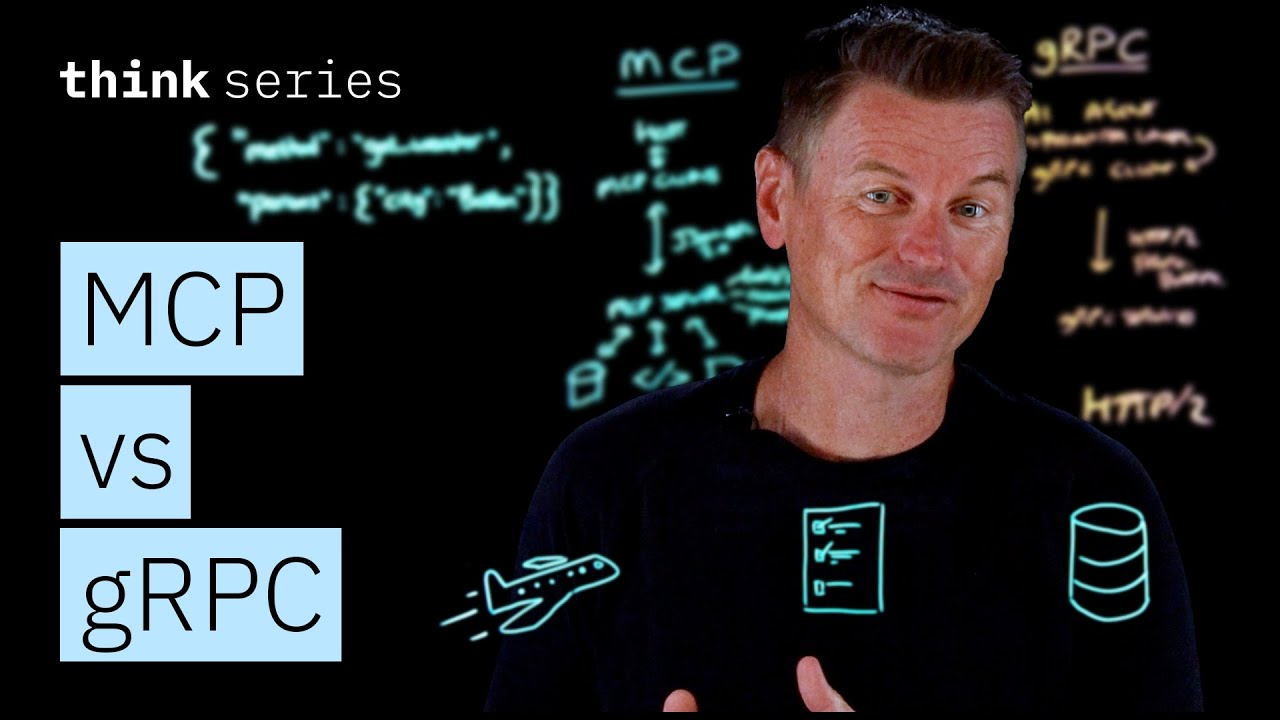
The Core Challenge: Connecting LLMs to External Systems
Large Language Models (LLMs) are constrained by their context windows and training data, which prevents them from holding vast, real-time information like customer databases or live data feeds. To overcome this, AI agents must act as orchestrators, querying external systems on demand. This introduces a fundamental problem: how can a text-based, probabilistic AI reliably communicate with deterministic external services? Two protocols offer solutions: the AI-native Model Context Protocol (MCP) and the established high-performance framework, gRPC.
MCP: The AI-Native Protocol for Discovery
MCP, introduced by Anthropic, is purpose-built for connecting LLMs to tools and data. It operates on the principle of semantic understanding, providing three key primitives with natural language descriptions that LLMs can comprehend:
- Tools: Functions the agent can execute, like
get_weather. - Resources: Data sources, such as database schemas.
- Prompts: Templates for interaction.
The core strength of MCP is its built-in discovery mechanism. An AI agent can connect to an MCP server and issue a tools/list command to receive a human-readable list of available tools. These descriptions go beyond simple function signatures, providing context like, “Use this tool when users ask about temperature.” This allows agents to dynamically find and utilize the right tool at runtime without needing to be retrained.
gRPC: The High-Performance Framework for Scale
gRPC (Google Remote Procedure Call) is a mature framework from the microservices world, renowned for its speed and reliability. It was not designed for AI, but its features are powerful:
- Protocol Buffers (Protobufs): An efficient binary serialization format.
- HTTP/2: Enables bidirectional streaming and multiplexing for real-time, parallel communication.
- Code Generation: Simplifies client and server development across multiple languages.
However, gRPC provides structural information, not semantic context. It can tell an agent how to call a service but not when or why. This necessitates an AI translation layer—an adapter that sits between the AI agent and the gRPC client to translate the agent’s natural language intent into specific, deterministic RPC calls.
Head-to-Head Comparison
| Feature | Model Context Protocol (MCP) | gRPC |
|---|---|---|
| Design Philosophy | AI-native, built for semantic understanding and discovery. | Designed for deterministic microservices, focused on performance and scale. |
| Discovery | Built-in and semantic. A client calls tool/list to get natural language descriptions of what tools do and when to use them. |
Relies on server reflection, which returns Protobuf definitions and method signatures without semantic context. |
| Architecture | Host App -> MCP Client -> MCP Server (Wrapper) -> External Service |
AI Agent -> Adapter Layer -> gRPC Client -> gRPC Service |
| Transport Protocol | JSON-RPC 2.0 (Text-based) | Protocol Buffers over HTTP/2 (Binary) |
| Performance | Messages are human-readable and easy to debug but are more verbose and slower. Suitable for lower-throughput tasks. | Messages are significantly smaller and faster to parse. HTTP/2 allows for multiplexing and streaming, making it ideal for high-throughput, low-latency workloads. |
Conclusion: A Hybrid Future
MCP and gRPC address the needs of agentic AI from different angles. MCP excels at discovery, empowering LLMs to understand and choose the right tools dynamically. gRPC provides the raw speed and efficiency required for production systems operating at scale.
The future of sophisticated AI systems will likely involve both protocols working in concert. MCP can serve as the “front door” for AI agents, handling the initial discovery and semantic reasoning. Once a tool is selected, the underlying execution for high-throughput workloads could be powered by gRPC’s high-performance engine. This hybrid approach leverages the strengths of both, enabling AI that is both intelligent and scalable.