Google Antitrust, Anthropic's $183B leap and are we in the AI winter?
Experts discuss the Google antitrust verdict's impact on agentic AI, Anthropic's high valuation driven by its coding prowess, and whether the discourse around GPT-5 signals an "AI winter" or a necessary market reality check.
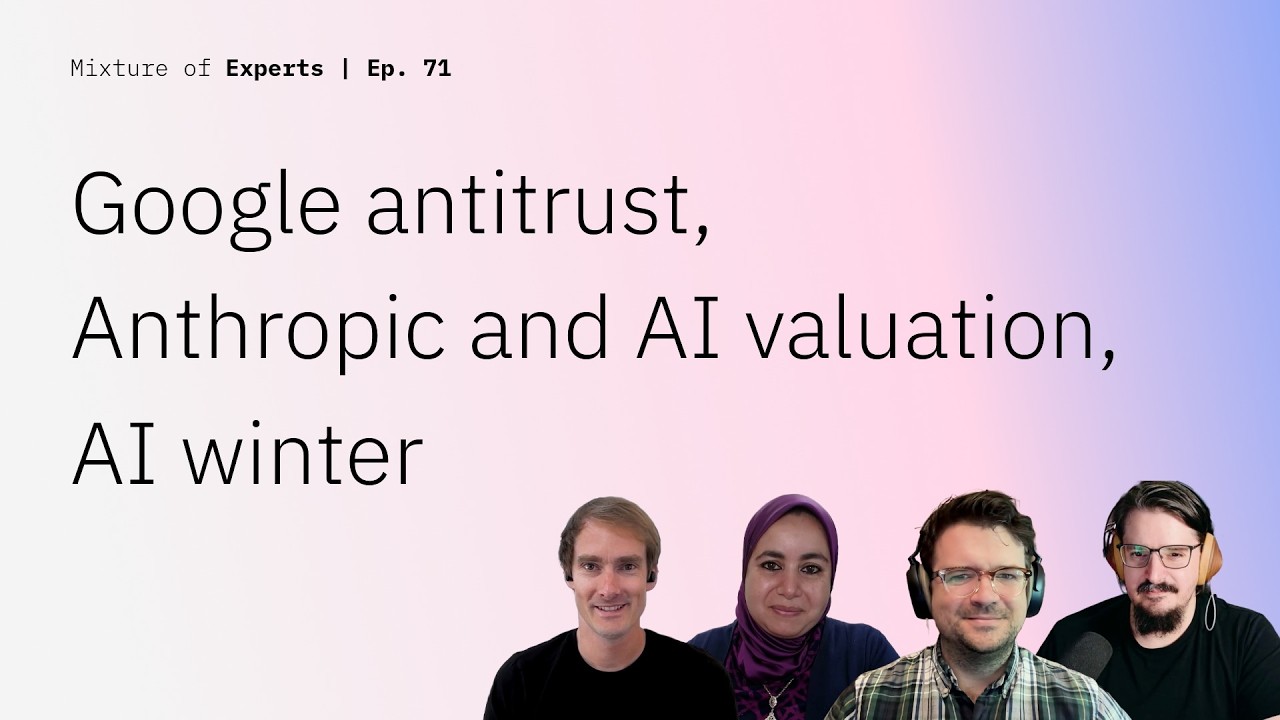
The Future of Search: Google, AI, and the Battle for “Default”
The recent, more conservative ruling in Google’s antitrust case has significant implications for the future of AI and search. While Google was not forced to divest Chrome or Android, the ruling reflects a major shift in the landscape since the case began in 2020: the emergence of generative AI as a “threat to the primacy of traditional internet search.”
The core of the discussion centered on the power of defaults. Most users don’t change default settings, which is why Google pays billions annually to be the default search engine on platforms like Apple’s Safari. This power intensifies with AI assistants, which don’t just provide links but shape answers and route to various tools, making the underlying default even more critical.
However, a key question remains: why haven’t AI tools like ChatGPT replaced browsers as the primary entry point to the internet? The panel identified several barriers:
- User Experience (UX): The web is a visual, interactive medium. Current AI assistants are primarily text-based. Until AI can generate rich, visual, and interactive user interfaces—a space where standards are still nascent—they will feel like a separate, less complete experience than a browser.
- Mental Models: Users currently perceive browsers and AI assistants as distinct tools for different tasks. One is a portal to interact with the web, while the other is a conversational assistant.
- Technological Convergence: The panel expects these two worlds to converge. The future may not involve switching between a browser and a chatbot but interacting through new interfaces (voice, neuromorphic) where a unified backend system routes requests to traditional web APIs or agentic AI systems as needed.
Ultimately, the ruling may level the playing field slightly by limiting some of Google’s exclusivity agreements, but the real battle will be fought over who becomes the default “kingmaker” on major platforms and who can create a converged, intuitive user experience that blends the best of search and generative AI.
Anthropic’s Valuation and the AI Coding Market
Anthropic’s recent Series F funding round highlights a trend of massive valuations for AI companies staying private longer. Anthropic has carved out a powerful niche in the market, focusing heavily on one of AI’s two “killer use cases” to date: code generation.
While other major players aim to build models that do everything, Anthropic has established a strong, defensible position in the developer space. Its advantage is multi-faceted:
- Cost-Effectiveness for a Niche: Models like Opus 4.1 are considered the best for complex planning tasks required by AI agents for coding, offering the best “bang for the buck” for this specific, high-value use case. They are, however, too expensive for general-purpose chat.
- Durable Advantage Through Systems: The panelists argued that Anthropic’s long-term advantage isn’t just the model’s performance but the entire ecosystem built around it. The user experience of tools like Claude Code, which integrate the model into a developer’s workflow, is the key differentiator. As raw model capabilities begin to level out across competitors, the tooling and UX will be what retains users.
- Expanding the Market: AI coding tools are lowering the barrier to entry, enabling “vibe coding” where less experienced individuals can prototype ideas quickly. While this expands the total market, the panel noted the challenge of turning these prototypes into secure, compliant, and maintainable enterprise-grade software. The real opportunity lies in building systems that manage the entire lifecycle, from generation to testing and deployment, ensuring a tangible return on investment.
AI Winter or a Pragmatic Reality Check?
Amidst the hype, a growing wave of AI cynicism has emerged, with some interpreting the incremental progress of models like GPT-5 as a sign of stagnating innovation and a potential “AI winter.” The panel unanimously disagreed with this prediction, framing the current moment not as a winter but as a necessary reality check.
Here’s why a full-blown AI winter is unlikely:
- Deeply Embedded Technology: Unlike previous AI winters where the technology was confined to research labs, today’s AI is embedded in billion-dollar, consumer-facing products like ChatGPT and Copilot. It has achieved real market traction and become integral to many workflows.
- Shift from Hype to ROI: The industry is moving from a period of hype to a more pragmatic phase focused on sustainable business models, real-world problem-solving, and demonstrating return on investment. This slowdown is a sign of maturation, not collapse.
- Invisible Progress: Progress is no longer just about headline-grabbing leaps in benchmark scores. Tremendous, albeit less visible, progress is being made in making models more cost-effective, efficient, and smaller. The innovation is shifting towards embedding these cheaper, faster models transparently into existing applications, making AI a ubiquitous utility rather than a standalone destination. Unrealistic expectations, not a lack of progress, are the biggest threat to the industry.