The Limits of AI: Generative AI, NLP, AGI, & What’s Next?
Exploring the evolution of AI, this summary breaks down the Data-Information-Knowledge-Wisdom hierarchy, revisits past predictions about AI's limits that have since been surpassed—such as reasoning and creativity—and delves into current challenges like hallucinations, AGI, and sustainability. It concludes by framing a collaborative future where humans define the 'what' and 'why,' while AI executes the 'how'.
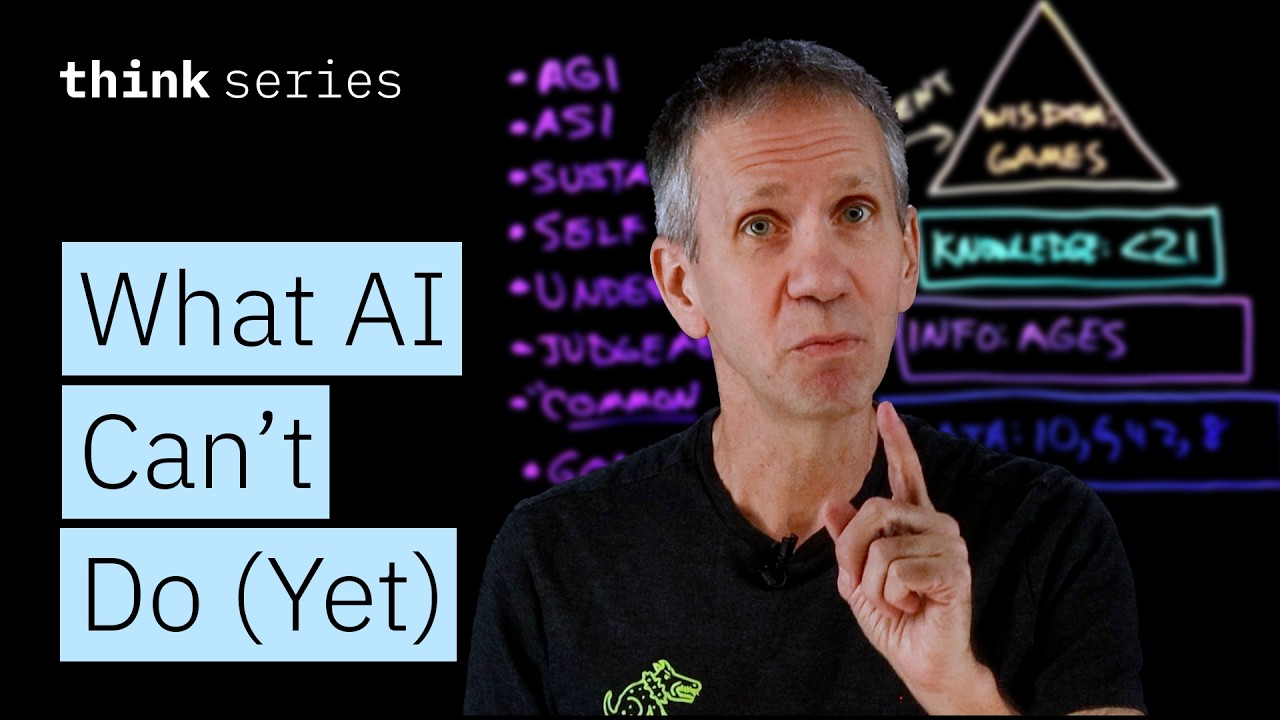
The history of Artificial Intelligence is filled with predictions about what it could never do, most of which have been proven wrong. The exponential growth in AI capabilities, especially in recent years, has moved the technology from research labs into everyday life, accomplishing tasks many thought impossible. Instead of betting against AI, it’s more productive to understand its current state, its limitations, and how to best utilize it as a powerful tool.
The Foundation: From Data to Wisdom
To understand AI’s role, it’s crucial to distinguish between data, information, knowledge, and wisdom, often visualized as a pyramid.
- Data: Raw, unorganized facts without context. For example, the numbers 10, 6, 42, and 8. In computing, this is a database.
- Information: Data with added context. The numbers now represent the ages of people in a room. This is the realm of information technology.
- Knowledge: The interpretation of information. For instance, observing that most people in the room are under 21. This is where AI truly begins to operate, adding a layer of interpretation to processed information.
- Wisdom: The application of knowledge. Using the knowledge about the ages to decide on age-appropriate activities. This remains the ultimate goal and a primary human domain.
Surpassed Milestones: The “Impossible” Made Possible
Many capabilities once considered definitive limits of AI have been successfully achieved, demonstrating the folly of underestimating its potential.
- Reasoning: Complex problem-solving was once seen as a uniquely human trait. However, AI has demonstrated advanced reasoning for decades, famously exemplified by IBM’s Deep Blue defeating chess grandmaster Garry Kasparov in 1997.
- Natural Language Processing (NLP): Human language, with its nuance, idioms, and humor, was a significant barrier. The journey from early chatbots like ELIZA (1965) to IBM’s Watson winning Jeopardy (2011) showcases massive progress. Modern generative AI excels at understanding user intent, inferring meaning, and even anticipating needs, making interaction feel more natural than ever.
- Creativity: The argument that computers cannot create original content is now obsolete. Generative AI can produce novel art and music. This process is analogous to human creativity, where new works are influenced by existing ones.
- Real-Time Perception: Once the domain of science fiction, real-time perception is now a reality in applications like self-driving cars and autonomous robots, which must perceive their environment, anticipate changes, and make critical decisions instantly.
Current Frontiers: Works in Progress
While some challenges have been met, others are still being actively addressed.
- Emotional Intelligence (EQ): Modern AI can simulate emotional understanding, recognizing user moods and responding with apparent empathy. However, this is a simulation of emotion, not a genuine internal state.
- Hallucinations: A significant challenge in generative AI is its tendency to confidently state falsehoods. This is a byproduct of its predictive nature. Progress is being made to mitigate this issue through techniques like Retrieval-Augmented Generation (RAG), which provides external context, as well as Mixture of Experts (MoE) and model chaining.
The Next Horizon: Enduring Limits and Future Challenges
These are the areas that represent the current, and perhaps future, limitations of AI.
- Artificial General Intelligence (AGI): An AI that matches human intelligence across all domains is not yet a reality. Current AI is powerful but generally narrow. The next step, Artificial Super Intelligence (ASI), which surpasses human intellect in every field, remains in the realm of science fiction.
- Sustainability: The enormous energy and cooling resources required to train and run large-scale AI models are unsustainable. The future depends on creating more efficient, “right-sized” models tailored to specific tasks.
- Self-Awareness and Consciousness: Whether an AI can be self-aware or possess consciousness is more a question of philosophy than computer science. It’s unclear if AI truly understands the information it processes or if it is merely an advanced simulation of thought.
- Judgment and Wisdom: AI struggles with ethical judgments, subjective quality assessments, and applying wisdom. It can follow rules but lacks the nuanced understanding to determine right from wrong in complex situations.
- Common Sense: This is notoriously difficult to program, as “common sense” is often context-dependent and varies among humans.
- Goal Setting: While agentic AI can set and achieve “micro-goals” to complete a given task, it does not define the overarching “macro-goal” or the purpose behind the task.
- Sensation and Deep Emotions: Lacking a biological body, AI cannot experience physical sensations like taste or feel deep emotions such as joy, loss, or a sense of accomplishment. It can simulate them, but it cannot truly feel them.
The Collaborative Future: Roles for Humans and AI
The most effective use of AI involves a partnership where humans and machines focus on what each does best.
- Humans: Should focus on the strategic, purpose-driven aspects. They answer the what (defining the overall goal) and the why (providing the meaning and purpose).
- AI: Excels at execution. Once given a goal, AI can determine the how (the method) and then do the task, often with greater speed and optimization than a human.
Ultimately, while today’s AI has clear limitations, history shows that these boundaries are constantly being pushed. The developments are at an inflection point, and the most prudent path forward is to harness this technology as a tool, not to bet against its continued evolution.