On Engineering AI Systems that Endure The Bitter Lesson - Omar Khattab, DSPy & Databricks
Omar Khattab, creator of DSPy, reinterprets the 'Bitter Lesson' for AI engineering, arguing that the key to building robust and enduring AI systems is to move beyond brittle prompt engineering. He advocates for a declarative, modular approach that separates the fundamental program logic from the rapidly changing landscape of LLMs, optimizers, and inference techniques.
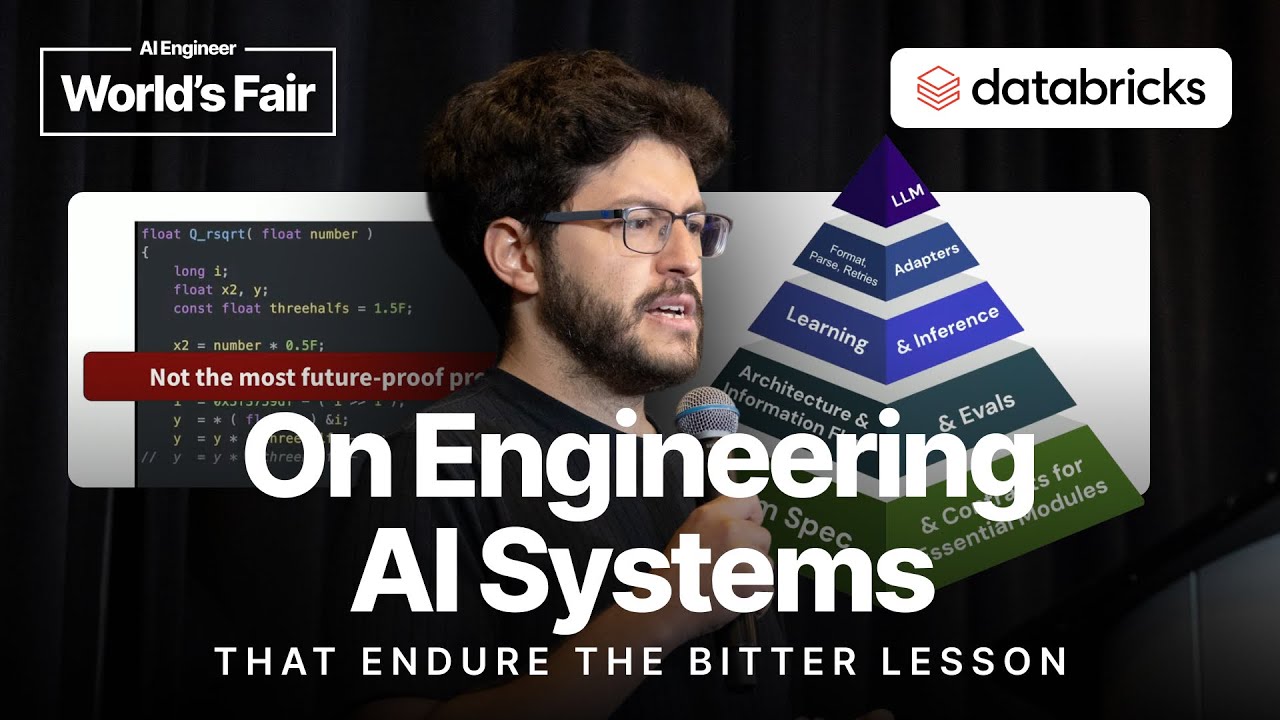
The central challenge in engineering modern AI software is the relentless pace of change. With new large language models (LLMs), learning algorithms, and inference strategies emerging weekly, even diligent engineers are forced to constantly “scramble” to keep their systems from becoming obsolete. This rapid evolution questions the very foundations of how we build AI systems and whether our work can endure.
Reinterpreting the “Bitter Lesson” for AI Engineering
Rich Sutton’s “Bitter Lesson” posits that general methods leveraging scale (search and learning) ultimately outperform complex methods built on human domain knowledge. This raises a critical question for engineers: if leveraging domain knowledge is counterproductive, what is the purpose of AI engineering?
The resolution lies in understanding the goal. AI research may aim to maximize general intelligence, but AI engineering aims to build reliable, robust, controllable, and scalable software. We build software not because we lack general intelligence—we have billions of humans for that—but because we need systems we can reason about and trust at scale. In this context, engineering is often about carefully subtracting agency and intelligence in specific places to ensure predictability and control.
The Bitter Lesson is not irrelevant; it’s a parallel to the classic software engineering principle: “premature optimization is the root of all evil.” The issue is not domain knowledge itself, but hard-coding it at a lower level of abstraction than can be justified. Just as a programmer shouldn’t be bit-shifting to calculate a square root on modern hardware, an AI engineer shouldn’t be micro-managing a model’s behavior with brittle, over-fitted instructions. The goal is to express intent at the highest, most durable level of abstraction possible.
The Problem with Prompts: A Flawed Abstraction
A prompt is a “horrible abstraction for programming.” It is a primary source of tight coupling and premature optimization in today’s AI systems. Prompts conflate several distinct concerns into a single, unstructured block of text:
- Fundamental Task Definition: The core instruction of what needs to be done.
- Model-Specific Quirks: Over-fitted phrasing and examples discovered through trial-and-error to make a specific model behave correctly (e.g., “You are Professor Einstein,” “I’ll tip you $1,000”).
- Inference Strategy: Implicitly baking in a reasoning process, such as telling a model it is an “agent” or should use a specific thought process.
- Formatting and Parsing: Instructions about the output format (e.g., “generate XML,” “answer in JSON”).
This entanglement means that when a new model is released, the entire prompt is invalidated, forcing a complete rewrite. There is no separation between the timeless specification and the temporary hacks.
A Principled Approach: Separation of Concerns with DSPy
The solution is to return to the “trusty old separation of concerns.” An engineer’s primary investment should be in designing the system, which involves three key, decoupled components:
- Natural Language Descriptions: Use natural language for its true power—expressing ambiguous, high-level concepts that cannot be codified otherwise. These are localized, fundamental descriptions, not model-specific prompts.
- Evaluations (Evals): Evals define what you fundamentally care about. Instead of tinkering with a prompt until it “looks right,” you define success criteria. Evals are durable; they remain constant even when models and methods change.
- Code: Delegate to code what it does best: defining tools, enforcing structure, managing information flow, and guaranteeing reliable function composition, an area where neural networks are notoriously weak.
The DSPy framework is designed around this philosophy. It provides a programming model that decouples the what from the how. The engineer’s job is to write a declarative program using Signatures—a new, first-class concept for defining the inputs and outputs of a transformation. This program specifies the logic and control flow of the application.
DSPy’s job is to take this high-level program and compile it for a specific target. This compilation process involves:
- Swappable Models: The program is not tied to a specific LLM. DSPy handles the adaptation.
- Swappable Modules/Inference Strategies: The engineer can switch from a simple chain-of-thought process to a complex multi-agent framework without rewriting the core logic. The program remains the same.
- Optimizers: DSPy can use the provided Evals to automatically optimize the program, whether through reinforcement learning, prompt optimization, or other learning algorithms, ensuring the entire system performs well on the specific task.
By investing in the durable assets—the declarative program, the tools, and the evaluations—engineers can ride the wave of new models and techniques instead of being drowned by it.