Sacks, Andreessen & Horowitz: How America Wins the AI Race Against China
David Sacks details the Trump administration's strategy for AI and crypto, focusing on unleashing permissionless innovation, combating regulatory capture, and winning the global AI race through infrastructure and open source, while warning against the rise of "Orwellian AI."
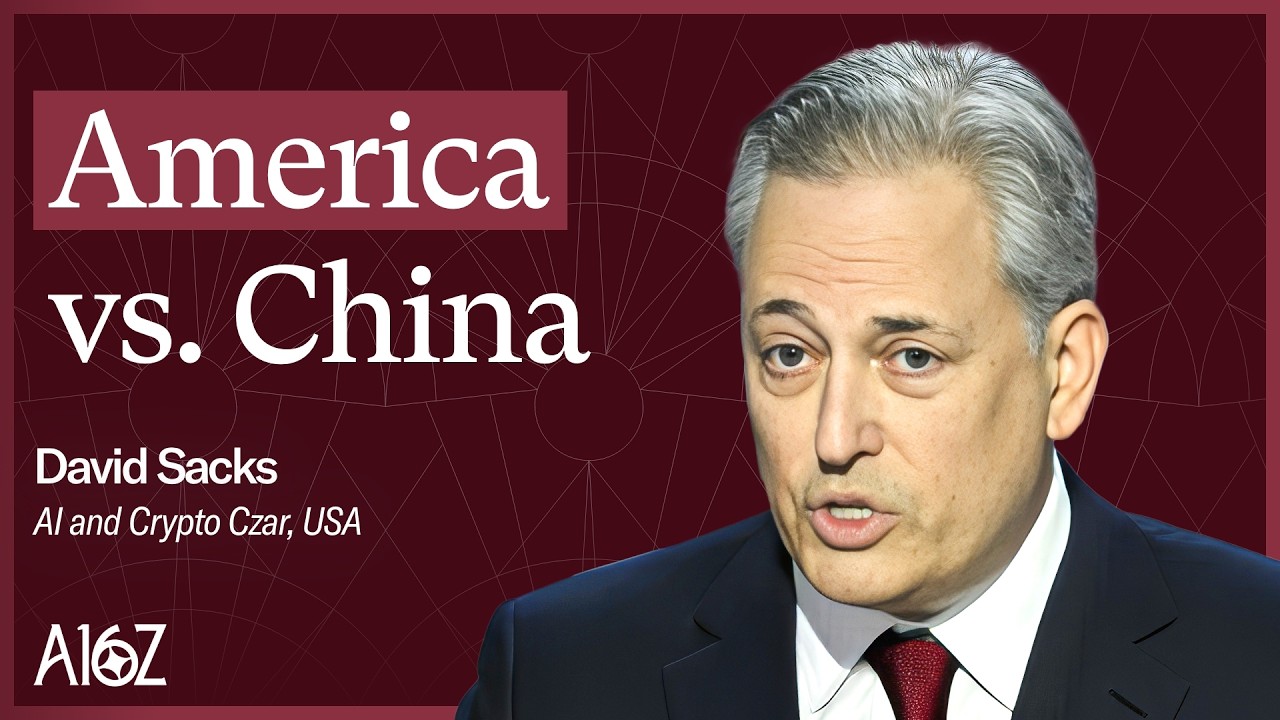
David Sacks, serving as a bridge between Silicon Valley and Washington, outlines the Trump administration’s policy approach to AI and cryptocurrency, emphasizing two distinct strategies for these emerging technologies. For cryptocurrency, the primary goal is to establish regulatory certainty. The previous administration’s “regulation through enforcement” approach created ambiguity and drove the industry offshore. The current objective is to provide clear rules, enabling entrepreneurs to comply, protecting consumers, and positioning the United States as the global “crypto capital.”
For AI, the strategy is the inverse: to unleash innovation by avoiding the heavy-handed regulations proposed by the previous administration. The core belief is that the U.S. wins the global AI race not through government mandates, but by empowering its private sector to out-innovate competitors, chiefly China.
The Threat of Regulatory Capture and “Orwellian AI”
A significant danger to American AI leadership comes from within the industry itself, through attempts at regulatory capture. Sacks points to certain companies, like Anthropic, that actively stoke fear about AI’s existential risks to push for a government pre-approval system for new models. He argues this is a direct threat to permissionless innovation—the principle that has historically made Silicon Valley a global hub of progress. Such a system would create bureaucratic hurdles that favor large, established companies with government affairs teams, stifling startups and slowing the pace of innovation.
This push for regulation is also manifesting at the state level, with a proliferation of bills targeting “algorithmic discrimination.” These laws hold model developers liable for downstream uses of their tools that may have a disparate impact on protected groups, even if the model’s output is factually accurate. Sacks warns that the only way for companies to comply is to build a “DEI layer” into their models, leading to sanitized or distorted information.
He contends that “woke AI” is an insufficient term for this phenomenon, preferring “Orwellian AI.” The greatest risk of AI is not a “Terminator” scenario but a “1984” scenario, where AI becomes a tool for those in power to control information, rewrite history in real-time to serve a political agenda, and conduct mass surveillance.
The State of AI Development: Pulling Back from AGI Hype
Contrary to the doomer narratives, Sacks observes a pullback in Silicon Valley from the idea of “imminent AGI” (Artificial General Intelligence). The current reality is more of a “Goldilocks scenario”: innovation is impressive and driving productivity, but we are not on the verge of a runaway superintelligence.
Key observations shaping this view include:
- AI is Polytheistic: We are seeing the rise of many specialized, smaller models (“deities”) rather than one all-knowing, all-powerful AI.
- AI is Middle-to-Middle: AI models require human guidance. They need to be prompted with an objective and their outputs must be validated and iterated upon. They are not yet “end-to-end” thinkers that can set their own goals, a fundamentally human trait.
- Decentralization is Winning: The market is hyper-competitive with multiple major model companies leapfrogging each other, and an explosion of new open-source efforts is underway. This contradicts the theory that one model would achieve recursive self-improvement and create an insurmountable lead.
A Strategy to Win the Global AI Race
The administration’s plan to ensure American leadership in AI rests on three pillars:
- Pro-Innovation: The government must foster a climate of permissionless innovation. This includes resisting the “frenzy of overregulation” at the state level and establishing a single, light-touch federal standard that preempts the patchwork of 50 different regimes.
- Pro-Infrastructure and Energy: The AI boom requires a massive infrastructure build-out, with energy as the primary bottleneck. The strategy involves removing permitting restrictions to facilitate the construction of data centers and power generation. While nuclear power is a long-term goal, the immediate focus is on natural gas and improving grid efficiency by shedding peak load to backup generators.
- Pro-Export and Diffusion: To win, America must build the largest possible technology ecosystem. This means rejecting Washington’s “hoard and control” mentality and embracing Silicon Valley’s “diffusion” mindset, where widespread usage creates network effects. The previous administration’s “Biden diffusion rule,” which restricted GPU sales to allies, was counterproductive, pushing countries toward China’s tech stack (e.g., Huawei). The goal is to make the American tech stack the global standard by actively exporting to friends and allies.
The Role of Open Source
Open source AI is considered synonymous with freedom, allowing enterprises and individuals to run their own models on their own hardware, maintaining control over their data. It serves as a critical check against the centralization of power, ensuring that even if the closed-model market consolidates, a powerful alternative remains. Currently, China has a surprising lead in open-source models, which may be a deliberate strategy to catch up. The administration views fostering a vibrant open-source ecosystem in the U.S. as essential for maintaining a competitive and decentralized market.