No Priors Ep. 125 | With Senior White House Policy Advisor on AI Sriram Krishnan
Sriram Krishnan, Senior White House Policy Advisor on AI, outlines the America AI Action Plan, a strategy designed to ensure U.S. dominance in artificial intelligence. He discusses the three core pillars of the plan—infrastructure, innovation, and global standards—while also exploring the geopolitical race with China, the critical role of open-source models, and the need for America to own the full AI stack, from GPUs to applications.
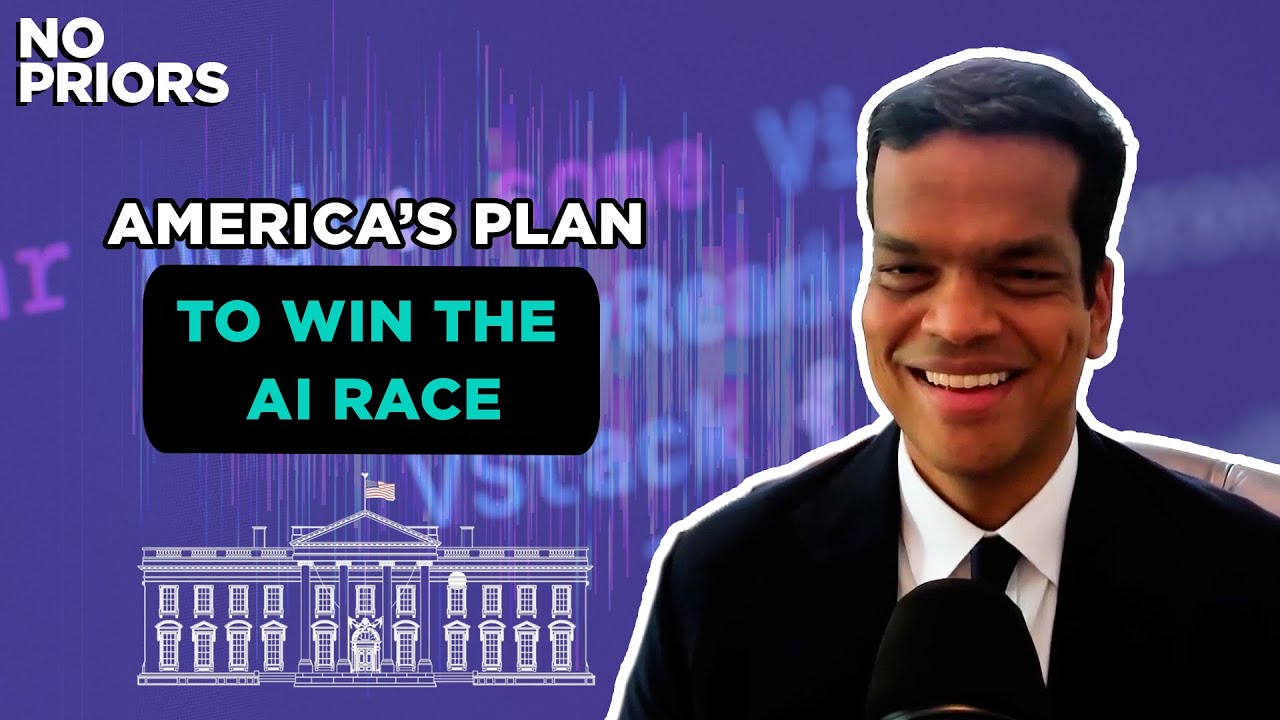
Sriram Krishnan, a former tech executive now serving as the Senior White House Policy Advisor on AI, details the impetus and strategy behind the America AI Action Plan. The plan was catalyzed by events like the release of China’s DeepSeek model, which served as a “starting gun,” revealing that America’s lead in AI is smaller than presumed and cannot be taken for granted. This underscored the need for a formal strategy to maintain and extend the nation’s lead in a technology considered the most transformational economic and cultural force of our time.
Defining and Winning the AI Race
Winning the AI race is not just a matter of national pride; it has profound economic, military, and cultural implications. The country that leads in AI will experience a flywheel effect, where breakthroughs in areas like drug discovery and material science feed back into the economy and infrastructure, accelerating its lead. From a military perspective, allowing an adversary to dominate in autonomous systems presents a clear national security risk.
A novel metric for measuring success in this race is the market share of inference tokens. The goal is to maximize the percentage of global AI computations that run on an “American stack,” which includes:
- Hardware: GPUs from companies like NVIDIA and AMD.
- Models: Foundation models from OpenAI, Google, Grock, and others.
- Applications: The layer of agents and software built atop these models.
Beyond the technical and economic aspects, AI models are a powerful vector for cultural exportation. Just as Hollywood and the early internet spread American values, the AI models that the world uses will shape global perspectives on history, information, and truth. Ensuring these models align with democratic values is a key strategic objective.
The America AI Action Plan: A Three-Pillar Strategy
The action plan is structured around three core pillars, designed to function like a cohesive technology company strategy.
1. Build Infrastructure: “Build, Baby, Build”
The foundation of AI dominance is physical infrastructure. The U.S. faces significant challenges in building out the energy grid and data center capacity required for large-scale AI, hampered by decades-old permitting laws and regulations. The plan aims to:
- Streamline Permitting: Make it easier to build data centers, particularly on federal land, by cutting through environmental and regulatory red tape.
- Boost Energy Production: Address the entire energy system—from generation (including nuclear) to the grid—which has not been battle-tested for the kind of demand growth AI is creating. The goal is to remove bottlenecks and encourage new construction.
2. Foster Innovation
To out-compete rivals, the U.S. must enable its innovators to move as fast as possible. This involves:
- Cutting Red Tape at the Federal Level: The plan advocates for AI to be treated as a national priority, with federal legislation pre-empting restrictive state-level laws like California’s proposed SB 1047, which would have stifled open-source development.
- Championing Open Source: The administration views open-source AI as a strategic asset, not a liability. It enables everyone from students to startups to innovate and is crucial for the broader ecosystem. This is a direct contrast to the previous administration’s approach, which sought to centralize and control AI development, a philosophy Sriram argues is antithetical to Silicon Valley’s success. Open source democratizes access and prevents a few large, government-controlled companies from dominating the field.
3. Promote Global Standards and Exports
The third pillar focuses on ensuring the world adopts American technology.
- Exporting the American Stack: The plan reverses the previous administration’s restrictive “diffusion rule,” which made it difficult to export U.S. GPUs even to allied nations. The new strategy is to actively push for global adoption of the full American stack—hardware, models, and applications.
- Building Alliances: By providing allies with the tools to build their own AI capabilities, the U.S. ensures they are integrated into its ecosystem, running American models rather than those from an adversary.
Countering Bias and Ensuring American Values
A key concern is the potential for ideological bias to be embedded in AI models. An executive order, “No Woke AI in the Federal Government,” mandates that any model procured by the federal government must be “truth-seeking” and free of artificial ideological bias. If bias is present, its source must be transparent. This is framed as a direct counter to both the censorship seen in models from authoritarian states and the “culture war” biases observed in some domestic models.
The Argument for Open Source Security
The plan strongly refutes the fear-based narrative around open-source models. The argument is that open source is inherently more secure, not less. It follows Linus’s Law: “more eyes make every bug shallow.” The constant scrutiny of a global community of researchers and developers is a more effective way to find and fix vulnerabilities than relying on a small, internal safety team at a closed-source lab. Furthermore, the push against open source is often seen as a form of regulatory capture by large incumbents seeking to limit competition.