Mark Zuckerberg & Priscilla Chan: How AI Will Cure All Disease
Priscilla Chan and Mark Zuckerberg of the Chan Zuckerberg Initiative (CZI) discuss their strategy to accelerate scientific discovery through the Biohub, an operating philanthropy at the intersection of frontier AI and biology. They detail the development of foundational tools like the Cell Atlas, a 'periodic table for biology,' and their new focus on building virtual cell models to allow scientists to test high-risk hypotheses in silico, ultimately aiming to cure, prevent, and manage all diseases.
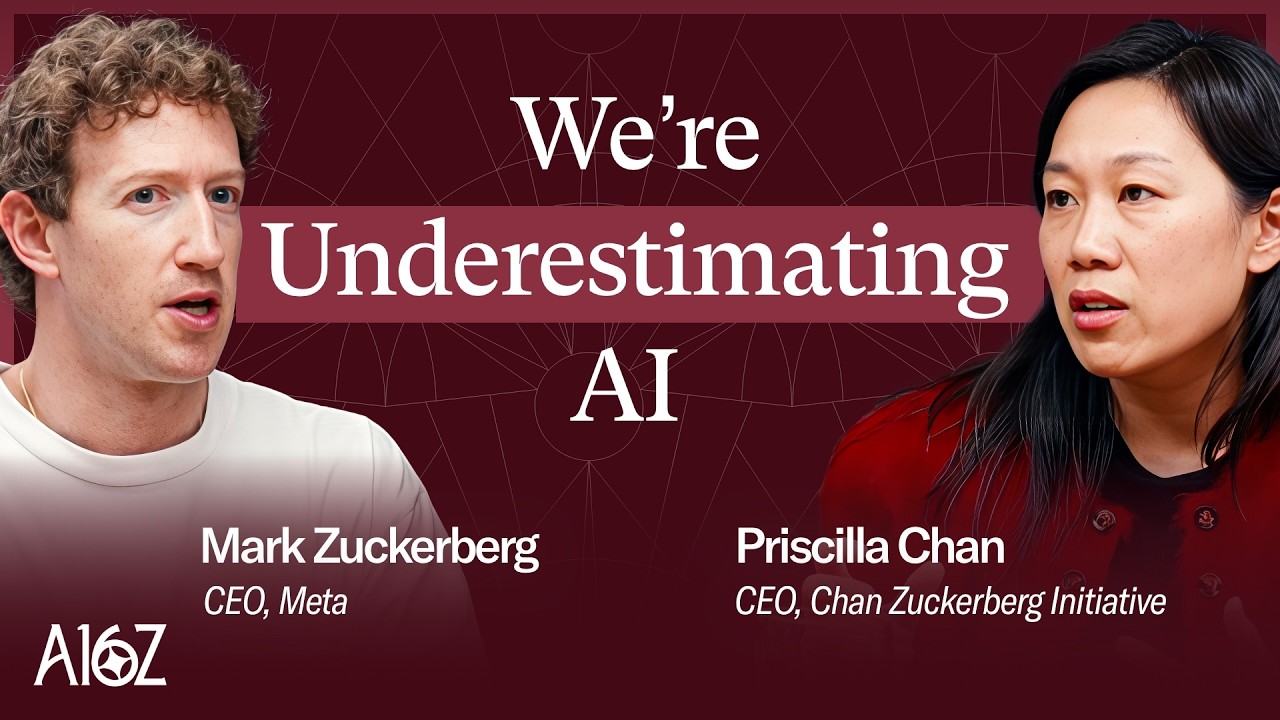
The Chan Zuckerberg Initiative (CZI) was founded with the ambitious mission to help the scientific community cure, prevent, and manage all diseases by the end of the century. The core strategy is not to fund individual, short-term grants but to accelerate the entire field of basic science by building foundational tools. This approach addresses a critical gap in the ecosystem, as traditional funding from entities like the NIH is often not structured for the long-term, high-cost (e.g., $100 million-scale over 10-15 years) projects required to develop these transformative resources.
The Biohub: Fusing Frontier AI and Biology
The CZI Biohub is the primary vehicle for this mission, operating at the intersection of “frontier biology paired with frontier AI.” This model is a strategic response to the realization that while many labs excel at one or the other, combining them is essential for the next wave of breakthroughs.
A significant organizational shift is the unification of the Biohub’s efforts under a singular vision, with AI expert Alex Rives (formerly of Evolutionary Scale) leading the entire science program. This decision underscores the central role of AI in CZI’s strategy, moving from a decentralized model to a cohesive team focused on a singular goal. The new model emphasizes expanding compute power—scaling GPU clusters into the tens of thousands—over physical lab space, reflecting the modern needs of computational biology.
The Biohub’s structure is designed to foster collaboration by:
- Bringing engineers and biologists to work shoulder-to-shoulder, breaking down traditional disciplinary silos.
- Connecting major research institutions (like UCSF, Stanford, and Berkeley in the Bay Area) to tackle “grand scientific challenges” on a 10-15 year time horizon.
Foundational Tools: From the Cell Atlas to Virtual Cells
A core belief is that major scientific breakthroughs are often preceded by the invention of new tools for observation. CZI has focused on creating these tools for the entire scientific community.
The Cell Atlas: A Periodic Table for Biology
One of CZI’s most impactful projects is the Cell Atlas, an open-source catalog of millions of cells. It was inspired by the absence of a biological equivalent to chemistry’s periodic table of elements.
- Origin Story: The project began as an internal annotation tool called Cell by Gene, built to solve a workflow bottleneck for researchers struggling to annotate single-cell data.
- Network Effect: By providing a standardized, easy-to-use tool, CZI created a common data format. This led to a powerful network effect where the broader scientific community adopted the tool and contributed back to the atlas. CZI funded only 25% of the data; the remaining 75% came from the community, demonstrating the value of building shared infrastructure.
The Virtual Cell: The Next Frontier
The next major focus is the development of virtual cell models. The goal is to create high-fidelity, in silico models that allow researchers to generate and test hypotheses computationally before committing to expensive and time-consuming wet lab experiments.
- De-risking Science: By simulating biology, scientists can explore riskier, more ambitious ideas that might not be fundable through traditional grants. This allows for rapid iteration and tinkering on the computational side to see if an idea has promise.
- A New Model Organism: The virtual cell is envisioned as the new fruit fly—a model organism with direct fidelity to human biology, enabling more precise and relevant experimentation.
The AI Engine Behind the Models
AI, particularly large language models (LLMs), is the engine driving the creation and utility of these new tools. It allows researchers to finally make sense of the massive, complex datasets they have been building.
- Hierarchical Modeling: The approach to building virtual cells is hierarchical. It starts with state-of-the-art protein models (leveraging the work of Evolutionary Scale), which form the sub-components of cellular models. These, in turn, can be combined to simulate more complex systems, like a “virtual immune system.”
- Specialized AI Models: CZI is developing several specialized models to probe biology in novel ways:
- VariantFormer: Predicts the downstream cellular effects of a specific CRISPR edit.
- Diffusion Models: Generate synthetic models of specific cell types based on descriptive inputs.
- Spatial Models: Provide a spatial understanding of how cells are structured in different states.
- Reasoning Models: An early-stage but critical direction, aiming to build models that can reason about biological cause and effect, rather than just identifying correlations.
Vision for Precision Medicine and Democratized Science
This tool-building philosophy is rooted in a vision for a more precise and accessible future for medicine. The guiding principle is that “most diseases should be thought of as rare diseases” because every individual’s biology is unique. The current trial-and-error approach to treating common conditions like hypertension or depression can be replaced by treatments precisely targeted to an individual’s biology.
By building tools with intuitive user interfaces, CZI aims to lower the barrier to entry for scientific discovery. This allows experts from different fields—for example, an immunologist investigating neurodegeneration—to collaborate and bring diverse perspectives to complex problems, accelerating the entire pipeline from basic science to novel therapeutics.