Michael Truell: How Cursor Builds at the Speed of AI
Michael Truell, CEO of Cursor, discusses the company's rapid growth, emphasizing a strategy of deliberate focus on power users over broad democratization. He shares insights into their unique two-day work trials that test for agency, the technical and relational challenges of out-scaling cloud and API providers, and a talent-first approach to M&A, all while navigating a market poised for its next 'iPhone moment'.
The journey of Cursor began not with a code editor, but with a broader “Cursor for X” framework, aiming to automate verticals of knowledge work. The initial idea was to build a product for a specific vertical, use it to gain distribution and data, and then leverage that data to improve the underlying models, creating a powerful flywheel. The team’s first attempt was in mechanical engineering, trying to build AI models for CAD systems. However, this effort was hampered by poor founder-market fit and a fundamental misunderstanding of the user’s workflow—a “blind man and the elephant problem.” This initial phase involved significant, and ultimately frustrating, modeling and data scraping work with foundational models that were not suited for the task.
The Power of Focus and Expediency
Pivoting away from mechanical engineering, the team returned to their core interest: programming. Traumatized by the slow, model-heavy work of their first idea, they adopted a strategy of extreme focus and expediency. At a time when many competitors were pursuing “science fiction” ideas like building autonomous software-writing agents or new foundation models from scratch, Cursor chose a more pragmatic path. They decided to fork VS Code and build a demonstrably better product on top of an existing ecosystem, leveraging the market education already done by GitHub Copilot.
This decision to own the editor surface was controversial at the time. The conventional wisdom was that developers were too tied to their editors to switch. However, the founders knew this was false from their own experience, having switched from command-line Vim to VS Code specifically because of Copilot’s utility. Their core belief was simple: if you build a better mousetrap, people will switch, even if the bar is high. This focused approach allowed them to get a product into users’ hands within weeks and launch a beta in a couple of months, quickly gaining momentum.
Navigating Hyperscale
Cursor’s rapid growth created immense scaling challenges for a small, relatively inexperienced team.
- Infrastructure: The company quickly ran a Kubernetes cluster larger than many established companies, leading to operational hiccups. They also pushed database services to their limits, eventually migrating from AWS’s supposedly limitless solutions to PlanetScale to handle their DB-heavy workloads. This experience informed a multi-cloud strategy from the start, utilizing AWS, GCP, Azure, and other specialized providers.
- API Providers: The scale of their usage began to stress their upstream AI model API providers. Cursor grew to represent a double-digit percentage of some providers’ API revenue, forcing those providers to make significant capacity and financing decisions. The team’s solution was both relational and technical: they forged strong relationships while also becoming adept at “hunting out all the Sonnet tokens that exist in the world,” diversifying their inference across multiple providers and token resellers to ensure stability and capacity.
An Unorthodox Approach to Talent and M&A
Cursor’s recruiting philosophy is built around finding the ground truth of a candidate’s ability and fit. Their most unique practice is a two-day, in-office work trial for all engineering and design hires.
Candidates are given a desk, a laptop with a frozen version of the codebase, and a choice of projects. The goal is to see if they are agentic, possess product sense, and can navigate the codebase end-to-end. It’s a powerful signal for both the company and the candidate, ensuring a high degree of mutual fit.
This hands-on approach initially extended to sales, where early candidates were given real inbound leads and a quota. The company’s commitment to securing top talent is extreme, involving “crazy recruiting stunts” like flying across the world to meet a candidate after they’ve already said no.
This talent-first mindset directly informs their M&A strategy. Rather than a purely strategic tool, acquisitions have primarily been a vehicle for acquiring exceptional people who happen to be working on their own companies. The acquisition of Supermaven, founded by a key figure behind Tabnine and an OpenAI researcher, is a prime example of bringing in a team with deeply complementary technology and talent.
The Future: Multi-Product and the ‘iPhone Moment’
While the editor remains the core focus, Cursor is deliberately moving toward becoming a multi-product company, envisioning an “AI coding bundle” that serves as the central AI provider for their customers. They recognize that as AI changes individual developer workflows within the editor, it will necessarily change how teams collaborate, creating a strategic opportunity for complementary tools.
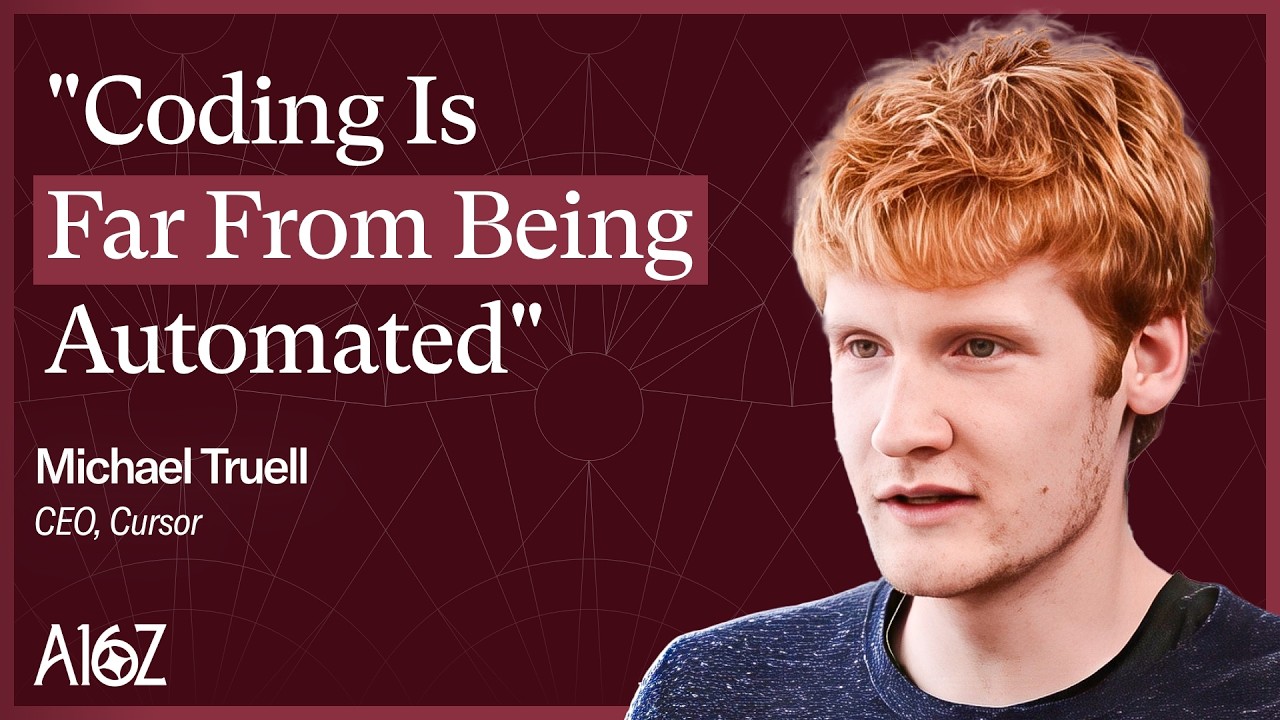
Addressing the “Ouroboros question”—the idea that Cursor could be disrupted by the very software it’s creating—Michael Truell believes software development is still “so far away from being automated.” He views the current market as having had its “iPod moment” but with several “iPhone moments” still to come. The key challenge, and opportunity, is to build a company that can consistently create these transformative moments. If they don’t, another company will. This constant pressure to innovate is what gives them an edge against larger, slower-moving incumbents.