Winning & Attracting AI Researchers in the Age of $100M Bounties | Babak Hodjat | CTO AI Cognizant
Babak Hodjat, CTO of AI at Cognizant and a co-inventor of the technology behind Siri, discusses the strategic shift from generative AI to autonomous, multi-agent systems. He explores how these agentic systems will redefine enterprise operations, the intense "arms race" for AI talent, and the critical need for a decentralized, secure framework for agent collaboration.
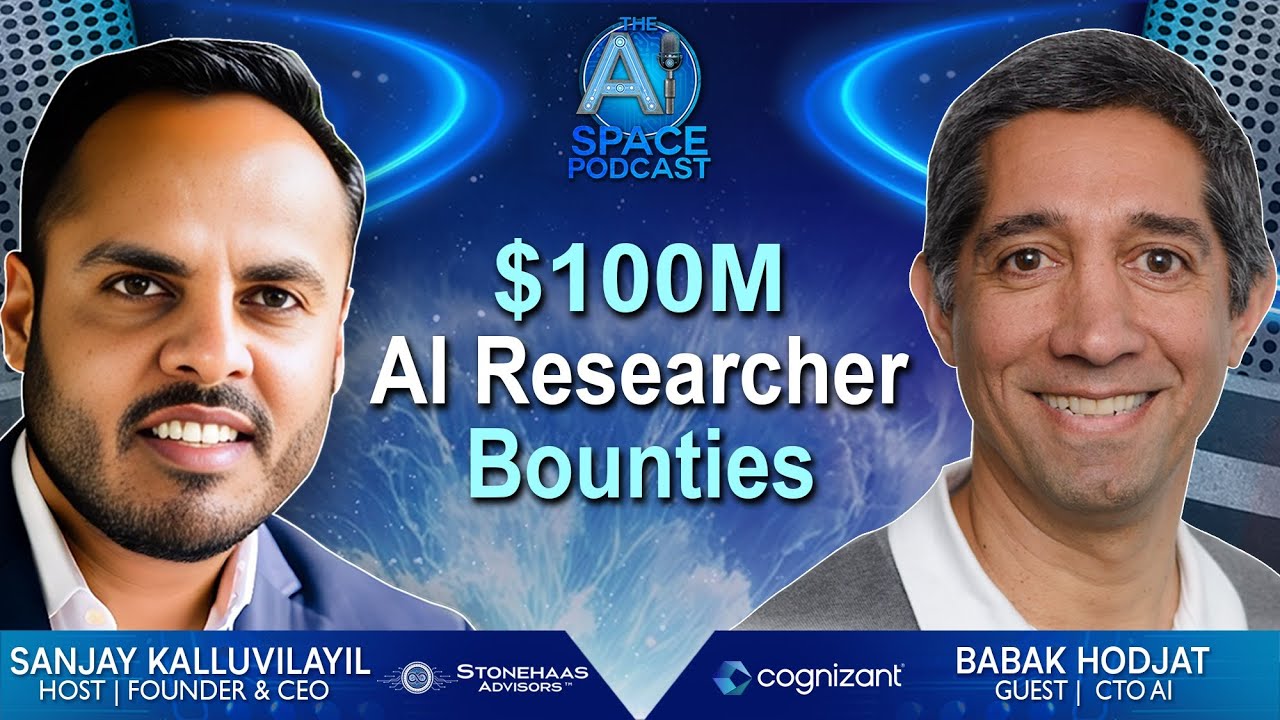
Babak Hodjat, CTO of AI for Cognizant, articulates a clear vision for the evolution of artificial intelligence, moving beyond the current hype of large language models (LLMs) towards a future dominated by sophisticated, collaborative multi-agent systems. This transition represents a fundamental shift from models that simply generate content to autonomous agents that perform actions and solve complex business problems.
The Future is Agentic: Beyond Generative AI
The current rage in AI is the move towards AI agents, which Hodjat defines as a significant step up from generative models. While LLMs transform input and produce output, “agents do things.” This forms the foundation for the next wave of innovation: multi-agent systems.
- Short-Term: The immediate focus is on deploying individual AI agents to augment business processes, enhancing not just efficiency but also the quality of outcomes.
- Medium-Term: The landscape will evolve into multi-agent systems where agents communicate, coordinate, and spontaneously form teams to execute complex tasks on a user’s behalf.
- Long-Term: Hodjat envisions a future of massively multi-agent systems as a crucial step on the path to AGI. In this world, agents will negotiate with other, non-aligned agents (e.g., your personal agent negotiating a purchase with a retailer’s agent).
A critical enabler for this future is natural language, which serves as a “future-proof” communication protocol between agents. It allows them to understand and express novel concepts, enabling them to react to situations they have never encountered before, much like humans do.
Rethinking Enterprise AI and Overcoming Model-Centric Thinking
For enterprises, the most significant value comes from creatively applying AI agents to use cases that were traditionally manual and inefficient. However, Hodjat warns against the pitfalls of “model-centric” thinking, where the expectation is that a single, monolithic model can solve everything.
He cites a recent paper from Apple showing that even advanced Chain-of-Thought reasoning models fail at scale on complex problems. The reasoning capability degrades over time and with increased complexity. The proposed solution is a multi-agent approach.
“If you move this from being one monolithic reasoning model into multiple agents with reasoning that kind of hand off the problem or hand off the reasoning portions to each other and collaborately solve a problem… you would be able to solve that at scale without these like catastrophic collapse in in the reasoning.”
This modularity, where specialized agents handle specific parts of a problem, is more resilient, scalable, and ultimately more effective. This aligns with the “mixture of experts” (MoE) model architecture but takes it a step further into a fully distributed, collaborative system.
Cognizant’s Strategy: Open Source and a Decentralized Future
Cognizant’s AI strategy is to lead in the multi-agent space, driven by a dedicated AI research lab focused on evolutionary computation and multi-agent systems. A key part of this strategy is fostering an open, interoperable ecosystem.
Cognizant has open-sourced a platform for multi-agent systems on GitHub. The goals of this platform are to be:
- LLM-agnostic
- Cloud-agnostic
- A foundation for agent interoperability and coordination
- A framework for establishing trust and security between agents
The platform addresses critical security challenges by separating an agent’s LLM (brain) from its code (execution). Security tokens and permissions are handled at the code level, preventing an LLM from being tricked into performing unauthorized actions. The coordination itself must also be decentralized to avoid a single point of failure.
The “Arms Race” for AI Talent
The conversation highlights an unprecedented “arms race” for top AI researchers and PhDs, with large tech companies offering “obscene packages.”
“It’s crazy what is demanded and what is paid by large companies. I’ve never seen anything like this before… Now you’re going against these large companies that are giving obscene packages.”
This has made sourcing talent incredibly competitive. While compensation is a major factor, Hodjat notes that passion and the opportunity to work on cutting-edge, meaningful problems are powerful motivators. Companies with a strong research vision in a specific niche—like Cognizant’s in multi-agent systems—can still attract top talent who are driven by more than just money.