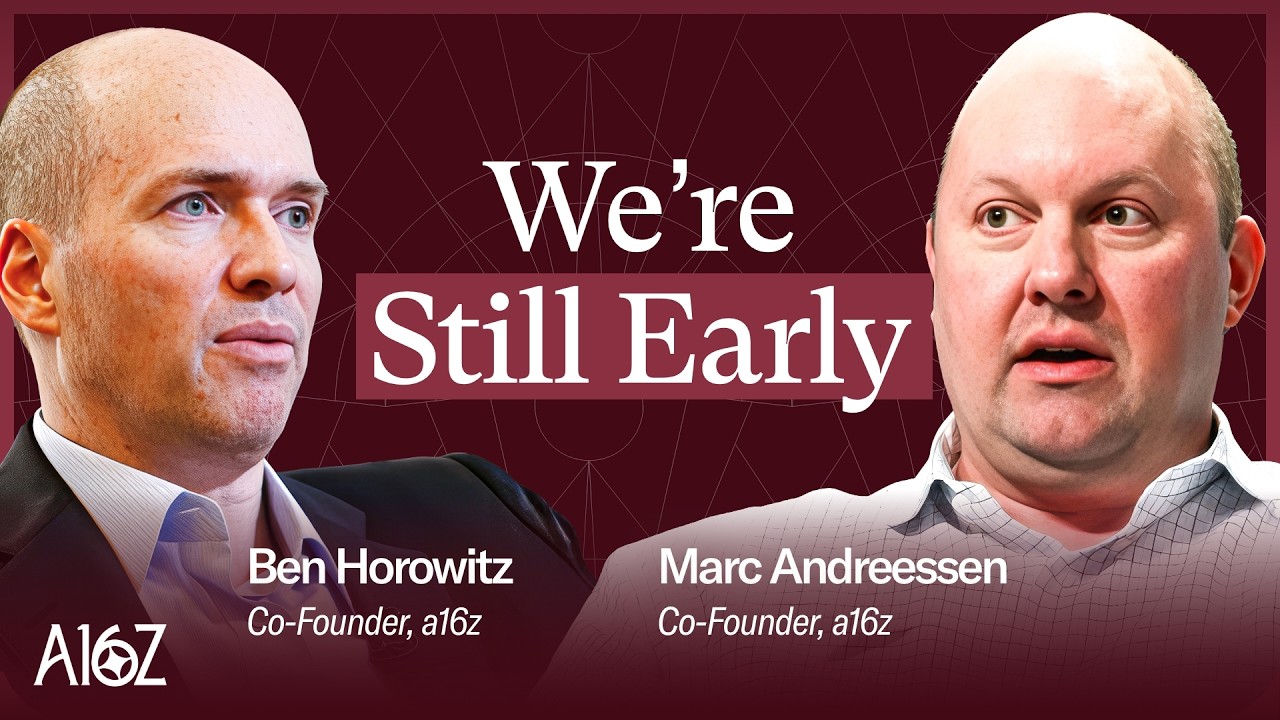
Marc Andreessen and Ben Horowitz on the State of AI
A discussion with Marc Andreessen and Ben Horowitz on the true nature of AI creativity, the limitations of intelligence in leadership, why the current AI boom is not a bubble, and the coming platform shifts and geopolitical race in robotics.
On AI, Creativity, and Intelligence
A common critique of Large Language Models (LLMs) is that they cannot produce genuinely new ideas or creative works, but rather remix their training data. Marc Andreessen challenges this by questioning the definition of human creativity and intelligence itself. He argues that true conceptual breakthroughs are exceedingly rare in human history; most progress, whether in technology or the arts, is the result of decades of prior work and “remixing” existing ideas. Even a genius like Beethoven was heavily influenced by his predecessors. The standard for AI, therefore, should not be a mythical ideal of pure invention but whether it can match or exceed the innovative capacity of the vast majority of humans. If a model can clear the bar of 99.99% of humanity, it represents a monumental leap.
Ben Horowitz echoes this sentiment from the world of music. Through his work with hip-hop legends, he notes that true “conceptual innovators” like Rakim or Dr. Dre are incredibly rare, representing a tiny fraction of all artists. Most artists, particularly in hip-hop, are interested in AI as a powerful creative tool, seeing it as a natural extension of their own methods of sampling and reinterpreting existing music to create something new.
Intelligence, Leadership, and Theory of Mind
The conversation challenges the assumption that superior intelligence inevitably leads to power or control. Andreessen points out the fallacy in this thinking by observing the world around us: “the PhDs all work for MBAs.” While IQ shows a positive correlation (around 0.4 in social sciences) with successful life outcomes, it fails to explain the majority of what drives success and leadership.
Leadership requires a different set of skills beyond raw intellect. Horowitz emphasizes qualities like emotional understanding, courage, motivation, and the ability to navigate difficult conversations—seeing decisions through the eyes of the team rather than just one’s own.
This leads to the concept of Theory of Mind: the ability to model the mental state of others. Andreessen highlights a fascinating finding from the U.S. military: a leadership problem arises if a leader’s IQ is more than one standard deviation away from their subordinates, in either direction. A leader who is significantly smarter than their team can lose their “theory of mind” for them, becoming unable to model their thought processes and connect effectively. This suggests a superintelligent AI with a 1000 IQ might be too “alien” to manage human systems effectively.
Further, human cognition is not a disembodied process. Andreessen argues against mind-body dualism, suggesting that intelligence is a full-body experience involving everything from our gut biome to hormones. Today’s AIs are “disembodied brains,” and the true robotics revolution will begin when AI is integrated into physical forms that can experience and learn from the world.
The “AI Bubble” and Market Fundamentals
Ben Horowitz asserts that we are not in an AI bubble precisely because the question is still being debated. A true bubble is a psychological phenomenon characterized by “capitulation,” where everyone, including skeptics, comes to believe it is not a bubble. Unlike the dot-com era where market size had to catch up to valuations, the AI space is currently characterized by immense, tangible short-term demand.
Andreessen brings the discussion back to two ground-truth fundamentals:
- Does the technology actually work? Yes, it delivers on its promise.
- Are customers paying for it? Yes, they are.
As long as these two conditions hold, the market is grounded in reality, not hype.
Platform Shifts and the Future of UX
While the current battle appears to be between incumbents like Google and new entrants like OpenAI, the ultimate product form factors for AI are still unknown. Andreessen draws a historical parallel to the personal computer, which existed as a text-prompt system for 17 years before the industry pivoted to GUIs and, five years later, to web browsers.
The chatbot and the search engine are likely just the first iterations. The real opportunity lies in inventing entirely new user experiences that are radically different from what we see today. This uncertainty and potential for invention are what keep the industry dynamic and create openings for new companies to win.
The Geopolitical Landscape and the Robotics Future
The discussion concludes with a look at the geopolitical race, particularly between the U.S. and China. Andreessen’s view is that the U.S. currently leads in conceptual breakthroughs, while China excels at rapid implementation, scaling, and commoditization of those ideas. This makes the competition a “game of inches” where the U.S. cannot afford to slow down or impose constraints on its companies that China does not.
The more significant, long-term challenge lies in the next phase of AI: robotics. Due to 40 years of de-industrialization, the West lacks the vast manufacturing ecosystem that China possesses. This ecosystem, essential for building the physical components of robots, cars, and drones, gives China a formidable advantage. Even if the U.S. maintains a lead in software, China could “lap us in hardware.” This presents a critical need for the U.S. to focus on re-industrialization to compete in the coming era of embodied AI.