Moonshot Podcast Deep Dive: André Prager on Prototyping at Wing
André Prager, former Chief Engineer at Wing, discusses the core engineering philosophy of simplicity and cost-effectiveness that enabled the drone delivery service. He covers the design of key systems like the passive charging pad, the intelligent winch, the non-powered autoloader, and the iterative process of making the drones acoustically unobtrusive.
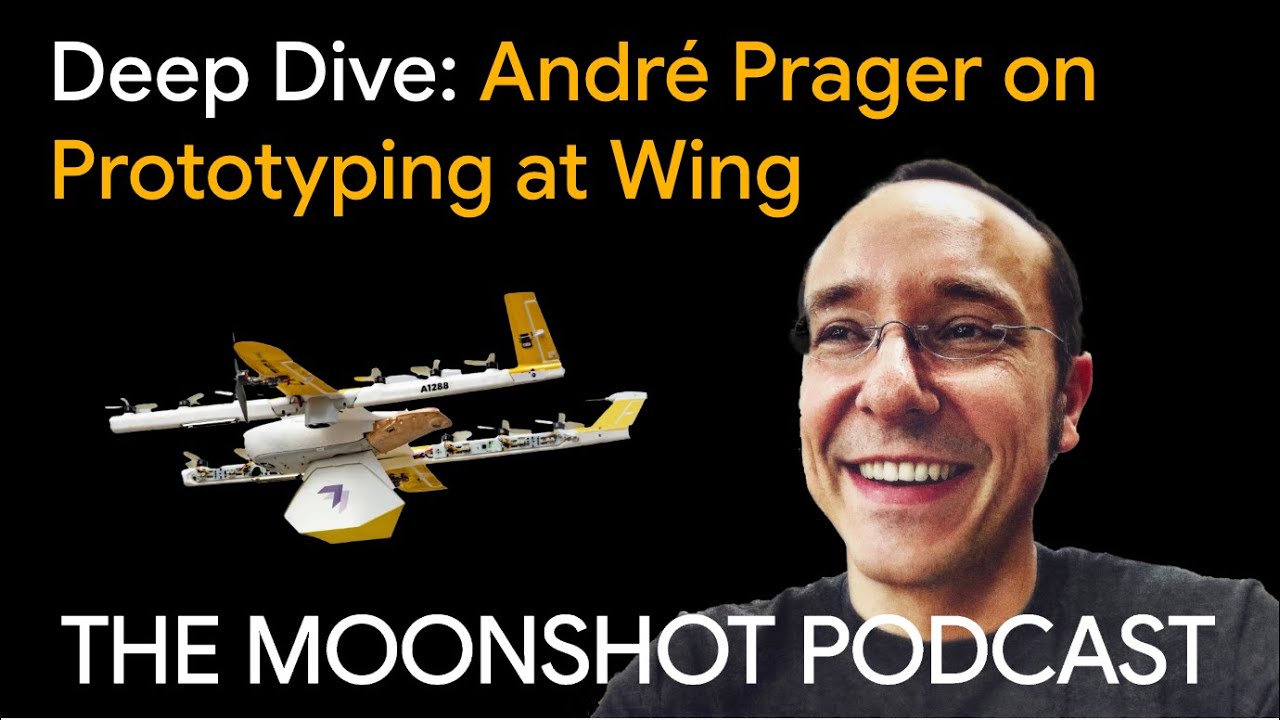
At the heart of Wing’s development was a core philosophy: radical simplicity. The most scalable, robust, and affordable system is one with the fewest components. As former Chief Engineer André Prager puts it, “Everything that’s not there doesn’t need to be developed. Everything that’s not there doesn’t break.” This principle guided the team away from complex, expensive solutions towards elegant, minimalist designs capable of scaling to a billion flights a year.
The Engineer as an Artist
Prager views engineering as more akin to art than pure mathematics—a creative process of discovery driven by curiosity. This mindset, rooted in childhood experiments like building an electric skateboard in the early ’90s, emphasizes building unique things where the outcome isn’t known beforehand. He argues that while math is easy to test, the creative and associative thinking required for innovative engineering is harder to measure but far more valuable. This approach seeks to find engineers who can make novel connections between different domains, a skill Prager believes is more difficult to find than pure mathematical proficiency.
The Real Challenge: The System, Not Just the Drone
When Prager joined Wing, the core architecture of the aircraft—a hybrid design with separate propellers for vertical hover and forward flight—was largely figured out. The fundamental challenge wasn’t just keeping the drone in the air, but solving for “everything else.” This included the entire operational ecosystem:
- Payload Management: How to get packages onto and off the drone efficiently.
- Infrastructure: Where the drones “sleep,” how they charge, and how they are managed.
- Air Traffic Management: How to coordinate a fleet of drones operating simultaneously.
Solving these problems required a relentless focus on cost and scalability, rejecting complex, demo-friendly prototypes in favor of systems that could be affordably deployed worldwide.
Engineering Simplicity in Action
Several key subsystems exemplify Wing’s philosophy of minimalist, hardware-simple, and software-intelligent design.
The Charging Pad
The goal was a landing pad that required no complex robotics, manipulation, or precise alignment. The team avoided heavy wireless inductive charging coils due to weight constraints. Instead, they developed a passive contact-based system. The drone has small, conductive “feet,” and the landing pad features a specific geometric pattern of positive and negative contacts. This geometry ensures that no matter how the drone lands on the 3x3 foot pad, its feet will complete a circuit and begin charging. The pad itself is simple, robust, and inexpensive, resembling a large printed circuit board (PCB).
The Winch and Delivery Hook
The system for lowering and retrieving packages could have been incredibly complex. The final design, however, features a hook with no moving parts and no electronics. This result was the product of a two-year development process with over 90 prototypes.
The intelligence resides in the winch motor and the software. By sensing force and position through the tether—much like sensing vibrations on a string—the system can infer a surprising amount of information:
- When the package has touched the ground.
- If a person is pulling on the line.
- If the hook is snagged on an obstacle.
This allows for a simple, lightweight hardware implementation where intelligence and new features can be added over time through software updates.
The Autoloader
To automate the process of attaching a package, Prager developed the “autoloader,” a device with no moving parts, no power, and no electronics. Inspired by the simplicity of a restaurant patio umbrella, the device consists of two arms that catch the drone’s tether as it hovers nearby. The drone performs a slight sideways movement, which guides the hook through a channel and attaches it to the package via friction. This makes the system incredibly cheap, reliable, and redundant. If one breaks—an unlikely event given its simplicity—it can be easily replaced without needing a technician.
From Manual Operations to a Self-Learning System
In the early days, setting up a new drone “nest” (airport) was a manual process requiring technicians to survey the exact GPS coordinates of each landing pad. Today, the system is autonomous. The pads can be placed down, and the drones will take off, use their sensors to identify the pads’ locations, and learn the layout of their new environment. The drones are continuously updated, becoming “smarter every month.” This allows the fleet to learn from edge cases, such as identifying and avoiding power lines after an initial encounter.
Solving for Sound: An Unexpected Discovery
The team initially focused on making the hover propellers quiet, assuming the noise during delivery would be the most significant public concern. They developed slower-turning (lower RPM) propellers with blades of slightly different lengths. This design splits the sound energy into two different, more pleasant harmonic frequencies instead of a single, louder pitch.
However, after deploying these quieter drones, noise complaints persisted. Data analysis revealed a crucial insight: the complaints weren’t from the delivery recipients but from people the drones flew over en route. The high-pitched “Formula 1 car” sound of the cruise propellers, though not loud, was noticeable.
This led to a redesign where the same acoustic principles were applied to the cruise system. The final design features four cruise propellers and a longer wingspan, which reduces the energy needed to stay aloft. This change, combined with a slightly slower cruise speed, dramatically reduced the en-route noise, effectively eliminating complaints. The drones are now so quiet that they are often unnoticeable during a normal street-level conversation.
A Pivotal Moment: Back to Basics
A key turning point for Wing came when the team was getting lost in optimizing the airplane itself and losing sight of the larger system. Under Astro Teller’s guidance, they went “back to basics” with a deceptively simple challenge: have a drone autonomously take off from one pad, fly 10 feet to another, land, charge, and repeat the process thousands of times a week.
This simple exercise immediately exposed the real-world challenges of the system—charging failures, navigation errors, and software glitches. It forced the team to focus on the core issues of simplicity, resilience, and cost, leading to the robust, scalable system that exists today.