Self-Driving Storage: AI Agent Automation for Data Infrastructure
Explore the concept of "self-driving storage," where AI and AIOps autonomously manage data infrastructure. Learn how mobile storage partitions, predictive analytics, and agentic AI are used to automate capacity management, workload placement, and on-demand performance optimization without human intervention.
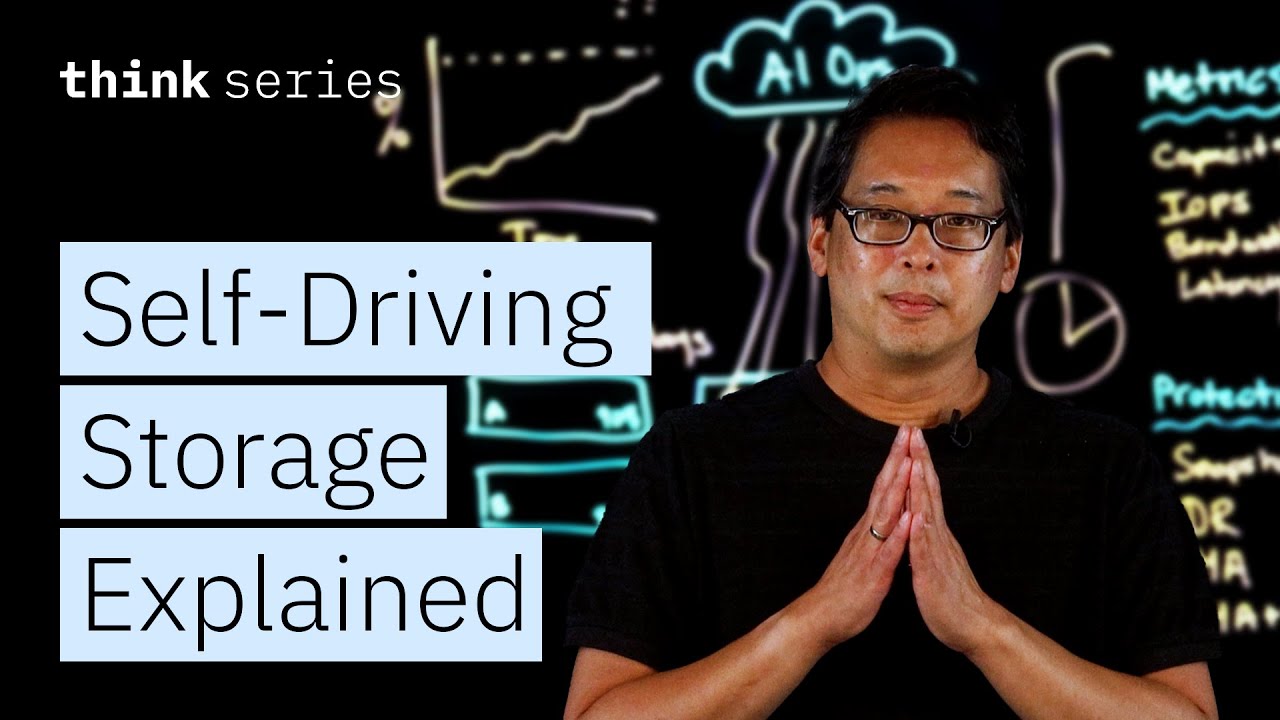
The concept of self-driving, commonly associated with autonomous vehicles, can be applied to data center storage infrastructure to create a fully autonomous, self-managing system. This “self-driving storage” leverages AIOps and machine learning to automate complex tasks like data placement, capacity management, and performance optimization.
The Foundation: Mobile Storage Partitions
Traditionally, block storage is static. Once data is placed on a volume, it doesn’t move. To enable a self-driving model, storage needs to become mobile. This is achieved through the concept of a Storage Partition.
A storage partition is a logical container that groups together all the necessary resources for an application:
- Volumes
- Hosts
- Volume Groups
- Host Clusters
By encapsulating these objects, the entire workload becomes a mobile unit that can be moved between different storage arrays within the infrastructure. This mobility is the fundamental prerequisite for autonomous storage operations.
The Brain: The AIOps Platform
The AIOps platform acts as the central intelligence, making decisions about the storage infrastructure. To do this effectively, it ingests a rich set of time-series data that describes each storage partition. This data falls into two main categories:
- Metrics: Quantitative data on capacity and performance.
- Capacity: How much data is being stored and its rate of growth.
- Performance: Key indicators like IOPS (I/Os Per Second), bandwidth (throughput), and latency (round-trip time).
- Protection: The data protection policies and capabilities associated with the partition.
- Snapshot: Local, point-in-time copies for protection against logical corruption or cyberattacks.
- Replication: Copying data to a second system within the data center or to a remote site.
- Disaster Recovery (DR): Replicating data to a different geographical region to survive a site-wide disaster.
- High Availability (HA): Synchronous replication between two arrays within a data center for zero downtime.
- HA + DR: A combination of local high availability and remote disaster recovery.
By analyzing this data over time, the AIOps machine learning models can understand historical trends, predict future needs, and make intelligent decisions.
A Phased Approach to Autonomous Storage
Trusting an AI to manage critical infrastructure requires a gradual approach. The journey to fully self-driving storage can be broken down into phases, each granting more autonomy to the AIOps engine.
Phase 1: Recommendations (Capacity Management)
The first step is to use AIOps for predictive analysis and recommendations, much like a car’s navigation software suggests the best route.
- Use Case: Proactive capacity management.
- Process: The AIOps engine analyzes historical capacity usage and forecasts that a storage array will run out of space in 30-60 days.
- AI’s Role: It sends a predictive alert and, using generative AI, recommends moving a specific storage partition to one or more alternative systems (e.g., System A or System B), providing a compatibility score for each recommendation.
- User’s Role: The administrator reviews the recommendations, makes the final decision, and then manually initiates the data migration.
Phase 2: Automated Provisioning (Workload Placement)
In the next phase, the AIOps engine is trusted not just to recommend, but also to act on the user’s decision.
- Use Case: Optimal placement for a new application.
- Process: An administrator defines the requirements for a new application (e.g., 30K IOPS, 4 TB of storage, snapshot, and DR capabilities).
- AI’s Role: The AIOps engine receives these requirements and analyzes the entire storage infrastructure to find the best placement. It presents the administrator with recommended systems. Once the administrator selects a system (e.g., System C), the AIOps engine automatically performs the operation, provisioning the storage partition, volumes, and all associated policies without further manual intervention.
- User’s Role: The administrator defines the initial requirements and approves the final placement location.
Phase 3: Fully Autonomous Action (On-Demand Performance)
The final stage is to “let go of the wheel” and empower the AIOps platform to act autonomously using agentic AI.
- Use Case: On-demand performance for seasonal peaks, like Black Friday in the retail industry.
- Process: The AIOps platform, having analyzed years of time-series data, knows that a massive demand spike occurs annually at the end of November.
- AI’s Role: Weeks or months in advance (e.g., in October), the AI autonomously decides to prepare for the peak. It identifies a primary system (System A) that needs to be cleared to handle the load. It then determines the best destinations for the existing workloads on System A and automatically, without user intervention, migrates those storage partitions to other systems (e.g., System B and System C). This migration happens transparently without application disruption.
- User’s Role: None. The entire process—decision-making, planning, and execution—is handled by the AIOps platform.
By the time Black Friday arrives, System A is optimized and ready for the massive influx of data, ensuring peak performance during a critical business period. This represents the future of data infrastructure management, where agentic AI drives a wholly autonomous, efficient, and self-optimizing storage ecosystem.