This week in AI models: Granite 4.0, Claude 4.5, Sora 2
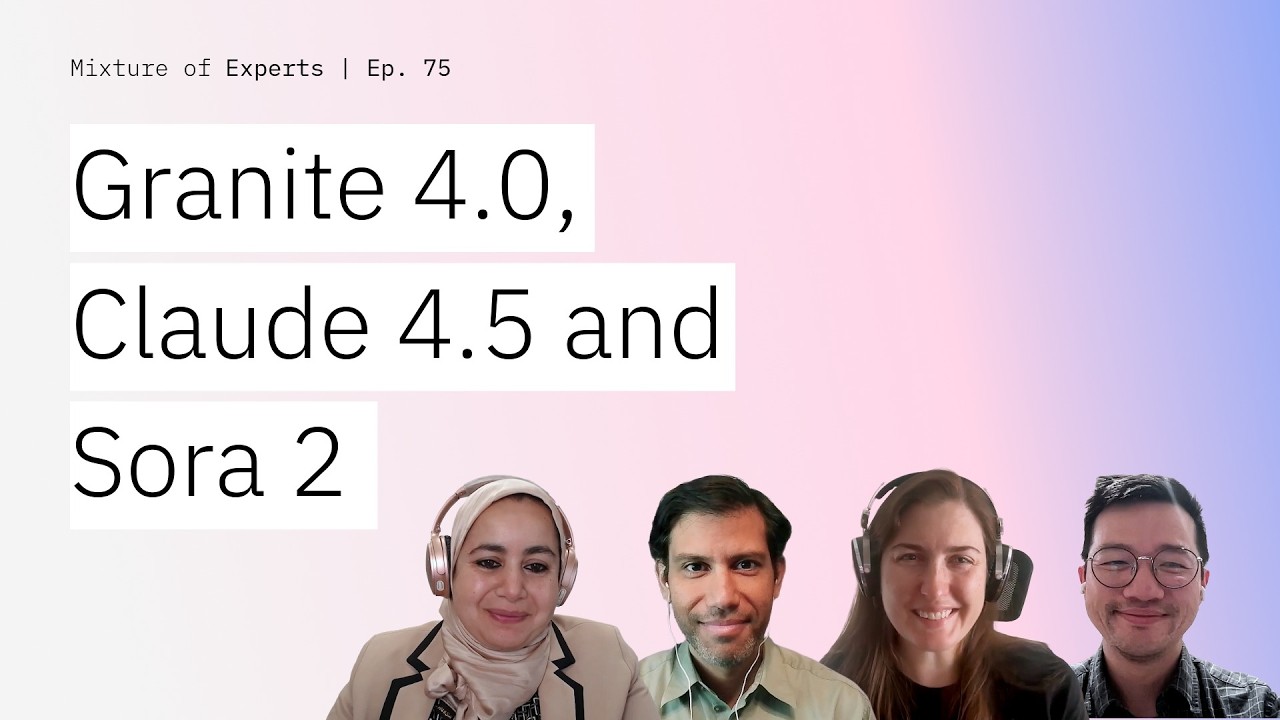
A deep dive into the latest AI model releases, including IBM's hyper-efficient Granite 4.0, Anthropic's code-focused Claude 4.5, and OpenAI's consumer-centric Sora 2. The discussion covers the strategic differentiation between major AI labs, the future of open-source, the rise of AI e-commerce agents, and the emerging cybersecurity challenges of social engineering AI.
IBM Granite 4.0: Redefining “Good” as Efficient and Capable
IBM’s release of the Granite 4.0 model family on Hugging Face marks a strategic shift in AI development, prioritizing efficiency and accessibility without compromising performance. The key theme is moving the definition of a “good” model from “most capable” to “most efficient and also capable.”
- Hyper-Efficient Architecture: The models feature a new hybrid architecture, making a bet on State Space Models as the future. This allows them to be incredibly memory-efficient. All models in the family can run on a single, consumer-grade GPU (like an L40s), a significant departure from the massive compute clusters required by other frontier models.
- Performance Gains: Despite their small size, the performance is a significant leap. The smallest Granite 4.0 model, requiring only about 4GB of memory, outperforms the largest Granite 3.0 model. This demonstrates a fundamental change in making models “smarter per compute.”
- Governance and Trust: Granite 4.0 is one of the first open-source models on Hugging Face to achieve ISO 42001 certification, underscoring the rigorous governance and safety protocols in its development. A new feature is the cryptographic signing of model checkpoints, allowing users to verify the model’s training process and provenance.
- Future Direction: The team plans to release even smaller models (in the 100-million parameter range) and also scale the efficient architecture to larger sizes, continuing to develop in the open.
The Great Differentiation: Claude, Sora, and Competing Visions
The latest releases from Anthropic and OpenAI highlight a growing divergence in strategy, with major labs “picking a lane” rather than building one-size-fits-all models.
Claude Sonnet 4.5: The Coding Specialist
Anthropic has positioned Sonnet 4.5 squarely as a tool for developers and software engineering. Instead of advertising “jack of all trades” capabilities, the release focuses heavily on its proficiency in coding tasks.
- Developer-First Strategy: This focus allows Anthropic to innovate specifically for the software engineering lifecycle.
- Extended Reasoning: A key feature is the ability to reason over complex, multi-step tasks for up to 30 hours, making it a powerful coding assistant.
- “Imagine with Claude”: An experimental demo showcased a new interaction paradigm where users can describe an application, and Claude generates it on the fly. Panelists viewed this as a sophisticated evolution of no-code tools, more likely to be a personal productivity enhancer than a replacement for enterprise software development.
Sora 2: The Consumer Entertainment App
OpenAI’s Sora 2 is framed less as a raw model release and more as a “mobile-first social experience”—a “Vibe video producing app.” This positions OpenAI in the consumer and entertainment space.
- Application Layer Focus: Both Anthropic and OpenAI are now competing at the application and interface level, not just on model weights. This presents a challenge for the open-source community, which has traditionally focused on the models themselves, to develop compelling application frameworks.
- Significant Risks: The release raised concerns about its potential for misuse. The branding of “deepfakes” as “cameos” was noted as a concerning “branding jiu-jitsu.” There are also fears of creating an “infinite slot machine” of shallow content that could exacerbate issues like doom-scrolling.
- Unsustainable Economics: The compute and storage costs for mass-market video generation are enormous. The panel questioned the long-term sustainability of the current pricing, suggesting it’s likely a demonstration of capability, with the true business model yet to be determined. A panelist compared Sora’s compute pattern to a “sports car” (short, powerful, expensive bursts) versus Claude’s “semi-truck” (continuous, moderate power).
The Rise of E-commerce Agents and AI Cybersecurity
“Buy with ChatGPT”
OpenAI’s new e-commerce agent feature signals a move to become the “front door to commerce,” a potential threat to incumbents like Amazon.
- The Trust Question: A central issue is whether users will trust an AI with their finances. The consensus was a graded approach: users might trust it with a credit card (where charges can be disputed) but not with more sensitive accounts.
- Competing Strategies: OpenAI’s strategy is to be the “first mover” in agentic commerce by using a centralized protocol (initially with Stripe) to achieve velocity and own the user experience. In contrast, Google is building a consortium of partners to establish an open, interoperable standard.
- Regulatory Scrutiny: The panel noted that as AI agents become critical financial infrastructure, government regulation will need to step in quickly to prevent corporate capture and ensure stability.
Securing the New AI Frontier
The rise of AI agents introduces novel cybersecurity challenges.
- Social Engineering AI: Unlike traditional software, AI agents are not “hacked” by exploiting code vulnerabilities. Instead, they are compromised through “social engineering”—using carefully crafted prompts to trick them into performing malicious actions.
- The Unsolvable Problem: The core challenge is that security experts have not solved how to prevent humans from being socially engineered, and now they must figure out how to protect AI from the same tactics.
- A Need for New Guardrails: A potential solution discussed was the need for a “real-world version of Asimov’s three laws of robotics” for AI agents—a universal set of standards and training to help them detect and resist manipulation, much like human security awareness training.