AI Agents for Cybersecurity: Enhancing Automation & Threat Detection
An exploration of how LLM-powered AI agents are transforming cybersecurity by moving beyond traditional static rules to provide dynamic, adaptive security operations. The summary covers key applications in threat detection and incident response, while also addressing critical risks like hallucinations and adversarial manipulation, emphasizing a "human-in-the-loop" approach.
The landscape of cybersecurity is challenged by two converging problems: a dramatic increase in data volume that hides threats and a chronic shortage of skilled professionals, with an estimated 500,000 open jobs in the US alone. Even if these roles were filled, security teams would likely still struggle to keep pace. AI agents, powered by large language models (LLMs), are emerging as a critical tool to augment human experts, enabling them to think, act, and reason within defined boundaries to manage modern cyber threats.
From Static Rules to Dynamic Agents
Traditional cybersecurity workflows are heavily reliant on predefined, static elements:
- Signature-based detection and fixed playbooks crafted by humans.
- Narrow machine learning models trained for singular, specific tasks like anomaly detection or malware classification.
- Fixed incident response sequences, where an analyst manually gathers data and follows a documented procedure.
These methods are often brittle and do not adapt without manual updates. In contrast, LLM-powered AI agents introduce a dynamic and adaptive layer to security operations. An agent is defined as a system that uses an LLM to autonomously decide on actions and interact with its environment in real time.
These agents can ingest both structured data (log files) and unstructured inputs (written reports, security advisories, CVE descriptions). Their ability to understand natural language and context allows them to:
- Interpret intent and context from diverse data sources.
- Choose which tools to use for the next step, such as calling a threat intelligence API, querying a database, or running a script.
- Use the results of these actions to inform subsequent decisions, adjusting workflows “on the fly” based on live information, much like a human analyst.
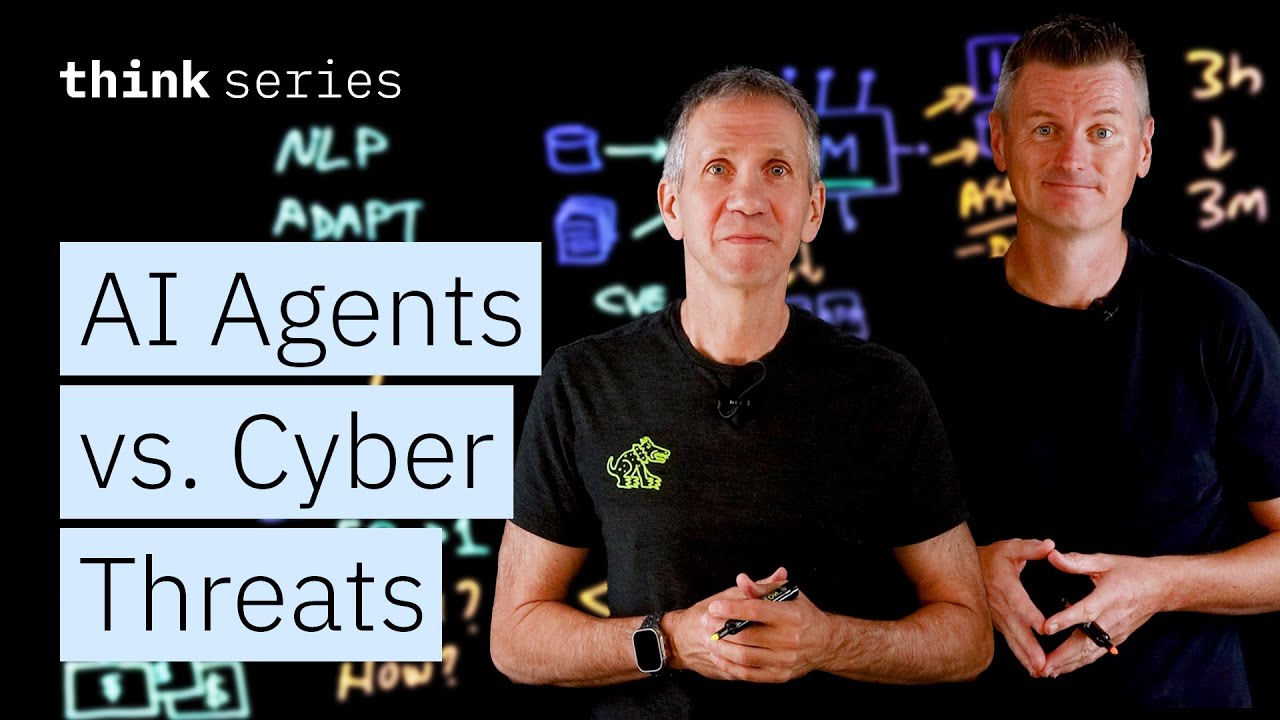
This adaptability is invaluable in a field where attackers constantly evolve their tactics. Agentic workflows can significantly cut down investigation times, reducing a three-hour task to as little as three minutes without sacrificing accuracy.
Core Applications in Security Operations
AI agents are being applied across various cybersecurity domains to enhance efficiency and effectiveness.
-
Threat Detection and Triage: Agents can analyze raw event data in plain language to determine if it suggests malicious activity, identifying unusual sequences not covered by explicit rules. In practice, they are used to triage alerts by automatically gathering related data (cloud logs, identity logs) to validate if an alert represents a real threat. They excel at reducing noise by summarizing and grouping alerts, for instance, identifying that 50 separate alerts actually constitute a single port scan attempt.
-
Incident Response: When a security event occurs, agents help answer the critical questions: “Am I affected?” and “How bad is it?” They can derive the likely cause of an alert by rapidly searching knowledge bases and correlating information across multiple sources, a process that is far faster than manual investigation.
-
Phishing Detection: The semantic analysis capabilities of AI agents surpass traditional spam filters. They can analyze an email’s writing style, look for attempts to create urgency or fear, check for consistency with past communications from the sender, and identify social engineering cues.
-
Malware Analysis: An LLM can function as a “junior reverse engineer” by reading through suspicious code and explaining its function in natural language. An analyst can provide a code snippet, and the agent will break it down, identify suspicious API calls, and explain what each section does.
Managing Risks and Limitations
Deploying AI agents in security is not without risk, and careful management is essential.
-
Hallucinations: LLMs can produce confident but incorrect or fabricated information. An agent might falsely declare a system “clean” or recommend a remediation step that could disrupt production systems. This necessitates strong guardrails and human oversight.
-
Adversarial Manipulation: Attackers can attempt to deceive agents through techniques like indirect prompt injection. By crafting malicious input data, such as log entries or email content, an attacker could trick an agent into ignoring certain alerts or outputting false information.
-
Overfitting and False Positives: While agents can have false positives, their precision can be improved over time with reinforcement learning based on analyst feedback. A more subtle risk is human analysts “overfitting” to the AI’s output—blindly trusting its conclusions without independent verification.
Best Practices for Deployment
To mitigate these risks, a “trust but verify” approach is crucial. AI should assist human thinking, not replace it entirely.
- Human in the Loop: Require human confirmation for any high-risk actions, such as shutting down a server or blocking a user.
- Start with Limited Permissions: Initially confine agents to read-only access or low-risk sandboxes.
- Test and Review: Extensively test the agent and continuously review its outputs for accuracy.
- Gradual Trust: Increase the agent’s autonomy and permissions gradually as it proves its consistency and reliability.
Ultimately, the ideal workflow involves the agent automating the laborious research phase of incident response—collecting data, enriching it with threat intelligence, correlating it across systems, and referencing frameworks like MITRE ATT&CK—before presenting a recommended response to a human analyst for final action. This augmentation allows human experts to focus on high-level analysis and strategic decision-making, empowering organizations to better respond to the scale and complexity of modern cybersecurity threats.