How AI Is Accelerating Scientific Discovery Today and What's Ahead — the OpenAI Podcast Ep. 10
Head of OpenAI for Science Kevin Weil and research scientist Alex Lupsasca discuss how frontier models like GPT-5 are beginning to accelerate scientific discovery. They cover real-world examples in physics, the evolving nature of human-AI collaboration in research, and the future trajectory of science in a new, AI-powered era.
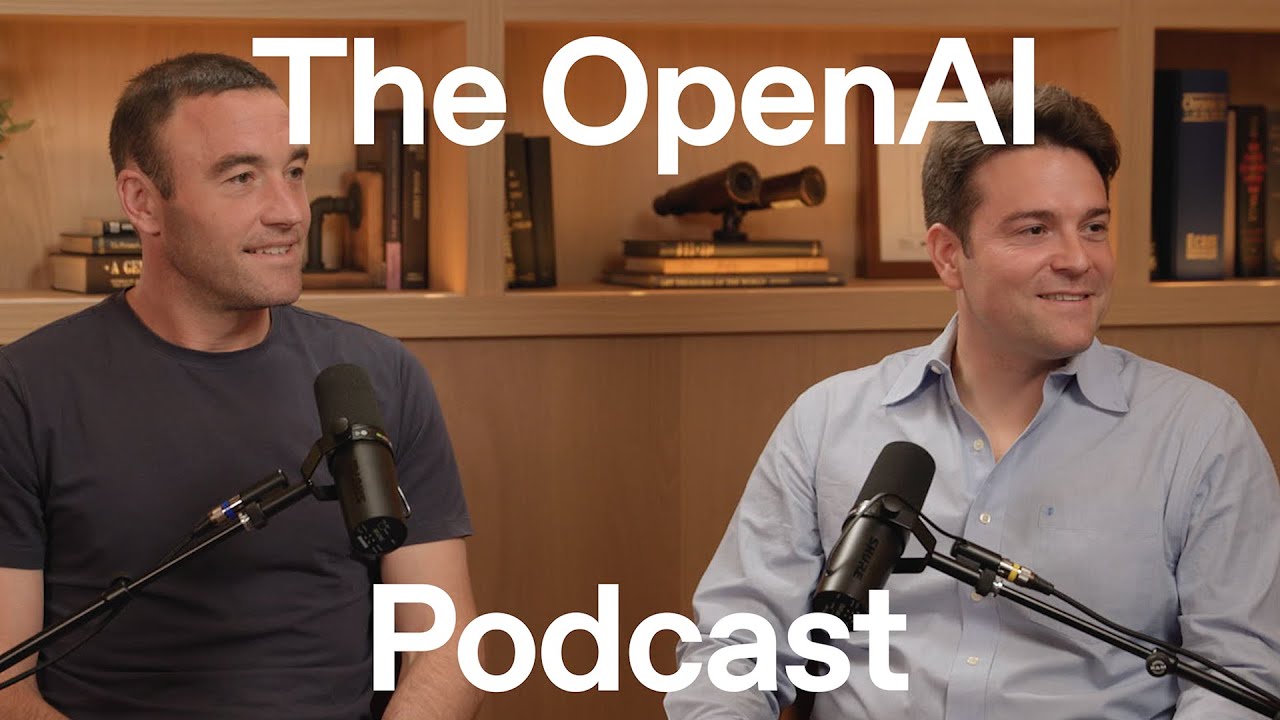
The mission of OpenAI for Science is to accelerate the pace of scientific discovery, with the ambitious goal of helping scientists achieve the next 25 years of research in just five. We are at a pivotal moment where frontier AI models are beginning to demonstrate the ability to perform novel science. While not yet making discoveries beyond human capability, models like GPT-5 are solving problems that humans have not yet solved, providing “existence proofs” that they can push past the frontier of human knowledge. The progression is rapid: what a model can barely do today becomes an indispensable tool twelve months later. Science is now entering this initial phase of AI-driven acceleration.
Redefining the Research Workflow
AI is fundamentally changing the scientific process, from ideation to calculation. Two key areas are seeing immediate impact:
-
Conceptual Literature Search: AI models can perform conceptual searches that transcend keyword limitations, disciplinary jargon, and even language barriers. In one example, a researcher working on high-dimensional optimization was unable to find prior work. GPT-5, understanding the core concept, found a related PhD thesis in German from the field of economics—a connection that would be nearly impossible to make with traditional search tools. Similarly, physicist Alex Lupsasca encountered an unusual equation in his black hole research, and ChatGPT immediately identified it as the “conformal bridge equation,” pointing him to relevant literature he was unaware of. This ability to bridge disparate fields is crucial, as many modern breakthroughs occur at the intersection of disciplines.
-
Accelerating Calculations and Exploration: Complex calculations that would take days can be completed in minutes, but the impact is more than just speed. It’s a qualitative shift in the research process. When a researcher can explore ten potential paths in an hour instead of just two over the course of a week, it dramatically increases the surface area for discovery. Alex Lupsasca experienced this firsthand while trying to solve a partial differential equation describing a pulsar’s magnetic field. He identified the solution as an infinite sum of Legendre polynomials. GPT-5 Pro, thinking for 11 minutes, broke down the problem, found a specific mathematical identity from a paper in a 1950s Norwegian journal, and correctly derived the solution (save for a minor typo, which was easily corrected).
Case Studies from the Frontier of Physics
Concrete examples highlight the profound potential of these models when applied to highly specialized, expert-level problems.
Fusion Physics at Lawrence Livermore
Kevin Weil recounted a meeting with Brian Spears, a physicist at Lawrence Livermore National Laboratory. Spears demonstrated how a year-old preview model could correctly answer a series of increasingly difficult questions about fusion. Starting with an undergraduate-level problem about a copper rod bombarded by pressure waves, he progressed through graduate, post-doc, and expert-level questions. The model not only kept pace but, for the final question, suggested using a set of partially-classified simulation tools exclusive to Lawrence Livermore to proceed. Spears noted that while he could have done the work himself, it would have taken days. The model provided an immense acceleration.
“The acceleration that is going to come from these tools is going to change science.” - Kevin Weil
Discovering Black Hole Symmetries
Alex Lupsasca, a specialist in black hole physics, put a recent model to the test with a problem at the edge of his own abilities: finding the symmetries of a complex equation related to black holes.
- The Hard Problem: Initially, he gave the model the full, complex equation. After five minutes, it incorrectly reported “no symmetries.”
- The Warm-Up: Taking a step back, he gave it a simplified “warm-up” version of the problem—the flat-space limit, an obvious starting point for a human physicist. The model thought for nine minutes and returned a beautiful, correct answer, identifying the conformal symmetry and its generators.
- Revisiting the Hard Problem: Primed by the simpler case, the model was given the original, difficult problem again. It thought for 18 minutes and produced the completely correct answer, a calculation Lupsasca described as being “at the edge of my abilities.” This experience was a key factor in his decision to join OpenAI.
The Art of Human-AI Collaboration
These examples reveal that leveraging AI for frontier science is not a simple query-response interaction but a nuanced collaboration.
- The Jagged Frontier: As Alex Lupsasca puts it, the edge of human knowledge is “very jagged”—some simple-sounding questions (like “why are there three dimensions?”) are impossible to answer, while some incredibly complex ones are solvable. AI models also have a jagged frontier of capability, and critically, it’s different from ours. The most productive collaborations happen at the intersection, where the model’s abilities extend beyond the human’s, or vice-versa.
- Patience and Iteration: For problems at the limit of a model’s capabilities, the “pass rate” may be low (e.g., 5%). A researcher can’t expect a correct answer on the first try. The most effective users engage in a patient back-and-forth, guiding the model, providing simpler warm-up problems, and refining its outputs. One of the research challenges at OpenAI is to reduce this cognitive load and make it easier to distinguish between a problem that is too hard and one that just has a low pass rate.
The Path Forward: A “Science 2.0” Moment
The pace of improvement is relentless; today’s models are the worst we will use for the rest of our lives. This rapid evolution is creating a new paradigm for science.
- Evolving Benchmarks and “Thinking Time”: As models improve, the benchmarks used to measure them must also evolve. Models are now achieving near-90% accuracy on PhD-level question benchmarks like GPQA, where human experts score around 70%. The new frontier for evaluation is testing models on unsolved scientific problems. A key factor in solving these harder problems is “thinking time.” Just as with humans, giving a model more compute time—allowing it to think for hours instead of minutes—dramatically increases its success rate on difficult tasks.
- The 5-Year Horizon: Within the next five years, AI is expected to move beyond theoretical, in silico fields and begin to have a major impact on the physical and life sciences. In areas like drug discovery, AI can intelligently prune the vast search space of candidate molecules, making physical experiments more efficient. In the long term, AI could help solve grand challenges like achieving scalable nuclear fusion, which would fundamentally reshape our world by providing abundant, clean energy.
- Empowering Scientists: The ultimate goal is not for AI to do science on its own, but to build the best possible general-purpose tools that empower scientists everywhere. The vision is to put these collaborators in the hands of every researcher, allowing them to accelerate their own work. This is the start of a “Science 2.0” moment, where the aim is to “see a hundred scientists win Nobel Prizes using AI.”