Ideas: Community building, machine learning, and the future of AI
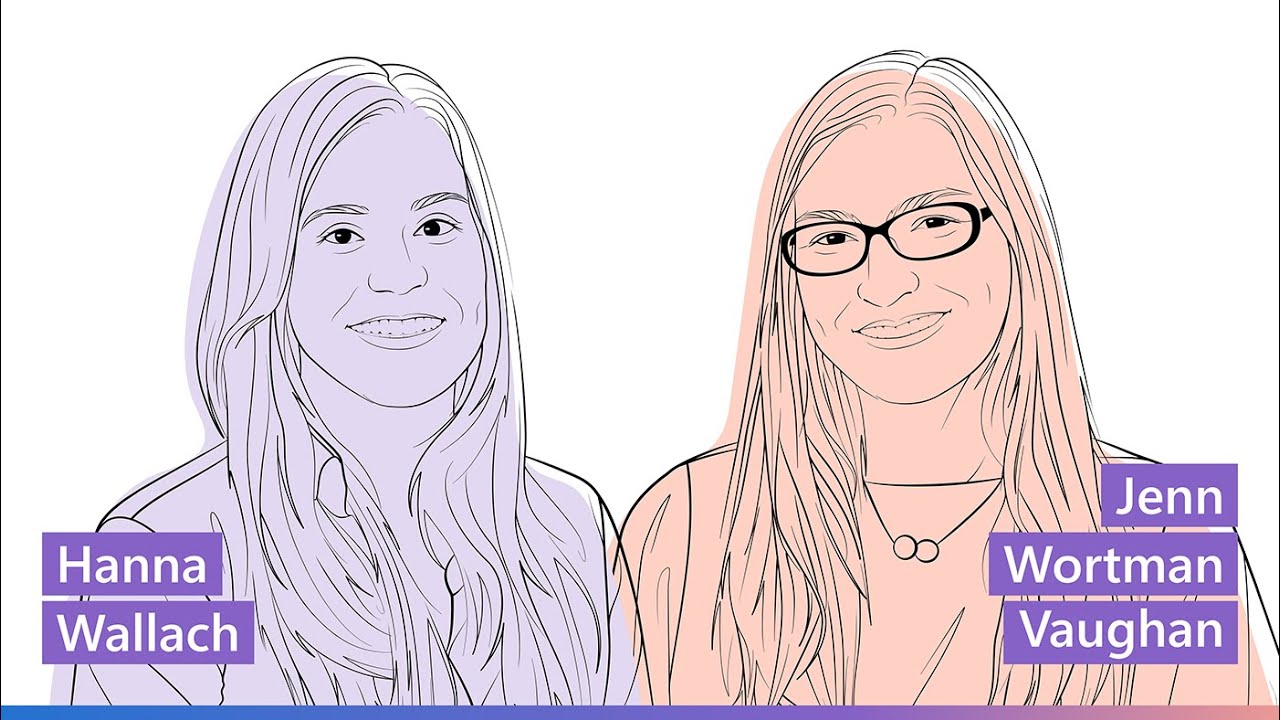
Co-founders Jenn Wortman Vaughan and Hanna Wallach reflect on 20 years of the Women in Machine Learning (WiML) workshop, discussing its origins, their parallel careers in responsible AI, and the future challenges of evaluating generative AI and fostering critical thought.
Parallel Paths to Responsible AI
Jenn Wortman Vaughan and Hanna Wallach began their careers on parallel, often intersecting, paths before joining Microsoft Research to work on responsible AI. Twenty years ago, as PhD students, their interests already pointed toward the human side of AI.
- Hanna Wallach, a PhD student at the University of Cambridge, focused on Bayesian latent variable models for text analysis. She was interested in text not for its own sake, but as a medium of human communication, which led her toward computational social science.
- Jenn Wortman Vaughan, a PhD student at the University of Pennsylvania, worked on machine learning theory and algorithmic economics. She was drawn to the intersection of people and AI systems, though her early work modeled “people” as mathematically ideal agents, avoiding the “mess of the real world.”
Both experienced the male-dominated environment of computer science departments at the time. Jenn recalls being the only woman in her incoming PhD class of 20 students. They found that building a small community, like their “weekly ladies brunch,” was crucial for support and perseverance. This early experience underscored the importance of community, a theme that would define much of their future work.
Their transition from academia to Microsoft Research (MSR) was driven by a search for a better research fit. Jenn joined the newly-opened MSR NYC lab in 2012, attracted by its unique focus on machine learning, algorithmic economics, and computational social science—a perfect intersection for her work. Hanna followed a few years later, after realizing that despite having a “dream job” in academia, she wasn’t happy. MSR offered her the unique opportunity to continue her specific line of interdisciplinary research with the support of an exceptional community.
Pivoting to Responsible AI Through Practice-Grounded Research
Their collaboration at MSR deepened as they shifted their focus toward what is now known as responsible AI. This shift was catalyzed by key research projects that revealed a significant gap between academic theory and real-world practice.
-
Interpretability as a Latent Property: A conversation about the importance of communicating uncertainty in AI systems led them to study the burgeoning field of interpretability. They found that many claims about model interpretability were made without defining who the model was interpretable to or for what purpose. Their research, conducted with colleagues, framed interpretability as a latent property influenced by various factors (e.g., number of features, UI design) and demonstrated that researchers’ intuitions about what makes a model interpretable are often unreliable without testing them on real people.
-
The Gap Between Fairness Research and Practice: A project with intern Ken Holstein, originally intended to design user experiences for fairness toolkits like Fairlearn, became a foundational study on the needs of industry practitioners. They discovered two key things:
- The academic literature at the time was hyper-focused on fairness for predictive models (classification/regression), whereas practitioners were working with a much wider range of applications, including unsupervised and language-based models.
- Practitioners struggled to use existing quantitative fairness metrics due to real-world complexities, particularly data challenges like the collection of sensitive attributes.
This work highlighted the necessity of qualitative, practice-grounded research to understand the actual challenges practitioners face, rather than making assumptions from an academic ivory tower.
The Origin and Evolution of Women in Machine Learning (WiML)
The idea for WiML was born at NeurIPS 2005. At the time, NeurIPS was a much smaller conference of about 600 people. Hanna, sharing a hotel room with other women for the first time, sat down with four others to list all the women they knew in machine learning. They came up with about 10 names.
Excited by the idea of bringing this small community together, Hanna, Jenn, and Lisa Wainer submitted a proposal for a session at the Grace Hopper conference. The proposal was rejected. In what they now describe as a “bold move” for three PhD students, they decided to organize their own co-located workshop anyway. The first WiML workshop, held the day before Grace Hopper, hosted around 100 women for a full day of research talks and posters.
The workshop faced several challenges in its early years:
- Justifying its Existence: Some members of the ML community didn’t see the need for a women-focused event, arguing that women’s experiences were no different from men’s.
- Sustainable Funding: After initial funding from the University of Pennsylvania, they secured an NSF grant and corporate donations to create a sustainable model.
- Finding the Right Venue: They moved the workshop from Grace Hopper to NeurIPS to better align with the research focus. This also had the benefit of enabling attendees to use their travel funding to attend the main conference and providing them with a familiar network of faces throughout the event.
Over 20 years, WiML has evolved from a one-off event into a robust non-profit organization with a board, a global mentorship program, and a significant presence at NeurIPS. Its success has also inspired the creation of numerous other affinity groups, such as Black in AI, LatinX in AI, and Queer in AI.
Current Research Frontiers: GenAI Evaluation and Critical Thought
Their research continues to evolve with the field.
-
Hanna Wallach is focused on the challenge of evaluating generative AI systems. She argues that this is fundamentally a social science measurement challenge. Concepts like “harmful content” or “memorization” are abstract and contested, much like concepts such as “democracy” in political science. She advocates for adopting the rigorous measurement frameworks used in the social sciences to bring more scientific validity to GenAI evaluations.
-
Jenn Wortman Vaughan is exploring AI and critical thought. Her work aims to design AI systems that support appropriate reliance, preserve human agency, and encourage critical engagement. She sees a risk of a future where overreliance on AI leads to atrophied skills, diminished innovation, and a “loss of joy” in activities we delegate. The goal is to build AI that enriches human capabilities and deepens our thinking, a future she believes must be intentionally designed for.
Advice to Their Younger Selves
Reflecting on their 20-year journey, they offered advice to their past selves:
-
Jenn’s Advice:
- Be brave about speaking up: Develop strategies to overcome shyness and introversion.
- Work on problems you want to see solved: Focus on research you are passionate about and feel good talking about after the work is done.
- Bring more people into your work: Recognize that the best research comes from collaboration and diverse perspectives.
-
Hanna’s Advice:
- Pursue fulfilling work: Push for the work you find most fulfilling, even if it means taking a non-traditional, interdisciplinary path.
- Be brave and share your work: Don’t let perfectionism prevent you from sharing your research with the community.
- Value the social side of research: Building friendships and social connections is as crucial as the technical work, providing a vital support network and fostering collaboration.