Tokenless

Interactive discovery

Explore the topic map

Follow the connections between themes, people, and ideas across the Tokenless archive in an interactive topic modeling map.

Machine Learning

View All
Judge a Transaction by the Company It Keeps — Somya Rai & MD Sharique, EXL

Judge a Transaction by the Company It Keeps — Somya Rai & MD Sharique, EXL

EXL developed an advanced fraud detection system that augments XGBoost with Graph Neural Network (GNN) embeddings. Traditional tabular models struggle to capture fraud signals residing in transaction neighborhoods. The system's innovative design includes meticulous sampling strategies, disjoint monthly graph construction for leakage control, and a GraphSAGE architecture that aggregates mean, max, and standard deviation of neighbor features to detect subtle fraud patterns. Emphasizing explainability for regulatory compliance and analyst trust, it also features a highly optimized serving architecture achieving 3ms P99 latency, pivoting to edge prediction to reduce cache footprint from 60GB to 2-3GB. This led to a 27-33% relative lift in true positive rates and a projected $65 million incremental fraud capture.

From 15% to 90% GPU Utilization: Fix the Data Pipeline, Not the Model

From 15% to 90% GPU Utilization: Fix the Data Pipeline, Not the Model

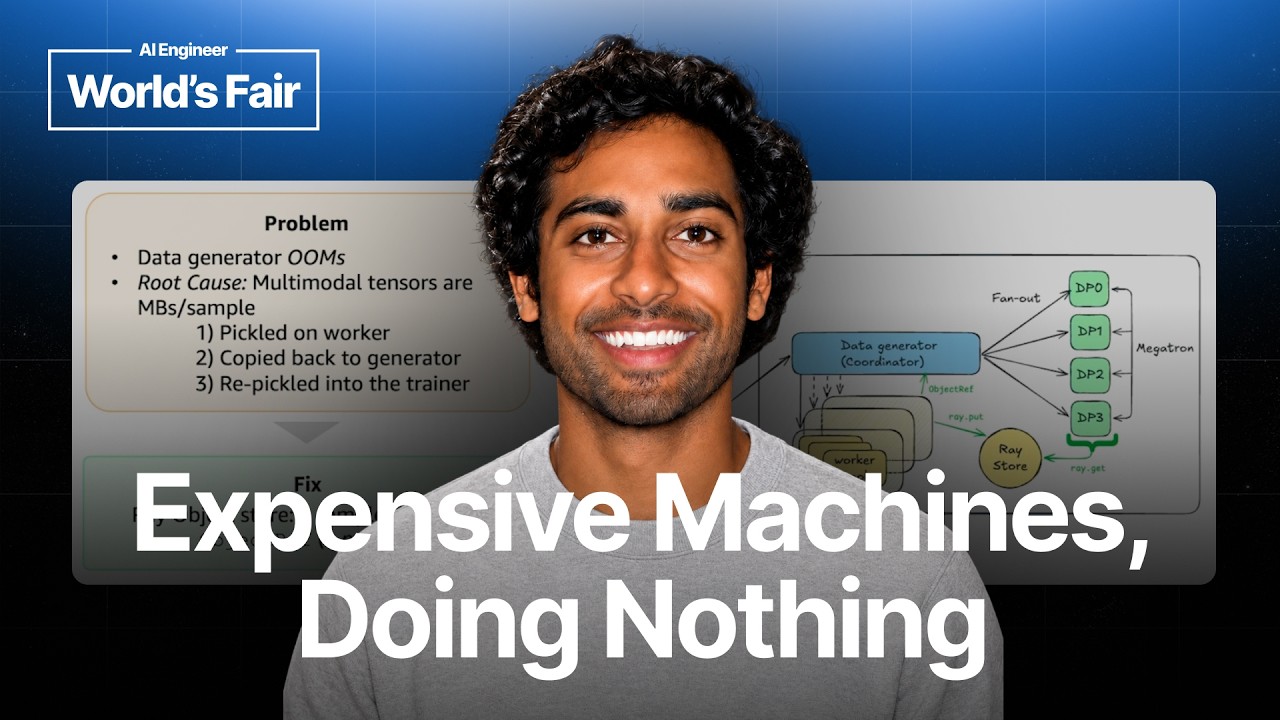
Tarun Sunkaraneni from Amazon AGI shows how a multimodal SFT pipeline that spent about 85% of its time waiting on data was brought to roughly 90% GPU utilization. He walks through concurrency with asyncio and Ray actors, prefetching, zero-copy transfer via Ray's object store, and a network-card bottleneck that appears only at scale, and argues that the hardest part of training throughput is often keeping GPUs fed rather than optimizing the model.

Small Models, Big Results: Training a Finance Agent for Under $500 — Charles Dickens, Snorkel AI

Small Models, Big Results: Training a Finance Agent for Under $500 — Charles Dickens, Snorkel AI

Snorkel AI and UC Berkeley's Sky Computing Lab show that a 4B Qwen3 model, trained with reinforcement learning for under $500 using the rLLM framework, beats its 235B sibling on expert-validated financial question answering built from SEC 10-K filings. The talk covers the FinQA dataset construction and verification, common failure modes of frontier models, transfer to multi-table and general tool-use tasks, and ablations showing that simple data and binary rewards outperform more elaborate setups, since the real bottleneck is disciplined tool use rather than reasoning depth.

Artificial Intelligence

View All
Why Leibniz Couldn't Find the Mind Inside the Mill (Joscha Bach)

Why Leibniz Couldn't Find the Mind Inside the Mill (Joscha Bach)

Joscha Bach lays out his Machine Consciousness Hypothesis, the claim that consciousness is a simple biological learning algorithm which self-organising machines might rediscover. The discussion covers causal patterns and software, why IIT and the explanatory gap fail to explain experience, zombies and LLM self-reports, functionalism, Gödel and the Ruliad, and what evidence could ever settle the question.

I Made a Fruit Fly Review My Code - Nick Nisi, WorkOS

I Made a Fruit Fly Review My Code - Nick Nisi, WorkOS

Nick Nisi argues that human reviewers have become the bottleneck in software development and demonstrates a simulated fruit fly connectome trained to judge code quality, reaching about 88% accuracy in testing. He then proposes a tiered review system where team skills, classifiers, and automated reviewers send only risky pull requests to people, backed by verifiable proof.

Why We Rebuilt Microsoft Office From Scratch for AI Agents - Yijia Liang, Compound AI

Why We Rebuilt Microsoft Office From Scratch for AI Agents - Yijia Liang, Compound AI

Yijia Liang, founder of Compound and former finance analyst, explains why personal agents succeeded and what finance needs beyond them: multiplayer agents with their own inboxes, a headless Office engine rebuilt with agents, and agent swarms that navigate massive data rooms and models while keeping every output grounded in citations.

Technology

View All
Why Founders Are Betting Big on Factories, Mines, and Energy

Why Founders Are Betting Big on Factories, Mines, and Energy

Erin Price-Wright and Connor Love unpack the AD50 and the rebuilding of America's industrial base, covering how defense demand is financing manufacturing capacity for commercial markets, how AI is reshaping factory economics, how a new generation of founders applies lessons from SpaceX, Tesla, Anduril, and Palantir to mining, energy, and manufacturing, and why private capital is now willing to fund physical infrastructure before government demand is guaranteed.

Mark Cuban’s Plan to Make Healthcare Affordable

Mark Cuban’s Plan to Make Healthcare Affordable

Mark Cuban and Julie Yoo discuss how transparency, direct contracting, and AI could reshape healthcare economics, from Cost Plus Drugs and modular pod manufacturing to personalized medicine, the future of physicians, and advice for founders who want to use AI to learn rather than to stop thinking.

Exploits Now Beat Patches: Open Source Security in the AI Era - Patrick Smyth, Chainguard

Exploits Now Beat Patches: Open Source Security in the AI Era - Patrick Smyth, Chainguard

Patrick Smyth of Chainguard examines how frontier AI has compressed the time between vulnerability disclosure and exploitation, leaving 30-day remediation cycles obsolete. The talk covers AI-assisted attacks, waves of supply chain malware, four attack surfaces spanning malware, known CVEs, zero days, and side doors like CI/CD, developer laptops, and agent skills, and practical defenses including cooldown periods, faster CVE remediation, and signing artifacts with SLSA and Sigstore.


Recent Post

Beyond Bigger Models: Recursion As The Next Scaling Law In AI

Beyond Bigger Models: Recursion As The Next Scaling Law In AI

Recent advancements with Hierarchical Reasoning Models (HRM) and Tiny Recursive Models (TRM) show how recursion at inference time enables small, 7-million parameter models to outperform models 1000x their size on complex reasoning tasks. This is achieved by giving models compute depth to break through the inherent reasoning ceilings of standard feed-forward Transformers.

Getting Humans Out of the Way: How to Work with Teams of Agents

Getting Humans Out of the Way: How to Work with Teams of Agents

Rob Ennals, creator of Broomy, discusses a paradigm shift in working with AI coding agents: moving away from micromanagement towards orchestrating teams of parallel agents. The key is to design robust, automated validation systems and reshape the development environment to empower agents to work autonomously, efficiently, and at scale.

988: In Case You Missed It in April 2026 — with @JonKrohnLearns

988: In Case You Missed It in April 2026 — with @JonKrohnLearns

This episode explores the foundations of AI agent memory, drawing parallels with human neuroscience. It also covers the practical impact of AI on data engineering roles, the democratization of AI development through low-code tools, and innovative applications of AI in elementary education to foster critical thinking.

Granite 4.1, IBM Bob & building a quantum ecosystem

Granite 4.1, IBM Bob & building a quantum ecosystem

This episode of Mixture of Experts breaks down IBM's enterprise-focused Granite 4.1 and Project Bob, Google DeepMind's DiLoCo distributed training method, the inference-efficient DeepSeek V4 model, and IBM's strategy for achieving quantum advantage through strategic partnerships.

Running AI Engineer with AI — swyx

Running AI Engineer with AI — swyx

Swyx, co-founder of the AI Engineer conference, reveals how his "tiny team" of nine people leverages AI agents like Cognition's Devin and Town Assistant to manage a multi-million dollar business and organize large-scale events. He shares practical examples of how agents have transformed their workflow, from converting Figma designs to pixel-perfect websites to managing complex conference schedules and even performing personal research tasks, arguing for a future focused on "Agent Experience" (AX).

Robots Don't Need More Compute. They Need This.

Robots Don't Need More Compute. They Need This.

Encord co-founders Eric and Ulrich discuss their $60M Series C, the company's origins before the AI hype, and their focus on building the essential data infrastructure for physical AI and robotics—the next frontier after LLMs.

Stay In The Loop! Subscribe to Our Newsletter.

Get updates straight to your inbox. No spam, just useful content.