Tokenless

Interactive discovery

Explore the topic map

Follow the connections between themes, people, and ideas across the Tokenless archive in an interactive topic modeling map.

Machine Learning

View All
Frontier results, on device - RL Nabors, Arize

Frontier results, on device - RL Nabors, Arize

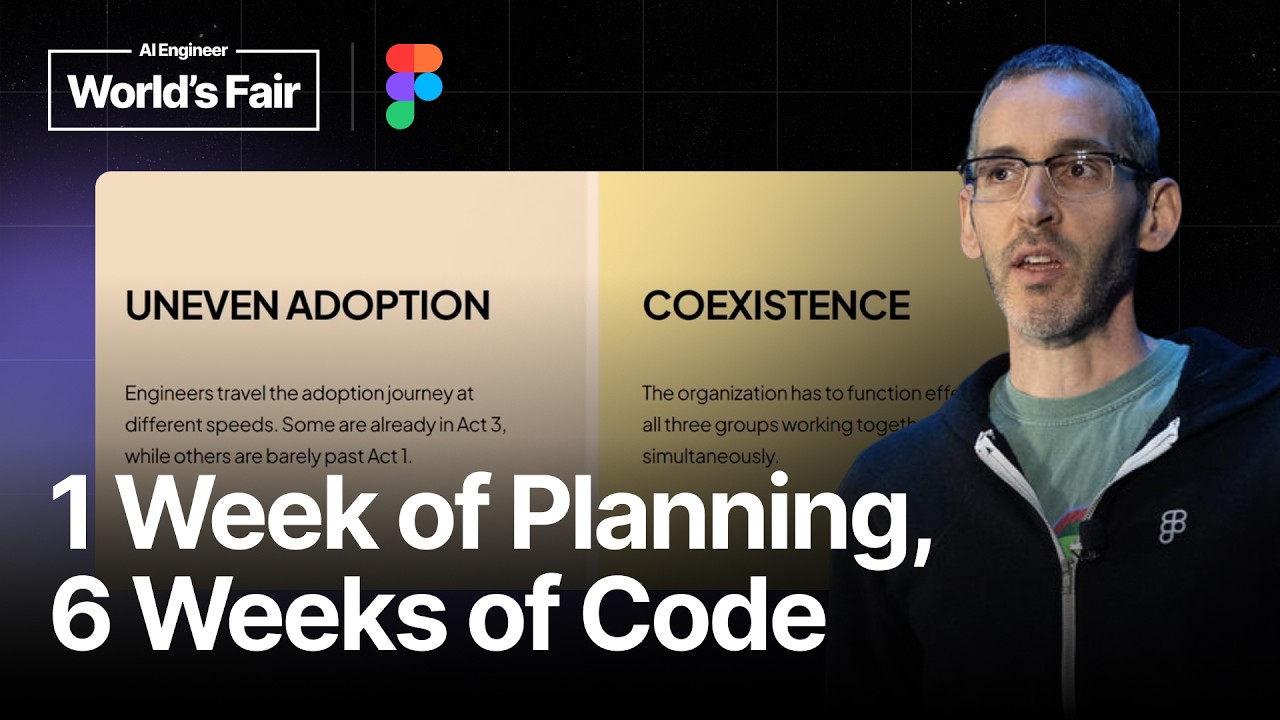
RL Nabors discusses the significant costs associated with using frontier AI models, covering security, latency, and financial implications. She introduces a framework for right-sizing AI solutions by leveraging smaller, task-specific models and Small Language Models (SLMs). The framework details how to prove task feasibility, establish success criteria with golden datasets, conduct capability evaluations (using tools like Phoenix), and select the most appropriate "Small And Good Enough" (SAGE) model. Nabors further demonstrates how prompt engineering, particularly few-shot prompting, and post-processing can close performance gaps with larger models, while advocating for continuous regression evaluations to maintain performance integrity. The overarching message is to "prototype big, deploy small" to optimize AI deployments.

Research to Reality: Bringing Frontier ML Research to Production - Vaidas Razgaitis, Higharc

Research to Reality: Bringing Frontier ML Research to Production - Vaidas Razgaitis, Higharc

Vaidas Razgaitis, Senior Research Engineer at Higharc, shares three tactical tips to accelerate the transition of novel AI/ML research into production-ready features. He emphasizes addressing the critical handoff challenge between ML researchers and software engineers through structured documentation (Research Prototype Taxonomy Document), a well-organized monorepo utilizing decoupled microservices, and a systematic approach to code decomposition and PR review. These strategies aim to improve legibility, maintainability, and delivery speed for ML-driven products.

Uncertainty-Guided Data Augmentation for Engineers | Deep Dive - Yongmin Kwon

Uncertainty-Guided Data Augmentation for Engineers | Deep Dive - Yongmin Kwon

This session details a data-efficient method for training engineering surrogate models by using uncertainty quantification (UQ) to guide geometric data augmentation. Instead of random deformations, the approach lets the deep ensemble model identify its own knowledge gaps (epistemic uncertainty), then uses Free-Form Deformation (FFD) to generate new shapes specifically in those uncertain regions. This ensures every expensive simulation run yields maximally informative data, significantly improving model accuracy for a fixed computational budget across domains like structural mechanics and aerodynamics.

Artificial Intelligence

View All
a16z Goes Global: Why American Tech Must Lead the World

a16z Goes Global: Why American Tech Must Lead the World

This discussion explores a16z's expanding international strategy, emphasizing technology's pivotal role in economic growth and national security. The panel delves into why America's tech leadership is crucial globally, how AI is redefining government-private sector relationships, and the drive for countries to adopt frontier technologies while building local innovation ecosystems. Key topics include AI infrastructure, cybersecurity, defense tech, global startup expansion, and the elements of enduring tech ecosystems, highlighting trusted partnerships and the importance of Western technology.

GPT-5.6 Sol, FIFA AI & Wall Street’s AI nerves

GPT-5.6 Sol, FIFA AI & Wall Street’s AI nerves

OpenAI's new GPT-5.6 Sol model sparks debate on AI safety and release strategies, while Wall Street expresses growing skepticism over the long-term economics of frontier AI models. The discussion also touches on AI's impact on the FIFA World Cup and a thought-provoking paper comparing LLM anthropomorphism to Age of Empires II "goats."

The Prompt Is Still a Punch Card - Ted Johnson, JoinIn AI

The Prompt Is Still a Punch Card - Ted Johnson, JoinIn AI

Ted Johnson argues that current AI interfaces, particularly prompting, operate on an outdated "batch processing" protocol akin to punch cards. Despite advanced LLM capabilities, this interface design forces humans to adapt to machines, hindering natural interaction. He advocates for a shift towards human-compatible interfaces where AI actively participates in real-time conversation, leveraging its intelligence to remove user burdens and amplify human potential.

Technology

View All
Are Your Tests Slowing You Down? • Trisha Gee • GOTO 2025

Are Your Tests Slowing You Down? • Trisha Gee • GOTO 2025

Trisha Gee delivers a compelling talk on Developer Productivity Engineering (DPE) for testing, dissecting common pain points in writing, troubleshooting, and running tests. She advocates for strategic use of IDEs, advanced tooling like build caches and predictive test selection (leveraging ML), and a disciplined approach to test design to overcome these challenges, emphasizing that good tests serve as crucial living documentation.

The new post-quantum cryptography executive order. Plus: What is Q-Day, really?

The new post-quantum cryptography executive order. Plus: What is Q-Day, really?

This episode delves into Q-Day, the anticipated future when quantum computers can break public key cryptography, and the U.S. Executive Order accelerating the transition to post-quantum cryptography. Experts discuss why Q-Day is a gradual process rather than a sudden event, the critical importance of "crypto-agility" as a long-term strategy, and the necessity for organizations to begin immediate discovery and planning to secure data against "collect now, decrypt later" threats. The discussion also touches upon the broader, transformative benefits of quantum computing beyond just security.

Plenary Talk 3​: Challenges and research opportunities for global hyperscale services

Plenary Talk 3​: Challenges and research opportunities for global hyperscale services

Jim Kleewein's talk outlines the immense challenges and critical research opportunities in building and operating global hyperscale services like Microsoft 365 and Azure. He emphasizes that at this scale, traditional approaches fail, necessitating a "new golden age of applied research" across areas like continuous availability, data management, security, and sustainability. Kleewein also discusses AI's powerful but limited role, stressing the ongoing need for human expertise, and highlights the ethical imperative to prevent failures that can have life-or-death consequences.


Recent Post

Vision: Zero Bugs — Johann Schleier-Smith, Temporal

Vision: Zero Bugs — Johann Schleier-Smith, Temporal

This talk explores the history of high-assurance software, from the near-perfect code of the NASA Space Shuttle to the Airbus A320. It argues that while these rigorous engineering and formal verification practices were once too expensive for mainstream use, the economic shift brought by AI and agentic coding can make aerospace-level reliability a practical reality for a wide range of applications, solving the key quality limitations of current AI-generated code.

Fully Connected 2025 kickoff: The rise (and the challenges) of the agentic era

Fully Connected 2025 kickoff: The rise (and the challenges) of the agentic era

Robin Bordoli of Weights & Biases explores AI's exponential growth, from past achievements to the current agentic landscape. He discusses the rise of reinforcement learning, the challenge of productionizing reliable agents, and highlights how foundational issues in AI development persist even as model capabilities soar.

Fully Connected keynote: Building tools for agents at Weights & Biases

Fully Connected keynote: Building tools for agents at Weights & Biases

A summary of the keynote by Lukas Biewald (Weights & Biases) and Camille Fournier (CoreWeave) at Fully Connected London 2025. They discuss recent product updates for W&B Models and Weave, the synergy behind the CoreWeave acquisition, and a deep dive into building and automating an autonomous software engineer agent.

The 2045 Superintelligence Timeline: Epoch AI’s Data-Driven Forecast

The 2045 Superintelligence Timeline: Epoch AI’s Data-Driven Forecast

Epoch AI researchers discuss the AI landscape, arguing against a bubble due to strong enterprise spending and profitability. They forecast significant economic shifts, including a potential 30% GDP growth with advanced AI and the automation of 10% of current jobs this decade. The summary covers the unlikelihood of a software-only singularity, the reality of data center buildouts (with Anthropic surprisingly in the lead), and why energy 'bottlenecks' are economic trade-offs, not hard limits. Also explored are timelines for AI solving major mathematical problems and why robotics remains primarily a hardware challenge.

AI That Can Change Its Mind? (New Architecture) [w/ Sakana CTO]

AI That Can Change Its Mind? (New Architecture) [w/ Sakana CTO]

Llion Jones, a co-inventor of the Transformer, and his colleague Luke Darlow from Sakana AI argue that the AI industry is trapped in a local minimum by the Transformer's success. They discuss the architecture's fundamental limitations using the 'spiral problem' analogy and introduce their new, biology-inspired Continuous Thought Machine (CTM), an architecture designed for more human-like, sequential reasoning and adaptive computation.

Context Engineering & Agentic Search with the CEO of Chroma

Context Engineering & Agentic Search with the CEO of Chroma

Jeff Huber, CEO of Chroma, discusses "context rot," the degradation of AI performance in large context windows, and outlines a new vision for retrieval infrastructure. He covers the evolution of search, the importance of a two-stage recall-then-precision pipeline, and the challenges of agentic memory, advocating for a shift from AI "alchemy" to reliable engineering.

Stay In The Loop! Subscribe to Our Newsletter.

Get updates straight to your inbox. No spam, just useful content.