Ml

Has AI Finally Cracked Time Series Forecasting?

Has AI Finally Cracked Time Series Forecasting?

Ameet Talwalkar, CMU professor and Datadog's Chief Scientist, traces the journey of time series foundation models from early skepticism to their current impact. He details Datadog's Toto V1 and V2, highlighting breakthroughs in zero-shot performance, scaling, and the crucial role of data mix. The discussion extends to the vision of 'world models' for observability, integrating diverse data for self-healing software systems, and concludes with insights on open-weights models and AI's transformative effect on computer science and academic research.
The Prime Intellect Stack — Will Brown, Prime Intellect

The Prime Intellect Stack — Will Brown, Prime Intellect

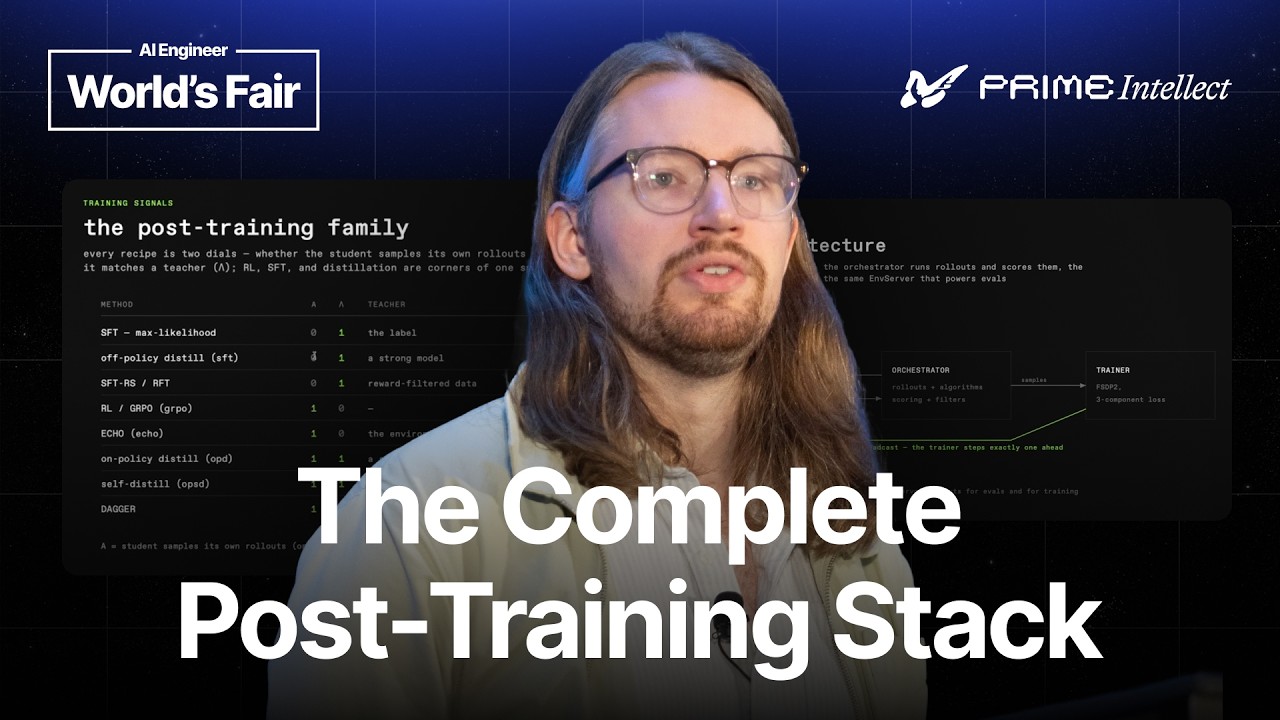
Deep dive into Prime Intellect's open-source ecosystem for post-training LLMs, covering the modular Verifiers V1 environment design, the asynchronous and scalable Primer RL training framework, and the Lab platform for hosted training and fine-tuning. Learn about advanced reward systems, the interception server pattern, and tokenization control with the Renderers library, all designed to enable frontier agentic model development.

SWE-Marathon: Evaluating Coding Agents at Billion-Token Scale - Rishi Desai, Abundant AI

SWE-Marathon: Evaluating Coding Agents at Billion-Token Scale - Rishi Desai, Abundant AI

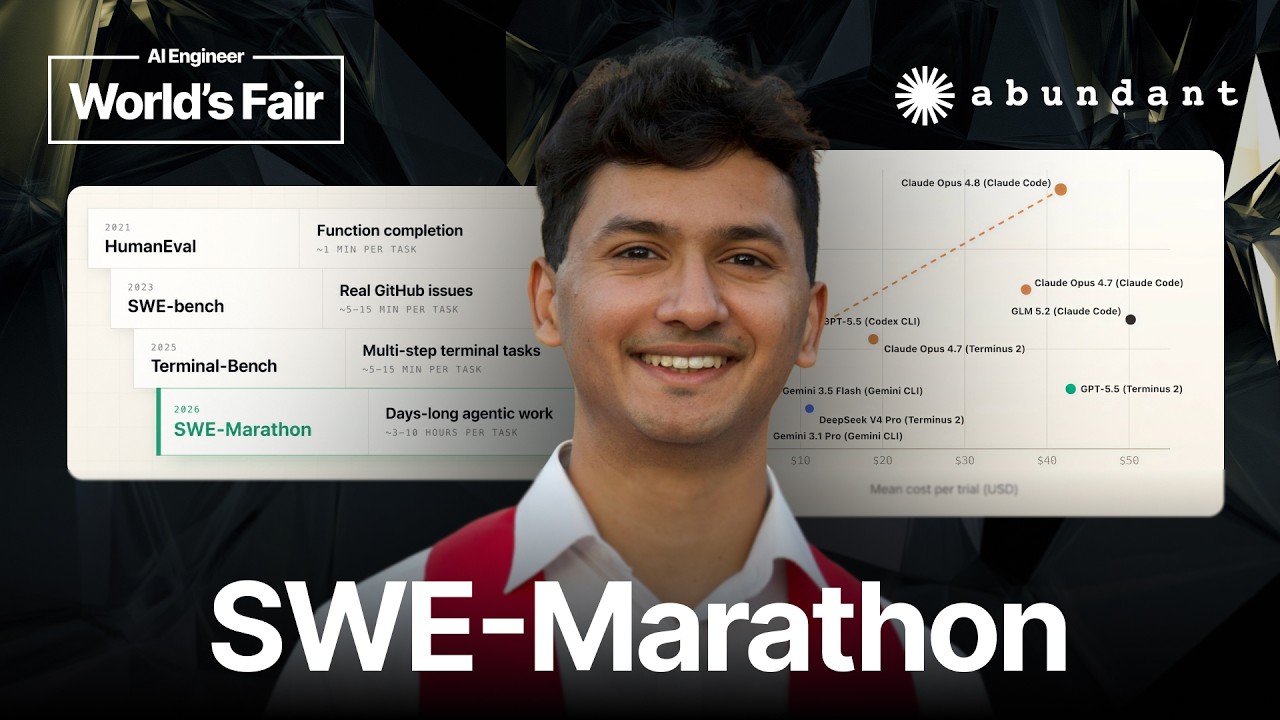
SWE-Marathon introduces a benchmark for long-horizon autonomous software engineering, pushing coding agents from bug fixes to full project ownership. It highlights the critical need for robust, multi-layered verification and anti-cheat mechanisms to prevent reward hacking in tasks spanning hundreds of millions of tokens, revealing that current agents achieve only a 26% success rate.

Reinforce Adjoint Matching: Scaling Diffusion RL

Reinforce Adjoint Matching: Scaling Diffusion RL

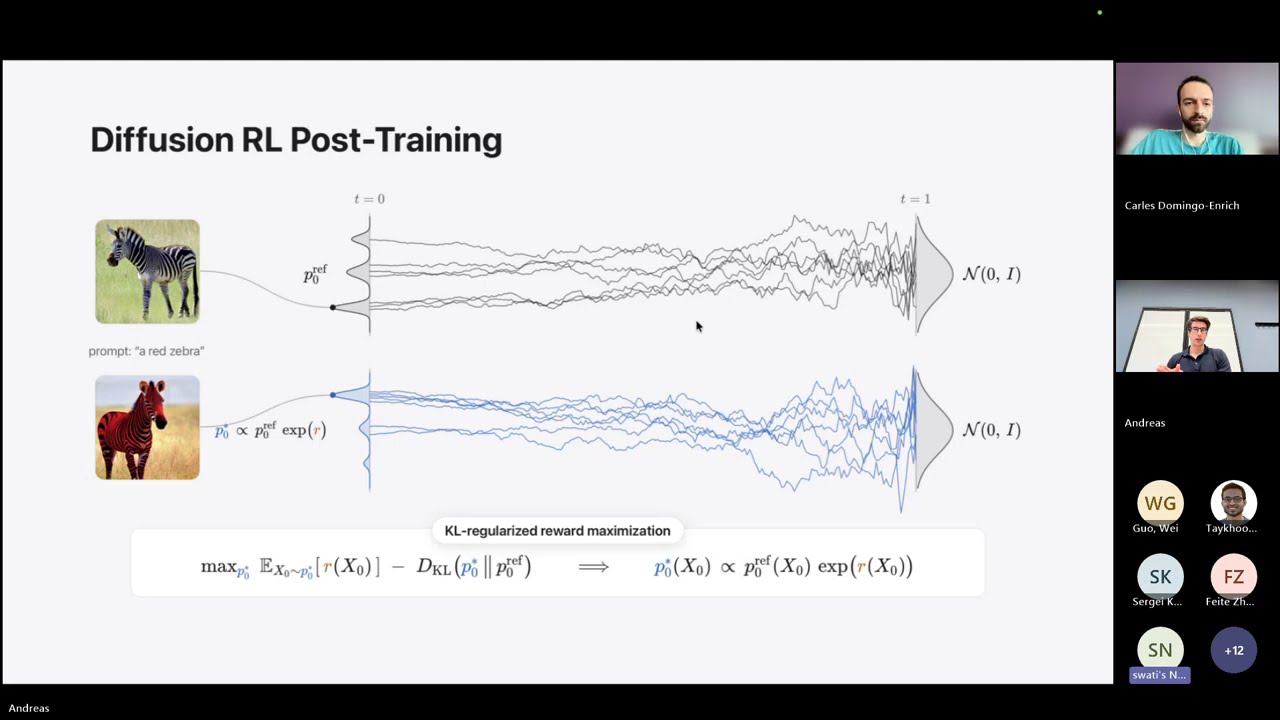
Andreas Bergmeister presents Reinforce Adjoint Matching (RAM), a novel method for scalable reinforcement learning post-training of diffusion models. RAM sidesteps the complexity of existing RL approaches by deriving a consistency loss that directly corrects the pre-training target with a reward signal, eliminating the need for costly SDE rollouts or reward gradients. This approach achieves superior performance and up to 50x faster convergence on challenging image generation tasks like complex composability, text rendering, and human preference alignment.

Frontier results, on device - RL Nabors, Arize

Frontier results, on device - RL Nabors, Arize

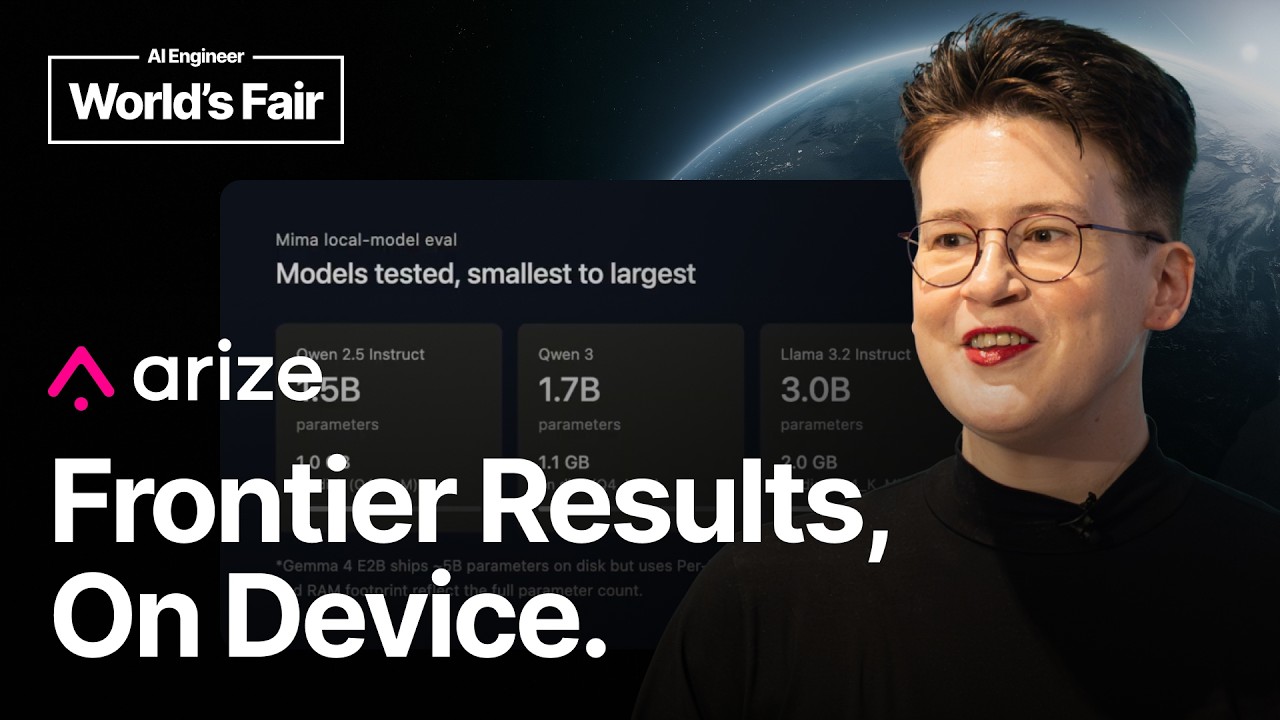
RL Nabors discusses the significant costs associated with using frontier AI models, covering security, latency, and financial implications. She introduces a framework for right-sizing AI solutions by leveraging smaller, task-specific models and Small Language Models (SLMs). The framework details how to prove task feasibility, establish success criteria with golden datasets, conduct capability evaluations (using tools like Phoenix), and select the most appropriate "Small And Good Enough" (SAGE) model. Nabors further demonstrates how prompt engineering, particularly few-shot prompting, and post-processing can close performance gaps with larger models, while advocating for continuous regression evaluations to maintain performance integrity. The overarching message is to "prototype big, deploy small" to optimize AI deployments.

Research to Reality: Bringing Frontier ML Research to Production - Vaidas Razgaitis, Higharc

Research to Reality: Bringing Frontier ML Research to Production - Vaidas Razgaitis, Higharc

Vaidas Razgaitis, Senior Research Engineer at Higharc, shares three tactical tips to accelerate the transition of novel AI/ML research into production-ready features. He emphasizes addressing the critical handoff challenge between ML researchers and software engineers through structured documentation (Research Prototype Taxonomy Document), a well-organized monorepo utilizing decoupled microservices, and a systematic approach to code decomposition and PR review. These strategies aim to improve legibility, maintainability, and delivery speed for ML-driven products.