Ml

PhylaFlow: Hybrid flow matching in phylogenetic tree space

PhylaFlow: Hybrid flow matching in phylogenetic tree space

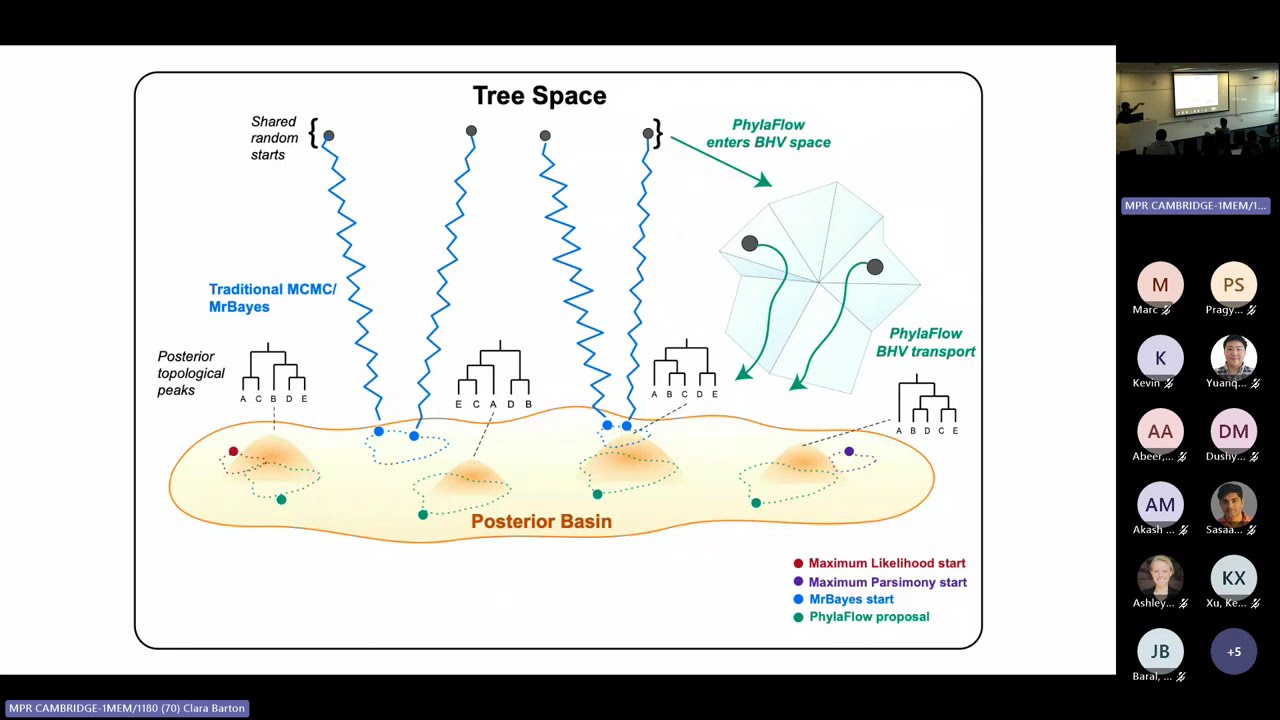
PhylaFlow is a hybrid flow-matching framework that navigates Billera–Holmes–Vogtmann (BHV) tree space to accelerate Bayesian phylogenetic inference. By learning geodesic paths from random trees to posterior samples, PhylaFlow efficiently initializes MCMC chains, drastically reducing the "burn-in" time. A PhylaFlow-MCMC variant, which guides MrBayes move acceptance, significantly outperforms traditional methods and even existing machine learning baselines for posterior sampling, achieving better results within the same computational budget. The work also explores conditioning on sequence embeddings, aiming for a future phylogenetics foundation model capable of zero-shot inference.

Infra behind Krea 2: How to train and serve at scale — Gabriel Jorge Menezes, Krea.ai

Infra behind Krea 2: How to train and serve at scale — Gabriel Jorge Menezes, Krea.ai

Krea's Gabriel Jorge Menezes shares critical insights into building the infrastructure for large-scale ML model training and serving. Key takeaways include the necessity of custom metrics beyond standard GPU utilization, aggressive checkpointing on ultra-fast storage to counter frequent cluster crashes, and a dynamic Kubernetes-based system using gang scheduling, virtual-kubelet, and taints to seamlessly shift inference workloads to external providers when training consumes on-prem GPUs. The approach highlights practical solutions for silent failures, thermal management, and optimizing resource utilization in a unified production and training environment.

RL Environments Explained: How AI Agents Learn Real-World Work | Brendan Foody, Mercor

RL Environments Explained: How AI Agents Learn Real-World Work | Brendan Foody, Mercor

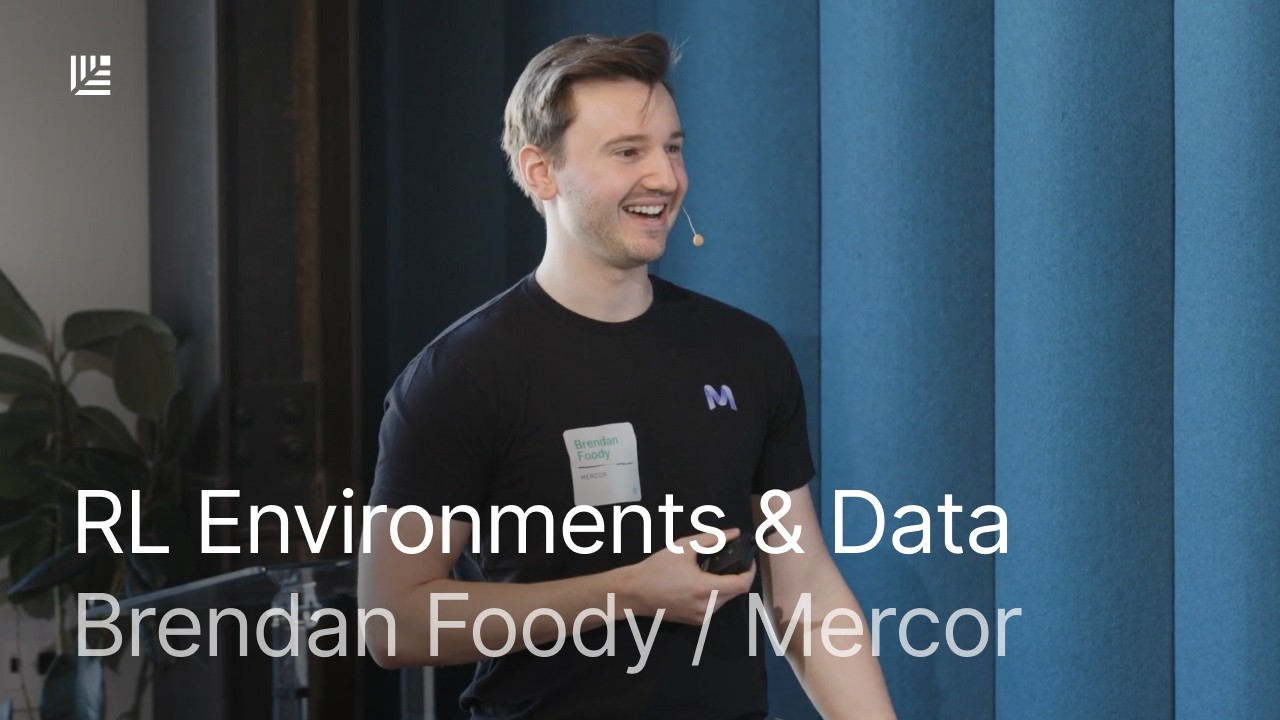
Mercor CEO Brendan Foody elucidates the concept of RL environments, essential for training advanced AI agents. He breaks down their three core components—worlds, apps, and tasks—and details Mercor's evolution from crowdsourced data to expert-driven, "agentic" data. Foody underscores the indispensable role of human experts in defining frontier tasks and creating robust verifiers, exemplified by a real legal RL environment. He shares post-training results demonstrating significant performance gains with modest compute, discusses data pricing and quality, demystifies synthetic data, and explores future directions like ultra-long-horizon tasks and virtual co-workers. The talk emphasizes that data sets are becoming a critical moat for application-layer companies, enabling them to own their intelligence.

Why Deep Networks Don’t Need to Memorize Everything — Matthieu Wyart

Why Deep Networks Don’t Need to Memorize Everything — Matthieu Wyart

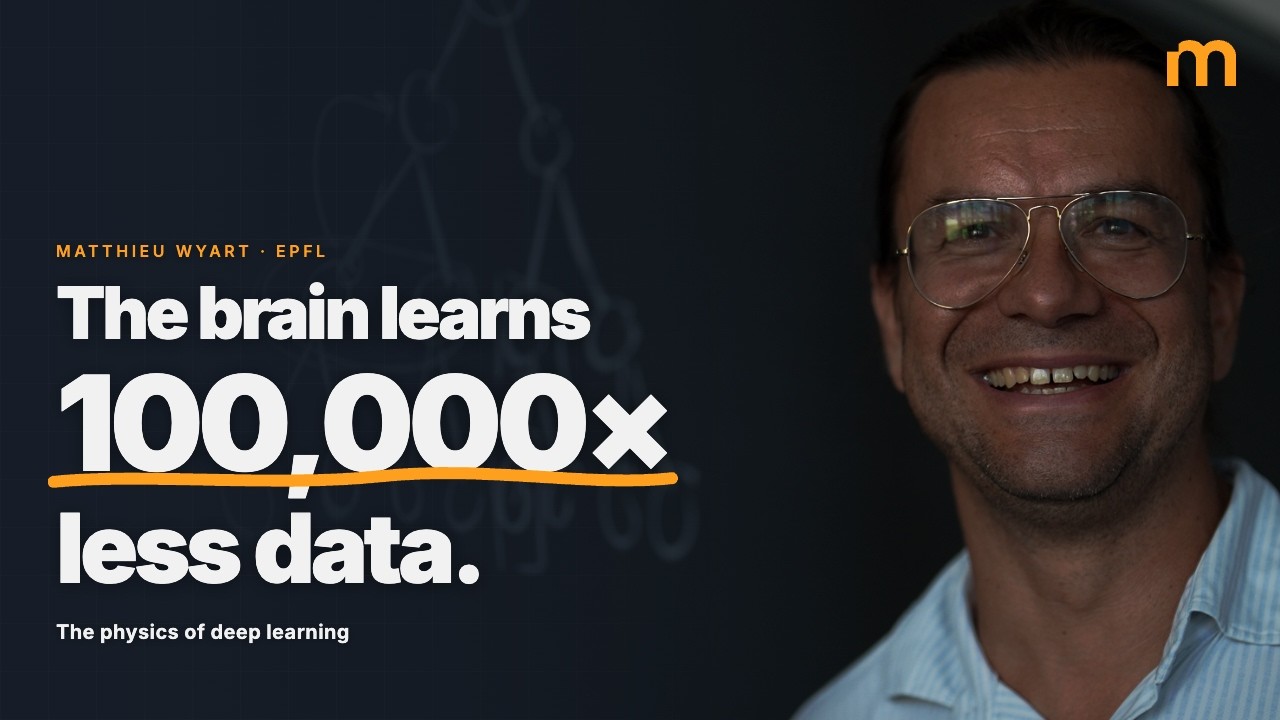
Matthieu Wyart, a statistical physicist, argues that deep networks discover abstractions by recovering hidden data hierarchies, allowing them to escape the curse of dimensionality. He explains how this mechanism, combined with predicting latent representations instead of raw tokens, can significantly improve sample efficiency. The discussion also covers the physics of rough loss landscapes, machine creativity, diffusion models, and a theoretical framework for neural scaling laws.

Taking Reinforcement Learning Cross Datacenter — Nan Jiang, Modal

Taking Reinforcement Learning Cross Datacenter — Nan Jiang, Modal

Nan Jiang introduces "Adam absorption" to revolutionize RL model synchronization. By exploiting finite precision serving and small Adam steps, less than 1% of served model weights actually change, allowing for 500MB patches instead of 500GB checkpoints. This enables a distributed "bulletin board" architecture, decoupling trainers from global rollout fleets and unlocking elastic, cross-region GPU capacity for RL.

Compression at the Edge — Chris Alexiuk, NVIDIA

Compression at the Edge — Chris Alexiuk, NVIDIA

This panel discussion explores the critical role of model compression, particularly quantization, in democratizing AI. It delves into how massive models like GLM 5.2 can be shrunk by over 80% without equivalent performance loss, thanks to techniques like mixed-precision quantization and understanding uneven layer importance. The discussion covers NVIDIA's NVFP4 format, challenges posed by new model architectures, the preference for KL divergence over accuracy benchmarks, and the vision of future AI running efficiently on all local devices.