Tool use

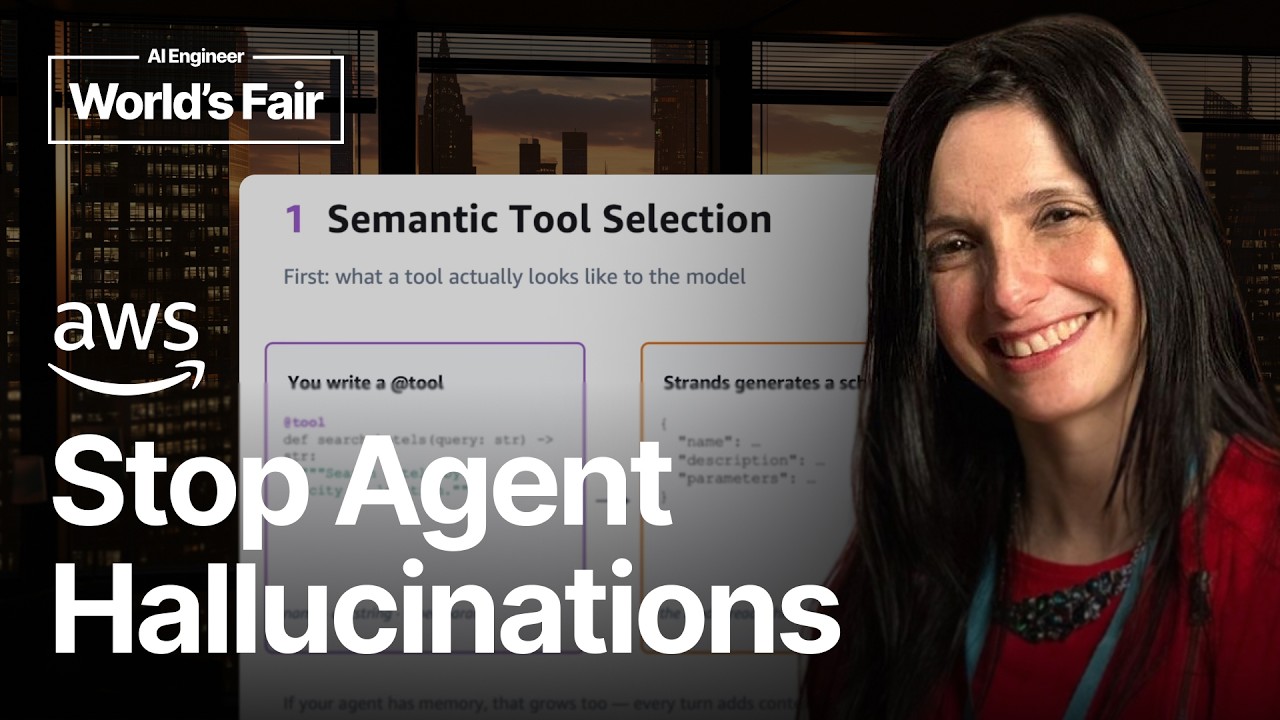
Stop AI Agent Hallucinations: 5 Techniques + Production Patterns - Elizabeth Fuentes, AWS

Stop AI Agent Hallucinations: 5 Techniques + Production Patterns - Elizabeth Fuentes, AWS

Explore five research-backed techniques to overcome common AI agent architectural limitations like hallucination, inefficient tool use, and rule violations. Learn how to implement semantic tool selection, Graph-RAG, multi-agent validation, neurosymbolic guardrails, and agent steering through code changes, not prompt engineering, and deploy them using AWS Bedrock Agent Core for robust and cost-effective AI agents.

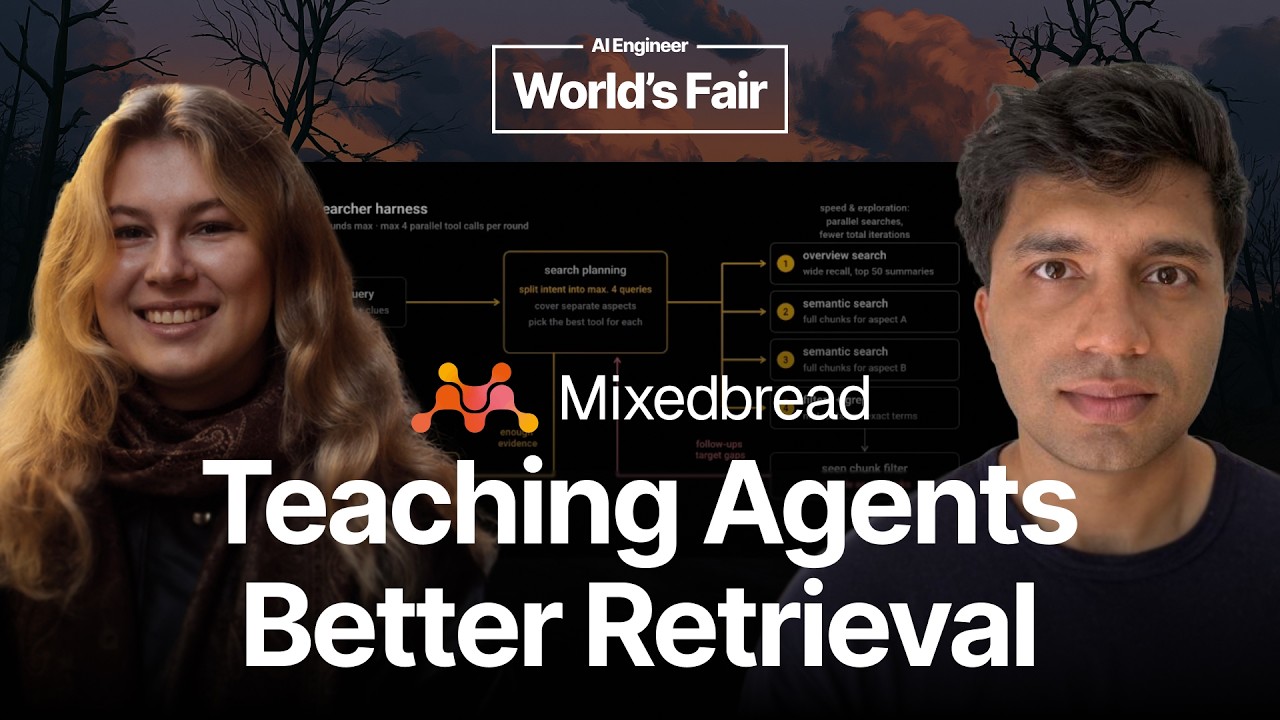
How we taught agents to use good retrieval - Hanna Lichtenberg, Mixedbread AI

How we taught agents to use good retrieval - Hanna Lichtenberg, Mixedbread AI

Mixedbread AI addresses the "Oracle Gap" – the disparity between LLM reasoning and retrieval capabilities – by developing agents trained to use advanced search tools effectively. They demonstrate how current LLMs generate poor queries due to training biases and introduce a sophisticated agent harness with diverse search tools and a unique training regimen, including supervised fine-tuning and reinforcement learning with custom rewards, to teach agents to form precise semantic queries. This approach significantly improves performance on benchmarks like Oblique Congress and Snowflake's Match QA, closing the gap between theoretical perfect retrieval and real-world agent performance.

Field Guide to Fable — Thariq Shihipar, Anthropic

Field Guide to Fable — Thariq Shihipar, Anthropic

Thariq Shihipar from Anthropic introduces Fable, their newest model, as a major leap forward, emphasizing "capability overhang" where tool use unlocks unprecedented intelligence. He provides a "field guide" on working with Fable, discussing evolving prompt engineering, advanced tool interactions (like HTML reports), and strategies for identifying project unknowns. He concludes by challenging the necessity of traditional tradeoffs, advocating for ambitious development that is both good, fast, and cheap, and urging AI engineers to prove the transformative power of AI.

Stop Making Models Bigger, Make Them Behave — Kobie Crawdord, Snorkel

Stop Making Models Bigger, Make Them Behave — Kobie Crawdord, Snorkel

Snorkel.ai's research demonstrates how a 4-billion-parameter model, fine-tuned with Reinforcement Learning for under $500, significantly outperformed a 235-billion-parameter model on financial analysis tool-use tasks. The key was cultivating 'tool discipline' and error correction capabilities, rather than relying on sheer model size or deeper reasoning. Single-table training generalized effectively to harder multi-table problems, emphasizing the importance of targeted behavioral fixes identified through detailed evaluation rubrics.

Building Agent Interfaces: Lessons from Chrome DevTools (MCP) for Agents — Michael Hablich, Google

Building Agent Interfaces: Lessons from Chrome DevTools (MCP) for Agents — Michael Hablich, Google

Michael Hablich from the Chrome DevTools team shares hard-won engineering lessons on building effective and secure interfaces for AI agents. The talk covers moving from raw data to semantic summaries, measuring interface efficiency with 'tokens per successful outcome', designing for error recovery, and the critical importance of trust boundaries and deliberate friction in UI design for agents.

SWE-rebench: Lessons from Evaluating Coding Agents — Ibragim Badertdinov, Nebius

SWE-rebench: Lessons from Evaluating Coding Agents — Ibragim Badertdinov, Nebius

Ibragim Badertdinov from Nebius AI shares lessons from building and maintaining SWE-ReBench, a monthly leaderboard that evaluates coding agents on fresh, real-world software engineering tasks. The talk covers the anatomy of a good benchmark task, the challenges of filtering out noisy or flawed problems, and fascinating examples of how advanced models like Claude Code "cheat" by exploiting the environment. Finally, it explains how the same pipeline used for evaluation has produced large-scale, high-quality training datasets like SWE-bench, used by frontier AI labs.