
Snorkel ai

Small Models, Big Results: Training a Finance Agent for Under $500 — Charles Dickens, Snorkel AI

Small Models, Big Results: Training a Finance Agent for Under $500 — Charles Dickens, Snorkel AI

Snorkel AI and UC Berkeley's Sky Computing Lab show that a 4B Qwen3 model, trained with reinforcement learning for under $500 using the rLLM framework, beats its 235B sibling on expert-validated financial question answering built from SEC 10-K filings. The talk covers the FinQA dataset construction and verification, common failure modes of frontier models, transfer to multi-table and general tool-use tasks, and ablations showing that simple data and binary rewards outperform more elaborate setups, since the real bottleneck is disciplined tool use rather than reasoning depth.
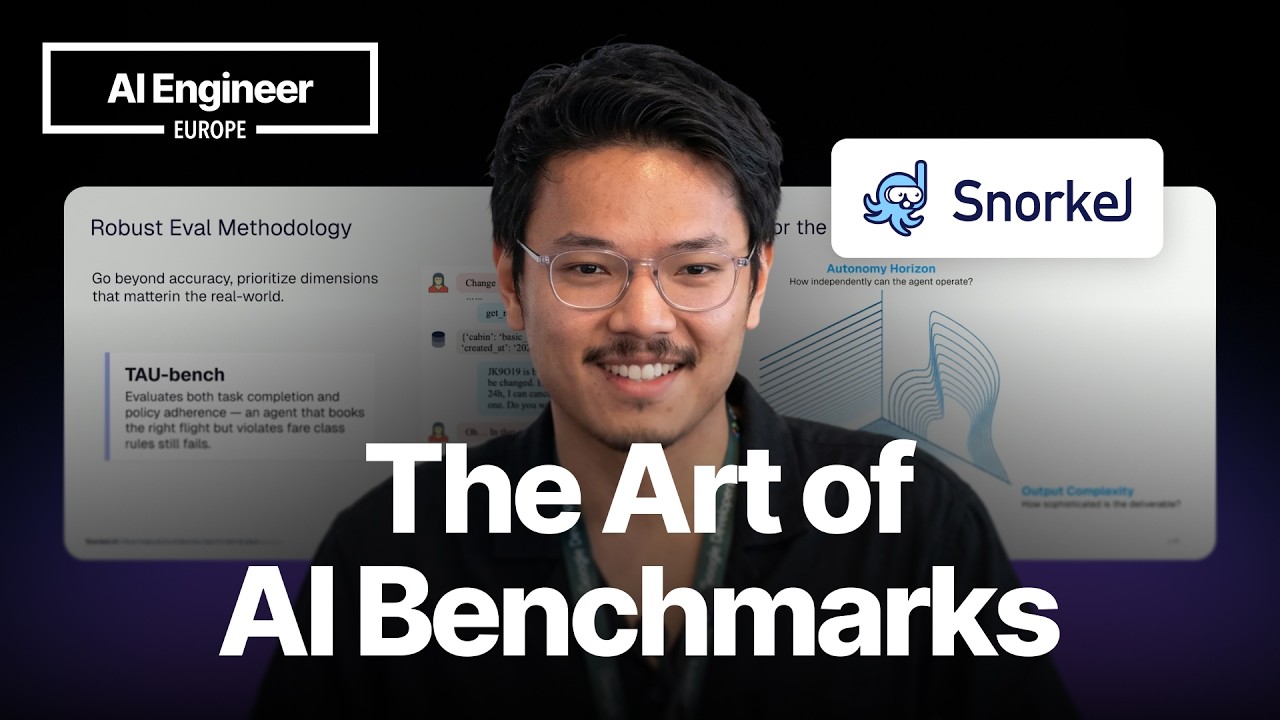
The Art & Science of Benchmarking Agents — Vincent Chen, Snorkel AI

The Art & Science of Benchmarking Agents — Vincent Chen, Snorkel AI

Vincent Chen of Snorkel AI discusses the crucial gap between rapidly advancing AI capabilities and our ability to measure them. He presents a framework for building effective benchmarks, encompassing task quality, distributional diversity, model headroom, and robust evaluation methodologies, alongside the "art" of having a clear thesis, inspiring research roadmaps, and prioritizing researcher UX. He concludes by outlining three critical axes for future benchmarks: environment complexity, autonomy horizon, and output complexity, to better reflect real-world AI applications.

Task Fidelity Scaling Laws — Kobie Crawdord, Snorkel

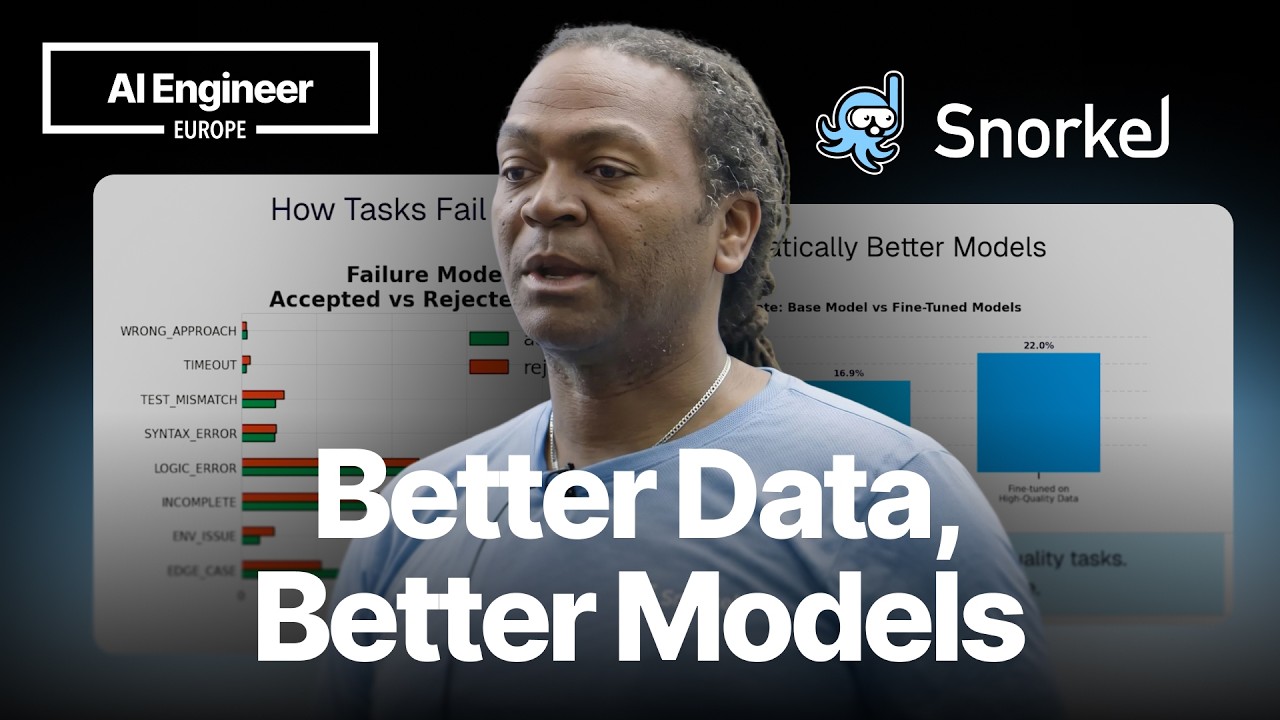
Task Fidelity Scaling Laws — Kobie Crawdord, Snorkel

An experiment by Snorkel AI reveals that in agentic AI training, the quality of tasks is paramount. Using the same model and compute, fine-tuning on high-quality tasks yielded a 6% performance improvement, a 5x greater uplift compared to the 1% gain from low-quality tasks. The key difference lies in the nature of the tasks: high-quality tasks are genuinely harder, featuring more tool calls and cleaner failure modes that provide a meaningful learning signal. In contrast, low-quality tasks often fail due to ambiguity and environmental noise, hindering effective model improvement.