The Art & Science of Benchmarking Agents — Vincent Chen, Snorkel AI
Vincent Chen of Snorkel AI discusses the crucial gap between rapidly advancing AI capabilities and our ability to measure them. He presents a framework for building effective benchmarks, encompassing task quality, distributional diversity, model headroom, and robust evaluation methodologies, alongside the "art" of having a clear thesis, inspiring research roadmaps, and prioritizing researcher UX. He concludes by outlining three critical axes for future benchmarks: environment complexity, autonomy horizon, and output complexity, to better reflect real-world AI applications.
The Evaluation Gap in AI: Building Benchmarks that Shape the Future
Vincent Chen, a research fellow and co-founder at Snorkel AI, highlights a critical asymmetry in current AI development: while agent capabilities are rapidly advancing, our ability to measure them effectively lags. This “evaluation gap” is particularly evident in high-stakes deployments where hesitation remains despite significant progress. Snorkel AI, operating at the intersection of academic frontiers and enterprise deployments, believes that open benchmarks are a crucial tool to close this gap, not merely by looking backward at progress but by actively shaping the field’s direction.
Snorkel’s Commitment to Open Benchmarks
To address this, Snorkel AI has launched a $3 million Open Benchmarks Grant, funding the next generation of benchmarks. Drawing insights from over 120 applications, Chen outlines a framework encompassing both the “science” and “art” of building effective, frontier-pushing benchmarks.
The Science of Effective Benchmarks (Empirical Measurement)
-
Individual Task Quality: Benchmarks require tasks that are rigorously validated, represent real-world complexity, have well-posed instructions, and verifiable solutions from domain experts.
- Example: GPQA’s adversarial quality control mechanism, involving multi-reviewer protocols, revision opportunities, and incentive structures based on agreement, sets a high standard for ensuring task quality in complex, graduate-level knowledge domains.
-
Distributional Diversity: Effective benchmarks define a clear taxonomy of the domain and intentionally distribute tasks across it to represent real-world scenarios or characterize crucial, albeit rare, failure modes.
- Example: MMLU’s ambitious taxonomy across 57 academic and professional domains allowed it to remain a lasting benchmark for understanding graduate-level knowledge.
- Difficulty and Model Headroom: Benchmarks must remain unsaturated, revealing genuine capability weaknesses and reliably differentiating frontier models.
- Example: ARC-AGI 2 intentionally created a benchmark with significant human-model performance gaps, which correlated with major leaps in reasoning capabilities in models over the past 18-24 months. ARC-AGI 3, launched recently, maintains this, with frontier models still performing under 1% on human-solvable tasks.
- Robust Evaluation Methodologies: Benchmarks should move beyond simple accuracy to capture real-world dimensions such as cost, latency, reasoning trace quality, and adherence to policy constraints, ensuring measurement aligns with practical outcomes.
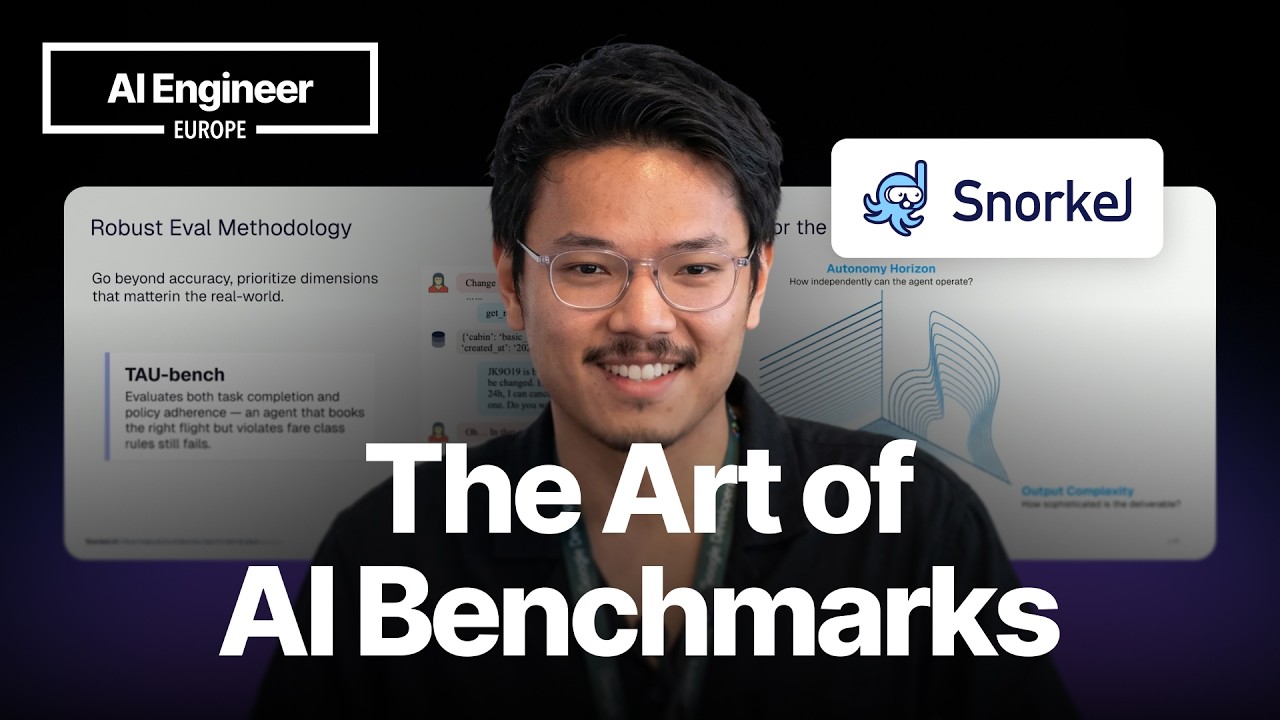
- Example: Tow Bench evaluates not only task completion but also adherence to policy constraints, recognizing that a solution violating rules (e.g., booking the right flight but violating fair class rules) is still a failure.
The Art of Frontier-Pushing Benchmarks (Differentiators)
These aspects separate benchmarks that are merely good from those that actively drive the field forward:
-
Having a Thesis: Great benchmarks embody a research question or a bold prediction about future capabilities, serving as a statement about where the AI world is heading.
- Example: Terminal Bench made an early bet on the command-line interface (CLI) as a core abstraction for general-purpose computer use by agents, a thesis that has proved consequential in the development of coding agents and enterprise capabilities.
-
Producing Research Roadmaps: The best benchmarks inspire new lines of attack against research problems and generate new methods, fostering further innovation and a family of related benchmarks.
- Example: SweBench, by leveraging existing coding PRs, spawned a family of benchmarks (SweBench-light, verified, pro, multilingual, multimodal) and fundamentally evolved thinking around coding agents.
- Prioritizing Researcher UX: High adoption of frontier benchmarks is driven by ease of use for researchers and builders—simplicity in running models, contributing tasks, and leveraging signals for training or tuning.
- Example: Platforms like Stanford’s CRFM Helm and Terminal Bench 2.0’s Harbor provide standardized, modular harnesses and evaluation infrastructure, significantly improving the user experience for agent development.
Three Axes for the Next Generation of Benchmarks
Snorkel AI identifies three key dimensions where future benchmarks need to push complexity and realism:
-
Environment Complexity: Benchmarks must better capture the dynamic, messy, and context-rich environments of real-world work.
- Example: For coding agents, this means incorporating org-specific policies, Slack context, flaky toolchains, CI/CD pipelines, and human reviewer preferences, moving beyond simplified code environments.
-
Autonomy Horizon: Benchmarks should evaluate agents across longer time horizons, accounting for evolving contexts, changing specifications, and the reliability breakdown points of agents in continual learning settings.
- Example: A customer experience agent needs to maintain context over weeks, adapt to changing product specs, and handle organizational shifts, reflecting a much longer and more complex operational horizon than typically benchmarked.
-
Output Complexity: Beyond plain text, benchmarks need to assess more complex, nuanced, and representative outputs, including verifiable strategic recommendations, organizational context, and the agent’s ability to express uncertainty or ask for clarification.
- Example: Evaluating a strategic report requires capturing subjective human judgment and organizational context, moving beyond simple objective metrics. Trustworthy outputs, where agents communicate uncertainty, represent a crucial, underexplored area.
Conclusion
Benchmarks are vital tools not just for measuring past progress but for actively steering the field’s future. Snorkel AI continues to seek innovative proposals through its Open Benchmarks Grant, encouraging the community to develop benchmarks that push the boundaries of AI capabilities.