Open weight models

How Cline Embraces an Open-Weights Model Ecosystem for AI Agents

How Cline Embraces an Open-Weights Model Ecosystem for AI Agents

Cline's CEO explains why open-weight models are rapidly taking over coding-agent workloads, and why the agent harness, not raw model capability, determines reliability. The talk covers model-specific tuning and failure handling, context and token optimization, self-improving harness loops, an SDK-first and UI-agnostic architecture, interactive evaluation built from real-world usage data, and production inference challenges such as KV cache hit rates.

$450K TO TRAIN A FRONTIER AI MODEL?

$450K TO TRAIN A FRONTIER AI MODEL?

Thomson Reuters CTO Joel Hron explains why the company built Thomson, a domain-specific frontier model adapted from open-weight checkpoints like Qwen 3.5, using decades of proprietary legal and tax content and expert judgment. The conversation covers the training lifecycle from realignment and continual pre-training to agentic RL, the economics ($450K final run versus roughly $40M total), team structure, CoCounsel orchestration, verification challenges in legal and tax, and the future balance between open-weight and frontier models.

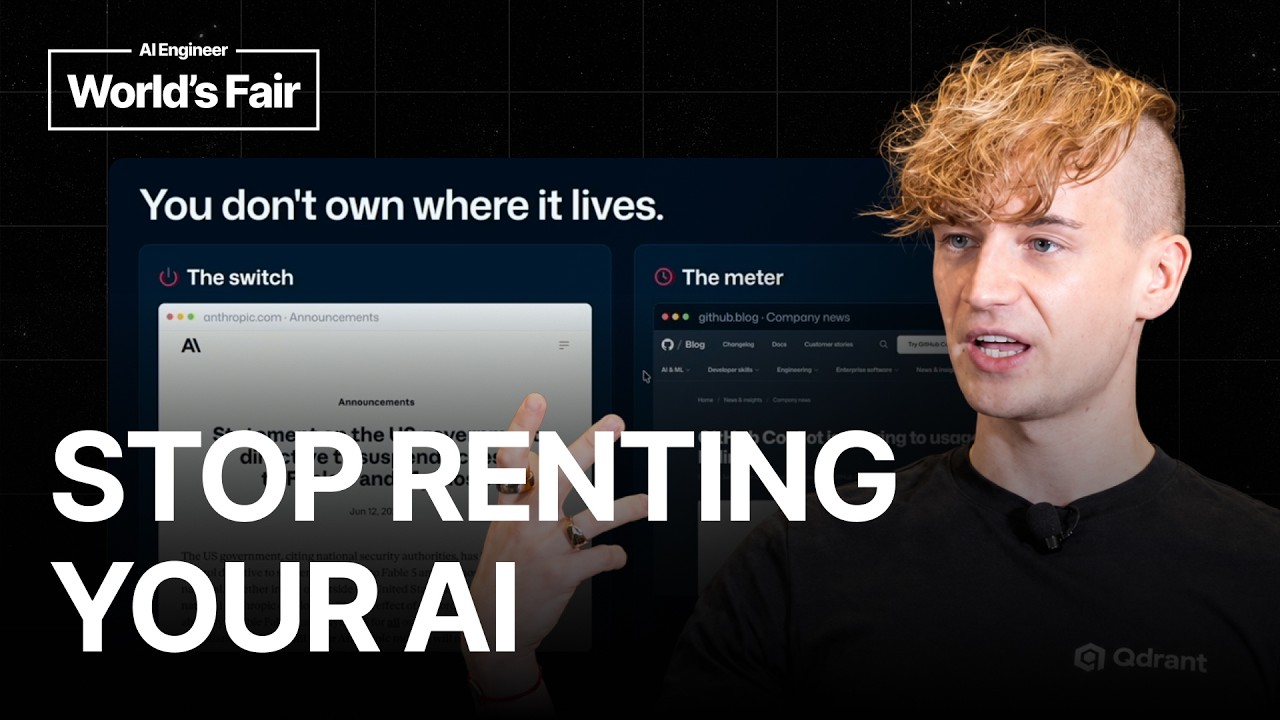
Stop Renting Your AI's Memory — Dylan Couzon, Qdrant

Stop Renting Your AI's Memory — Dylan Couzon, Qdrant

Dylan Couzon, developer relations engineer at Qdrant, argues that frontier-class models now run on hardware people can own, but the memory that makes an assistant personal still lives in someone else's cloud. He covers why owning inference gives autonomy while owning memory gives continuity, the CPU, RAM, and disk model for LLMs, why retrieval beats stuffing everything into the prompt, and a live offline demo of a drone building searchable memory with Qdrant Edge, plus opt-in shared memory.

The $10 Trillion Token Economy — Alex Atallah, OpenRouter & Anjney Midha, AMP

The $10 Trillion Token Economy — Alex Atallah, OpenRouter & Anjney Midha, AMP

Alex Atallah and Anjney Midha trace OpenRouter's path from early open-weight models and Discord experiments to a neutral routing layer serving over 10 million developers, and explain why its Stripe acquisition is as much about fraud defense as payments.

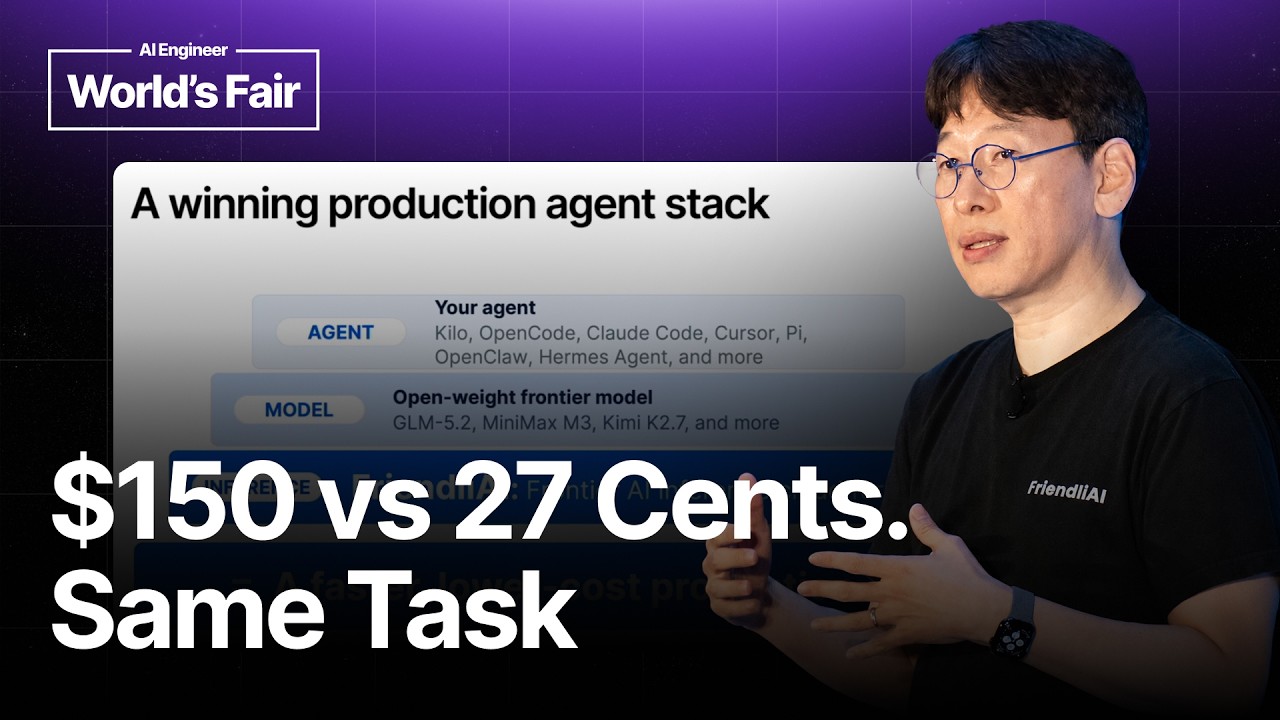
The Frontier AI Inference Cloud for Agents — Byung-Gon (Gon) Chun, FriendliAI

The Frontier AI Inference Cloud for Agents — Byung-Gon (Gon) Chun, FriendliAI

Byung-Gon Chun from FriendliAI details how agentic inference fundamentally differs from traditional chat-based LLM usage, requiring a specialized infrastructure to optimize for end-to-end task completion rather than single request latency. He highlights the economic advantage of open-weight models for agentic workflows and explains FriendliAI's innovative inference stack, featuring prefix caching, advanced KV cache management, cache-aware routing, and agent-aware optimization, which together deliver significant speedups and cost savings for production AI agents.

Box's Aaron Levie: On Reinventing Yourself in the AI Age and Enterprise Diffusion

Box's Aaron Levie: On Reinventing Yourself in the AI Age and Enterprise Diffusion

Aaron Levie, CEO of Box, details his company's successful pivot to AI, emphasizing the critical role of application companies in bridging raw model capabilities to complex enterprise workflows. He argues that significant value will accrue to "applied AI" solutions that understand domain-specific needs, can handle intricate data permissions, and build specialized agents, rather than relying solely on foundational models. Levie shares insights on the economics of tokens, the rise of open-weight models, and why AI diffusion in coding differs from other knowledge work, predicting that 90% of enterprise tokens will soon be consumed by non-human initiated tasks.