Mlops

Building AI Agents That Survive Production

Building AI Agents That Survive Production

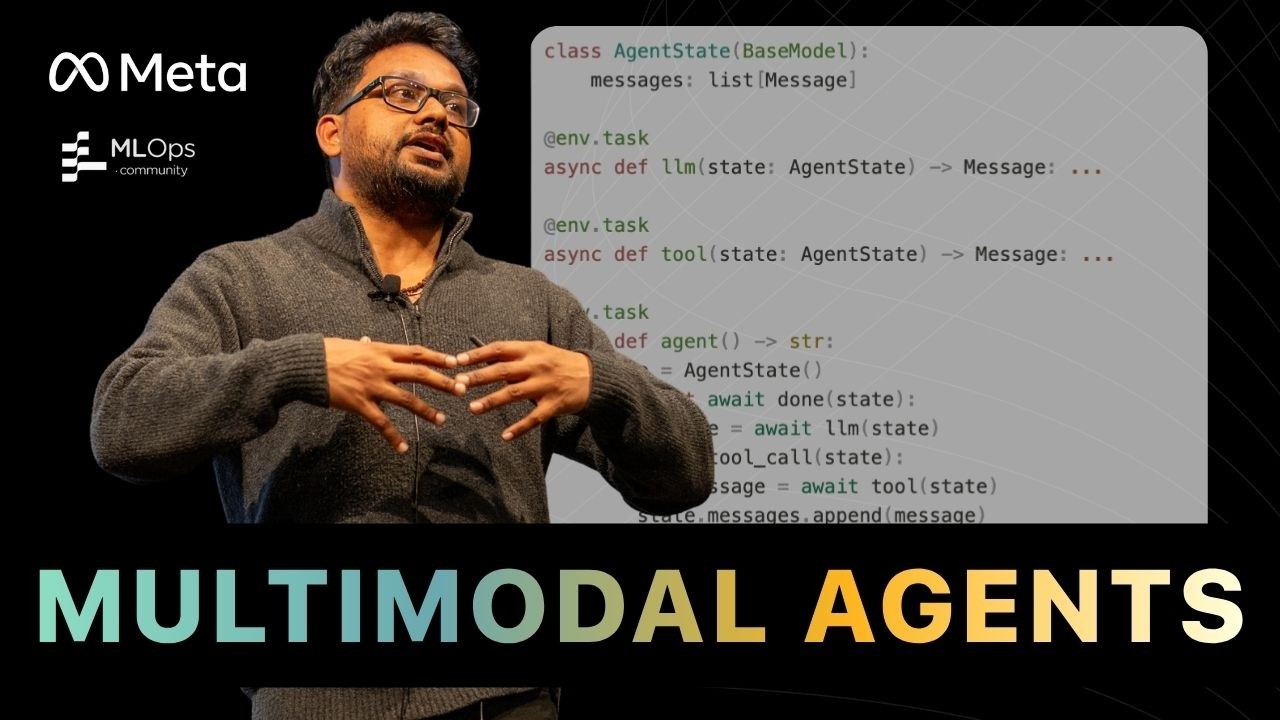
Haytham Abuelfutuh, CTO of Union.ai, argues that the key to production-ready AI agents is not preventing failure, but embracing it. He introduces the '3 D's' framework—Dynamic, Durable, and Defended—for building agents that can fail cheaply and recover automatically, grounded in a real-world case study of an agent system indexing over 250,000 products on Flyte.

Lessons from Trillion Token Deployments at Fortune 500s — Alessandro Cappelli, Adaptive ML

Lessons from Trillion Token Deployments at Fortune 500s — Alessandro Cappelli, Adaptive ML

95% of GenAI pilots fail due to feedback integration issues, not deployment challenges. Alessandro Cappelli argues that Reinforcement Learning (RL) provides the only systematic way to incorporate business metrics and production signals to continuously improve models, especially for complex agent-based systems.

Why AI Agents Shouldn't Replace Your Fraud Models

Why AI Agents Shouldn't Replace Your Fraud Models

Varant Zanoyan, original author of the Chronon feature platform, introduces 'agentic experimentation'—a pattern where AI agents improve high-stakes ML systems without making live decisions. He explains how Chronon solves key challenges like infrastructure sprawl, safety, and reproducibility through a semantic API, branch-based isolation, and compute reuse, enabling agents to safely create production-ready pipelines for human review.

Playground in Prod - Optimising Agents in Production Environments — Samuel Colvin, Pydantic

Playground in Prod - Optimising Agents in Production Environments — Samuel Colvin, Pydantic

Samuel Colvin, creator of Pydantic, demonstrates a hands-on workflow for continuously optimizing AI agents in production. The session covers using Logfire for running evaluations, GEPA (Genetic Pareto) for autonomously evolving better prompts, and managed variables to deploy these improvements to live services without redeployment.

The Small Model Infrastructure Nobody Built (So We Did) — Filip Makraduli, Superlinked

The Small Model Infrastructure Nobody Built (So We Did) — Filip Makraduli, Superlinked

Filip Makraduli from Superlinked discusses the common infrastructure gaps and profiling mistakes encountered when deploying small embedding and transformer models. He introduces the Superlinked Inference Engine (SIE), an open-source solution designed for dynamic model loading, hot-swapping, and memory-aware eviction to maximize GPU utilization and streamline the path from development to production.

Getting Humans Out of the Way: How to Work with Teams of Agents

Getting Humans Out of the Way: How to Work with Teams of Agents

Rob Ennals, creator of Broomy, discusses a paradigm shift in working with AI coding agents: moving away from micromanagement towards orchestrating teams of parallel agents. The key is to design robust, automated validation systems and reshape the development environment to empower agents to work autonomously, efficiently, and at scale.